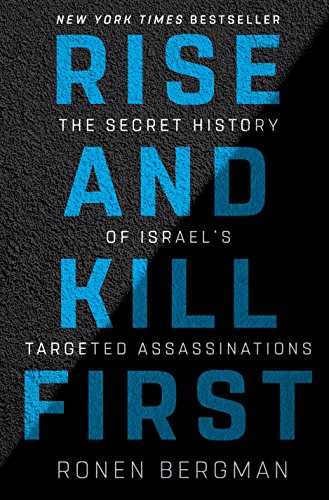
For the last half-dozen years, Israeli-born Ronan Bergman has served as a
reporter with the New York Times, and I’ve regularly heard him described as
the best-connected American journalist in Israel, with especially close ties to
that country’s powerful security services such as the Mossad, Shin Bet, and
Unit 8200.
Much of that reputation goes back to the 2018 publication of his book Rise and Kill
First, a widely praised and highly authoritative history of the Mossad, Israel’s
foreign intelligence service, as well as its sister agencies.
As I wrote in early 2020:
The author devoted six years of research to the project, which was
based upon a thousand personal interviews and access to an
enormous number of official documents previously unavailable.
As suggested by the title, his primary focus was Israel’s long
history of assassinations, and across his 750 pages and thousand odd source
references he recounts the details of an enormous
number of such incidents.
That sort of topic is obviously fraught with controversy, but
Bergman’s volume carried glowing cover-blurbs from Pulitzer
Prize-winning authors on espionage matters, and the official
cooperation he received is indicated by similar endorsements from
both a former Mossad chief and Ehud Barak, a past Prime
Minister of Israel who himself had once led assassination squads. Over the last couple of
decades, former CIA officer Robert Baer has become one of our most prominent authors in
this same field, and he praised the book as “hands down” the best he had ever read on
intelligence, Israel, or the Middle East. The reviews across our elite media were equally
laudatory.
If Bergman ever considers bringing out an updated, revised edition of that volume,
I think that this newer text might devote an entire chapter to the very serious blow
that Mossad recently struck against Lebanon’s Hezbollah organization though the use
of booby-trapped exploding pagers, an operation at least as daring and successful
as anything covered in his very thick 2018 volume.
Although the Israeli government has not officially claimed credit for the attacks,
no one doubts that Mossad was responsible and a dozen of their current and former
defense and intelligence officials provided all the details to the New York Times.
Over the last year or two, Hezbollah had become increasingly concerned that the cell
phones used by its members were giving away their locations and allowing the Israelis
to target them with airstrikes or missiles, so its leadership finally decided to shift
most of its communications network to the use of old-fashioned pagers, which only
receive signals rather than also emitting them.
However, according to news reports by Bergman and others, the Israelis had cleverly
anticipated that possibility, and several years ago they had established a front-company
based in Hungary that produced pagers and other electronic devices under license
from a Taiwanese manufacturer. Its initial products were entirely legitimate but Mossad
was prepared for any sabotage opportunities that might eventually come along.
So when Hezbollah placed its order for some 5,000 such pagers, the
company provided them, but each device also contained a deadly load of high-explosives
and ballbearing shrapnel. Then, at 3:30pm on Tuesday, September 17th all the pagers beeped for an incoming
message, prompting their owners to pick them up and exploding a few seconds later.
The result was thousands of such simultaneous pager explosions across Lebanon and elsewhere, with
reports of some 2,700 casualties, hundreds of whom were maimed or severely injured, together with
about a dozen deaths. The following day, walkie-talkies that had been similarly booby-trapped with
high explosives also detonated as did as some solar panels, and although those numbers were much
lower, another couple of dozen deaths were reported, probably because those larger devices concealed
heavier explosive charges. All of this produced widespread terror across Lebanon, with everyone
suddenly fearful of electronic devices, including reports that terrified mothers
were unplugging babymonitors from their cribs.
Over the years, Hezbollah had become quite proud of its security, and the leadership
freely admitted that this was the worst breach they had ever suffered, resulting in
very serious losses. I haven’t seen reports that any of the organization’s senior
leaders had been killed or wounded in the blasts, but given the huge number of
casualties, I’m sure that at least some were caught in the attack. Then, just a
couple of days later, an Israeli airstrike destroyed a Beirut building, killing
a high-ranking Hezbollah military leader and a number of other members as they
were meeting together, perhaps to plan a retaliatory strike against Israel.
It’s obvious that Hezbollah has suffered a very bloody nose, and a
major setback in its ongoing military conflict against Israel
Mossad certainly achieved a brilliant tactical victory, one that its members and
pro-Israel partisans will surely boast about for years. But many aspects of the attack
seemed very puzzling to me, and experienced military analysts wondered whether any
long-term gains had been achieved.
After Israel invaded Gaza in retaliation for the Hamas raid last October, Hezbollah
and its Israeli enemies soon began trading cross-border fire, bombarding each other
with missiles, rockets, drones, and artillery shells, and those exchanges have now
continued for nearly a year. As a result, some 160,000 civilians on both sides of the
border have fled their homes, with perhaps 60,000 of these being Israelis.
With so many tens of thousands of Israelis having become internal refugees, displaced
from their communities in the north of the country and spending the last year living
in temporary accommodations, the government of Prime Minister Benjamin Netanyahu
has been under enormous political pressure to attack and invade Lebanon in order
to drive away the Hezbollah forces on the border, thereby allowing those Israelis
to return home. In addition, the most extreme religious elements among his supporters
regard portions of southern Lebanon as part of Israel’s God-given lands and wish
to see them conquered and annexed, with their local Lebanese residents eventually
expelled and replaced by Jewish settlers.
However, the last time the Israelis launched a ground invasion of Lebanon in 2006,
their forces suffered a severe defeat at Hezbollah’s hands, and during the last
eighteen years that organization has become far more powerful, with many of its
ground troops having gained a great deal of military experience during their
successful deployment in the Syrian civil war. Meanwhile, a year of fighting against
Hamas in Gaza has left the IDF exhausted, so despite Israel’s command of the air,
it’s not at all clear how well such a ground invasion would go. Moreover, Hezbollah
has reportedly amassed an enormous arsenal of some 150,000 rockets and missiles,
and these could be used to inflict devastating damage upon most of Israel’s cities
and towns if it chose to do so.
The combination of these two conflicting factors has led to repeated indecision on
Israel’s part. For months, media leaks have reported that Israel had made the decision
to invade Lebanon and that the attack was imminent. But nothing has ever happened,
presumably because the military risks of such an operation were considered too great.
Those booby-trapped pagers and other devices might have played an absolutely crucial
role in such an Israeli ground invasion. If they had all been detonated at the
beginning of such an attack, Hezbollah’s forces would have been left dazed and confused,
with their entire communications network knocked out, thereby preventing them from
mounting an effective defense or retaliatory measures, and likely allowing the IDF
to win a major initial victory on the ground.
But instead these explosions occurred alone, with no invasion taking place.
So Hezbollah has merely licked its wounds and is surely now putting in place a
replacement communications network, presumably based upon a large shipment of
carefully vetted pagers received from Iran or China or Russia. Israel thus lost
the element of surprise, with little to show for it except wounding a large number
of Hezbollah members. So the exploding pagers merely produced a tactical victory
instead of a potentially strategic one.
This raises the obvious question of why the Israelis chose to shoot their bolt when
they did instead of waiting until the pagers could be detonated in conjunction
with a major invasion.
According to media reports, the Israelis may have suspected that some Hezbollah members
had discovered that the pagers contained explosives, and were thus faced with a
use-it-or-lose-it dilemma, choosing to immediately detonate all the devices before
they were discarded and the entire long Mossad effort was totally wasted.
This is certainly possible, but given the extreme difficulty the Israelis had
previously had in penetrating Hezbollah’s organization, I really wonder how
they could have learned that a couple of Hezbollah operatives had discovered the
explosives during the short time interval before the latter notified their top
commanders and a quick order came down to junk all the pagers.
My own guess is quite different. I think that the explosions indicate that despite media
leaks to the contrary, the Netanyahu government had taken a firm decision to abandon
plans for any ground invasion of Lebanon in the foreseeable future as just too risky.
If any such invasion were now off the table, the pagers had lost their strategic value,
so they were instead detonated for essentially political reasons. Netanyahu hoped that
the serious damage and humiliation the attacks inflicted upon Hezbollah would provide
his government with an immediate boost in popularity, helping to deflect the continuing
anger over its lack of success in returning its displaced civilians to their homes
in the north. Thus, under this interpretation, the pager explosions suggest that
no ground invasion of Lebanon will take place.
Meanwhile, Hezbollah’s military effectiveness hardly seems to have been crippled.
Early Sunday morning, its forces fired off some 150 rockets, cruise missiles, and drones
into Israel, bombarding areas far south of those they had previously targeted.
The very tight Israeli censorship makes it difficult to estimate damage, but it sounds
like Israel’s Iron Dome defenses failed to stop many of the projectiles, which inflicted
numerous injuries and started large fires, and Hezbollah could probably keep these
attacks at this level every day for the next several years, completely saturating
and overwhelming Israel’s defenses. Thus, pager explosions or not, Hezbollah’s huge
arsenal could easily level most of Israel’s cities while the Israelis still seem
reluctant to tangle with its very formidable ground forces. So perhaps just as
observers had suggested, the Mossad operation was merely a tactical Israeli victory
with little if any strategic significance.
However, my own view is somewhat different. I think that the longer term strategic
consequences of the exploding pager operation may be very negative for Israel.
Although America’s totally pro-Israel mainstream media would never treat it as such,
the sudden simultaneous detonation of those thousands of pagers all across Lebanon and
some nearby areas obviously amounted to a gigantic terrorist attack, and was certainly
seen as such by nearly the entire world.
Hezbollah is one of Lebanon’s largest political organizations, and many of those pagers
had apparently been distributed to its affiliated civilian members, who were obviously
not legitimate targets of deadly attacks, especially in a country not at war.
Non-military members of Hezbollah would have the same relationship to its fighters
that ordinary Israeli civilians do to the IDF, and using explosives-filled pagers
to attack the former is really no different than detonating a large car-bomb on a
crowded Israeli street near a military base. If thousands of booby-trapped electronic
devices had suddenly exploded all across Israel—or across the United States—the Western
media would certainly have regarded such an attack as the most blatant possible
example of massive, illegal terrorism.
The Internet is filled with videos showing explosions in crowded Lebanese markets,
with some of the dead victims being children. Pagers were used by the medical staff in
Lebanese hospitals, and this was also true of the exploding walkie-talkies. Given the
thousands of those sudden explosions and the enormous numbers of victims, many of whom
were civilians, including women, children, and medical workers, I’ve seen this
described as the world’s worst terrorist attack since 9/11, and that hardly seems an
unreasonable appraisal.
Over the decades and especially during the last twelve months of the attack on Gaza,
the Jewish State has become absolutely notorious for its endless, flagrant violations
of international law and the rules of warfare, and this latest pager attack is merely
a particularly egregious example of this. As the Australian Broadcasting Corporation
reported
A global treaty, which has been signed by more than 100 countries including Israel,
bans “the use booby traps or other devices in the form of apparently harmless portable
objects that are specifically designed and constructed to contain explosive material”.
Most of the legal experts quoted by NPR took the same position, so it seems clear
that the Israelis have further compounded their long record of flagrant war-crimes.
Moreover, nothing like this had ever previously happened, and the precedent of
Israel’s Mossad operation may have dangerous consequences for the entire world.
Now that this line has been crossed and everyone has witnessed the huge potential
impact of this sort of deadly attack, others may decide to do the same. The technology
involved is easily available to every major country as well as many non-state actors,
and with the precedent now having been set, it seems very possible that others may
follow the same approach. Apparently the high-explosive compound employed was very
difficult to detect by scanning or any other means, so what would stop explosive-filled
laptops or other large electronic devices from being used to bring down civilian planes
in flight? The societies of America and the West are very soft targets, unused to
the regular attacks that Israel has inflicted upon its Middle Eastern neighbors,
so the deployment of booby-trapped electronic devices would have a hugely negative
impact upon our way of life.
The possible damage to the market reputation of Taiwan’s consumer electronics industry
and that of other manufacturers aligned with the West may also be very substantial.
With Mossad having so easily taken deadly advantage of the security gaps of the contract
manufacturers in those supply chains, what rational country in the Middle East would
not factor that risk into its future orders? Huawei and other Chinese companies
provide the full range of such products, with their quality at least as good and
their prices generally much lower, while their devices would be almost totally
immune to such sabotage. Over the last year, Israeli representatives have expressed
ferocious public hostility towards almost all of the nations of the world, denouncing
them for joining together in the series of near-unanimous UN votes condemning the
ongoing genocidal rampage in Gaza. Many of these countries and organizations may
begin to wonder if they might eventually be targeted in political retaliation,
and therefore chose to be safe rather than sorry by switching their purchases
of consumer electronics to Chinese vendors.
For generations, the nations of the world have signed international protocols and
treaties prohibiting exactly these sorts of terrorist attacks for exactly these reasons,
so Israel’s endless violations of such standards may inflict a great deal of damage
upon the peace and security of the rest of the world, eventually provoking huge
international hostility. Israel has obviously now become almost universally
recognized as a rogue, terrorist state, the worst sort of international criminal
regime. Eventually the rest of the world may conclude that its continued existence
poses too much of a risk to global peace and take concerted actions to eliminate
that threat, together with the entire population deemed responsible. Indeed,
if not for the totally slavish subservience of America’s bought-and-paid-for political
leadership, I think that such steps would have already been taken long ago.
But although these negative strategic consequences for Israel’s long-term situation
are obviously quite serious, I think they are actually far overshadowed by certain
other implications of this extremely successful Mossad operation, which may have a more
immediate and historic impact. This project certainly ranked as one of the most
brilliant and effective covert strikes in the history of the world, with few other
comparable examples coming to mind. Yet I think that exactly those characteristics
may lead to Israel’s total destruction, perhaps even in the relatively near future.
In many respects, this use of thousands of weaponized pagers to target the members
of an opposing organization almost seemed much more like something produced by a
Hollywood scriptwriter than anything carried out in real life, and in many respects
it straddled the line between representing a massive wave of simultaneous, targeted
assassinations and a huge terrorist attack against the cities of a hostile country.
Although neither Mossad nor any other intelligence service had ever tried any similar
operation in the past, Bergman’s authoritative history does provide a very long list
of past Mossad assassinations, as well as similar actions by the various Zionist groups
prior to Israel’s creation. I think it is worth reviewing some of that material to get
a better sense of the likely mindset of those involved in formulating this recent
operation, and I described this back in early 2020:
The sheer quantity of such foreign assassinations was really quite remarkable,
with the knowledgeable reviewer in the New York Times suggesting that the Israeli
total over the last half-century or so seemed far greater than that of any other nation.
I might even go farther: if we excluded domestic killings, I wouldn’t be surprised if
Israel’s body-count greatly exceeded the combined total for that of all other major
countries in the world. I think all the lurid revelations of lethal CIA or KGB Cold War
assassination plots that I have seen discussed in newspaper articles might fit
comfortably into just a chapter or two of Bergman’s extremely long book…
Israeli operatives sometimes even contemplated the elimination of their own top-ranking
leaders whose policies they viewed as sufficiently counter-productive. For decades,
Gen. Ariel Sharon had been one of Israel’s greatest military heroes and someone of
extreme right-wing sentiments. As Defense Minister in 1982, he orchestrated the Israeli
invasion of Lebanon, which soon turned into a major political debacle, seriously
damaging Israel’s international standing by inflicting great destruction upon that
neighboring country and its capital city of Beirut. As Sharon stubbornly continued
his military strategy and the problems grew more severe, a group of disgruntled
officers decided that the best means of cutting Israel’s losses was to assassinate
Sharon, though that proposal was never carried out.
An even more striking example occurred a decade later. For many years, Palestinian
leader Yasir Arafat had been the leading object of Israeli antipathy, so much so that
at one point Israel made plans to shoot down an international civilian jetliner in
order to assassinate him. But after the end of the Cold War, pressure from America and
Europe led Prime Minister Yitzhak Rabin to sign the 1993 Oslo Peace Accords with his
Palestinian foe. Although the Israeli leader received worldwide praise and shared a
Nobel Peace Prize for his peacemaking efforts, powerful segments of the Israeli public
and its political class regarded the act as a betrayal, with some extreme nationalists
and religious zealots demanding that he be killed for his treason. A couple of years
later, he was indeed shot dead by a lone gunman from those ideological circles,
becoming the first Middle Eastern leader in decades to suffer that fate. Although
his killer was mentally unbalanced and stubbornly insisted that he acted alone,
he had had a long history of intelligence associations, and Bergman delicately
notes that the gunman slipped past Rabin’s numerous bodyguards “with astonishing ease”
in order to fire his three fatal shots at close range.
Many observers drew parallels between Rabin’s assassination and that of our own
president in Dallas three decades earlier, and the latter’s heir and namesake,
John F. Kennedy, Jr., developed a strong personal interest in the tragic event.
In March 1997, his glossy political magazine George published an article by the
Israeli assassin’s mother, implicating her own country’s security services in the
crime, a theory also promoted by the late Israeli-Canadian writer Barry Chamish.
These accusations sparked a furious international debate, but after Kennedy himself
died in an unusual plane crash a couple of years later and his magazine quickly folded,
the controversy soon subsided. The George archives are not online nor easily available,
so I cannot effectively judge the credibility of the charges.
The central object of Sharon’s anger was Palestine President Yasir Arafat, who suddenly
took ill and died, thereby joining his erstwhile negotiating partner Rabin in permanent
repose. Arafat’s wife claimed that he had been poisoned and produced some medical
evidence to support this charge, while longtime Israeli political figure Uri Avnery
published numerous articles substantiating those accusations. Bergman simply reports
the categorical Israeli denials while noting that “the timing of Arafat’s death was
quite peculiar,” then emphasizes that even if he knew the truth, he couldn’t publish
it since his entire book was written under strict Israeli censorship…
Having thus acquired serious doubts about the completeness of Bergman’s seemingly
comprehensive narrative history, I noted a curious fact. I have no specialized expertise
in intelligence operations in general nor those of Mossad in particular, so I found
it quite remarkable that the overwhelming majority of all the higher-profile incidents
recounted by Bergman were already familiar to me merely from the decades I had spent
closely reading the New York Times every morning. Is it really plausible that six years
of exhaustive research and so many personal interviews would have uncovered so few major
operations that had not already been known and reported in the international media?
Bergman obviously provided a wealth of detail previously limited to insiders, along
with numerous unreported assassinations of relatively minor individuals, but it seems
strange that he came up with so few major new revelations.
Having himself narrowly avoided assassination by Israeli operatives, Sharon gradually
regained his political influence, and did so without compromising his hard-line views,
even boastfully describing himself as a “Judeo-Nazi” to an appalled journalist.
A few years after Rabin’s death, he provoked major Palestinian protests, then used
the resulting violence to win election as Prime Minister, and once in office, his very
harsh methods led to a widespread uprising in Occupied Palestine. But Sharon merely
redoubled his repression, and after world attention was diverted by 9/11 attacks
and the American invasion of Iraq, he began assassinating numerous top Palestinian
political and religious leaders in attacks that sometimes inflicted heavy
civilian casualties.
Indeed, some important gaps in his coverage are quite apparent to anyone who has even
somewhat investigated the topic, and these begin in the early chapters of his volume,
which include coverage of the Zionist prehistory in Palestine prior to the
establishment of the Jewish state.
Bergman would have severely damaged his credibility if he had failed to include the
infamous 1940s Zionist assassinations of Britain’s Lord Moyne or U.N. Peace Negotiator
Count Folke Bernadotte. But he unaccountably forgot to mention that in 1937 the more
right-wing Zionist faction whose political heirs have dominated Israel in recent
decades assassinated Chaim Arlosoroff, the highest-ranking Zionist figure in Palestine.
Moreover, he omitted a number of similar incidents, including some of those targeting
top Western leaders. As I wrote last year:
Indeed, the inclination of the more right-wing Zionist factions toward assassination,
terrorism, and other forms of essentially criminal behavior was really quite remarkable.
For example, in 1943 Shamir had arranged the assassination of his factional rival,
a year after the two men had escaped together from imprisonment for a bank robbery
in which bystanders had been killed, and he claimed he had acted to avert the planned
assassination of David Ben-Gurion, the top Zionist leader and Israel’s future
founding-premier. Shamir and his faction certainly continued this sort of behavior
into the 1940s, successfully assassinating Lord Moyne, the British Minister
for the Middle East, and Count Folke Bernadotte, the UN Peace Negotiator,
though they failed in their other attempts to kill American President Harry Truman
and British Foreign Minister Ernest Bevin, and their plans to assassinate
Winston Churchill apparently never moved past the discussion stage. His group also
pioneered the use of terrorist car-bombs and other explosive attacks against
innocent civilian targets, all long before any Arabs or Muslims had ever
thought of using similar tactics; and Begin’s larger and more “moderate” Zionist
faction did much the same.
As far as I know, the early Zionists had a record of political terrorism almost
unmatched in world history, and in 1974 Prime Minister Menachem Begin once even
boasted to a television interviewer of having been the founding father of terrorism
across the world.
Indeed, I also recounted the remarkable history of Zionist and Israeli terrorism,
some of which was discussed by Bergman
Although somewhat related, political assassinations and terrorist attacks are distinct
topics, and Bergman’s comprehensive volume explicitly focuses on the former,
so we cannot fault him for providing only slight coverage of the latter.
But the historical pattern of Israeli activity, especially with regard to false-flag
attacks, is really quite remarkable, as I noted in a 2018 article:
One of history’s largest terrorist attacks prior to 9/11 was the 1946 bombing of the
King David Hotel in Jerusalem by Zionist militants dressed as Arabs, which killed 91
people and largely destroyed the structure. In the famous Lavon Affair of 1954,
Israeli agents launched a wave of terrorist attacks against Western targets in Egypt,
intending to have those blamed on anti-Western Arab groups. There are strong claims
that in 1950 Israeli Mossad agents began a series of false-flag terrorist bombings
against Jewish targets in Baghdad, successfully using those violent methods to help
persuade Iraq’s thousand-year-old Jewish community to emigrate to the Jewish state.
In 1967, Israel launched a deliberate air and sea attack against the U.S.S. Liberty,
intending to leave no survivors, killing or wounding over 200 American servicemen before
word of the attack reached our Sixth Fleet and the Israelis withdrew.
The enormous extent of pro-Israel influence in world political and media circles meant
that none of these brutal attacks ever drew serious retaliation, and in nearly all cases,
they were quickly thrown down the memory hole, so that today probably no more than one
in a hundred Americans is even aware of them. Furthermore, most of these incidents
came to light due to chance circumstances, so we may easily suspect that many
other attacks of a similar nature have never become part of the historical record.
Of these famous incidents, Bergman only includes mention of the King David Hotel
bombing. But much later in his narrative, he describes the huge wave of false-flag
terrorist attacks unleashed in 1981 by Israeli Defense Minister Ariel Sharon, who
recruited a former high-ranking Mossad official to manage the project.
Under Israeli direction, large car bombs began exploding in the Palestinian neighborhoods
of Beirut and other Lebanese cities, killing or injuring enormous numbers of civilians.
A single attack in October inflicted nearly 400 casualties, and by December,
there were eighteen bombings per month, with their effectiveness greatly enhanced
by the use of innovative new Israeli drone technology. Official responsibility for all
the attacks was claimed by a previously unknown Lebanese organization, but the intent
was to provoke the PLO into military retaliation against Israel, thereby justifying
Sharon’s planned invasion of the neighboring country.
Since the PLO stubbornly refused to take the bait, plans were put into motion for
the huge bombing of an entire Beirut sports stadium using tons of explosives during
a January 1st political ceremony, with the death and destruction expected to be
“of unprecedented proportions, even in terms of Lebanon.” But Sharon’s political
enemies learned of the plot and emphasized that many foreign diplomats including
the Soviet ambassador were expected to be present and probably would be killed,
so after a bitter debate, Prime Minister Begin ordered the attack aborted.
A future Mossad chief mentions the major headaches they then faced in removing
the large quantity of explosives that they had already planted within the structure.
Bergman’s weighty book constituted an extremely comprehensive if fully authorized
history of Mossad’s assassination operations, and it also provided considerable
coverage of its terrorist attacks as well. But as an important supplement to the latter,
I would strongly recommend State of Terror: How Terrorism Created Modern Israel
published in 2016 by Thomas Suarez. Although it focuses primarily upon the Zionist
terrorism that played such a central role in the creation of the State of Israel,
it also provides some coverage of later years as well. Most importantly, it massively
documents the complete ideological support for that technique found across all of
the early Zionist leaders, who then continued governing that country during
the decades that followed, even into the 1990s. Although the work is long out
of print and copies available on Amazon start at nearly $5,000, it may also be
found at Archive.org.
As I mentioned earlier, the sudden, simultaneous explosion of thousands of pagers all
across Lebanon’s streets and cities was regarded as a gigantic terrorist attack
by most of the world, probably the worst since 9/11. I very much doubt that any
intelligence service other than Israel’s Mossad would have possessed the combination
of skills, daring, and imagination necessary to successfully carry out such an
operation
Indeed, the only terrorist attack in world history that seems even bolder, more complex,
and more successful would be the 9/11 attacks themselves, whose 23rd anniversary
just passed a couple of weeks ago. That brilliantly conceived and implemented terrorist
operation inflicted enormous damage to America’s financial and military centers
while easily circumventing our usual air defenses on that fateful day.
Yet oddly enough, while most of us freely admit that only an organization with Mossad’s
superb resources, brilliance, and training could have carried out the exploding pager
attacks, according to the official story, the even greater 9/11 terrorist attacks
were merely the work of a rag-tag band of poorly-trained Arabs directed by an eccentric
dwelling in an Afghanistan cave. The contrast in the supposed actors behind those
two operations is so extreme as to defy rationality, and the recent events
in Lebanon must surely raise doubts among even the most credulous and gullible.
For more than two decades, large numbers of highly-credible journalists, academics,
and former government officials have raised enormous doubts about
the official 9/11 story. As far back as 2006, former high-ranking CIA official
William Christison characterized it as “almost certainly a monstrous series of lies.”
Over the years, a substantial fraction of the entire American population has
come to very similar conclusions, thereby joining the skepticism of most of the
rest of the world’s population.
But if the successful 9/11 terrorist attacks were not the work of Osama bin Laden
and his small band of Arabs, then who was responsible? If what was arguably
the second boldest, most successful terrorist attack in the history of the world
was recently carried out by the Israeli Mossad, does that not suggest an obvious
suspect?
In the immediate aftermath of the 9/11 Attacks, the FBI rounded up and arrested
some 200 Mossad agents, many of whom had been based in the exact vicinity of the
destruction, with five of them caught red-handed, celebrating the successful attack
on the WTC towers. I discussed all of this at considerable length in an article
published around the twentieth anniversary of the attacks:
American Pravda: Seeking 9/11 Truth After Twenty Years
Ron Unz • The Unz Review • September 7, 2021 • 7,800 Words
For those who wish to place all of this in the broader context
of past Mossad operations, many of which were carefully excluded
from Bergman’s lengthy but highly-selective account,
I’d recommend my extremely long article from early 2020, which is conveniently
divided into a series of major sections:
American Pravda: Mossad Assassinations
Ron Unz • The Unz Review • January 27, 2020 • 27,300 Words

From the Peace of Westphalia to the Law of the Jungle
“Rise and Kill First”
“Who Killed Zia?”
“By Way of Deception”
“The Other Side of Deception”
“Final Judgment” on the JFK Assassination
The Strange Death of James Forrestal and Other Fatalities
The 9/11 Attacks – What Happened?
The 9/11 Attacks – Who Did It?
Important Historical Realities, Long Hidden in Plain Sight
The Past Perspective of American Military Intelligence
We also recently published a long article documenting the extremely strong evidence
linking the Israeli Mossad and its American collaborators to the 9/11 Attacks.
Although the style is somewhat breathless and there are a few minor inaccuracies,
the enormous volume of material presented seems absolutely overwhelming, and
I would urge people to read it.
Israel Did 9/11
Wyatt Peterson • The Unz Review • September 12, 2024 • 13,300 Words
Given the gigantic mass of very strong evidence implicating Israel and its Mossad
in the worst attacks ever launched against the United States, the consequences
when and if this becomes widely known are likely to be terminal both for the
Jewish State and the bulk of its population.
For a variety of different reasons, large portions of the America’s political,
financial, and media elites, both Jewish and Gentile, have bound themselves
very tightly in support for that foreign nation. So unless they take strong
steps to sever that connection in the loudest and most emphatic manner,
they would probably share its fate.