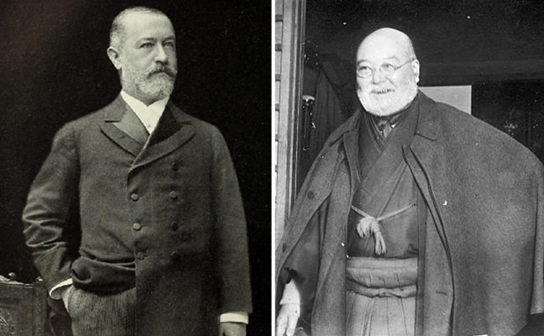
The Banker Jacob Schiff who got revenge on the Russians
Takahashi Korekiyo was born on July 27, 1854 in Edo (the former name of Tokyo). From
the early years of his life he studied English. In 1866 he gained a job as a dogsbody in the
London India and Chain Bank, which won him a scholarship to continue his English studies
in the United States of America. After a two-year stay abroad, he came back to Tokyo, and
under the supervision of the politician and minister of education Mori Arinori he continued
his studies at the Nankô University (the former name of the University of Tokyo). In 1872
Takahashi started his job as an interpreter in the Ministry of Finance, and one year later he
moved to the Ministry of Education. After the establishment of the Institute of Trademark
Registration as a part of the Engineering Department in the Ministry of Agriculture and
Trade in 1884, it was headed by Takahashi. This led him on another journey, this time to
Europe and the United States, the aim of which was the preparation of a new patent law in
Japan. In 1889, Takahashi became the head of the Patent Department, but in the same year
he left Japan for Peru to run a silver mine. When this venture fell through, he got a position
as the head of the construction office of a new seat of the bank, and then its employee,
thanks to Kawada Koichirô, the then President of the Bank of Japan.
During the First Sino--Japanese war (18941895) Takahashi was responsible for investing in the bond market of
the Bank of Japan, through which the state budget could gain the funds it needed to prosecute the war with China.
After this armed conflict, Takahashi was moved to the Yokohama Specie Bank, which became an important institution in the international business
brokerage thanks to his activities. In 1889, Takahashi went on another journey abroad, and
one year later he took the position of vice-president of the Bank of Japan.
His main task was to gain financial support for the increased expenditures on armaments,
associated with the approaching war with Russia. To acquire foreign capital just after war
broke out, in 1904 Takahashi and his secretary went to the United States, and then to Great
Britain. The person who acceded to Takahashi's requests and partially financed the
Japanese war was Jacob Schiff, the president of the Kuhn, Loeb & Co. Bank, who became
an ally of the Japanese side in the Russo-Japanese War, mainly because of his suspicion of
Tsarist Russia, which was conducting an anti-Jewish policy.
The Kishinev pogrom in 1903, as well as those which took place two years later in
Bialystok and Odessa, caused an influx of Jews community to the United States from areas
under the control of the Tsarist authorities. Emigrations of similar intensity occurred in the
1890s, and caused the creation of a special commission by the then President Benjamin
Harrison, the aim of which was to examine this case. Among the members of this commission,
and one of its initiators, was Jacob Schiff. The anti-Jewish activities in Russia were a
reason why Schiff became a supporter of Japan in the war, which started in 1904.
Jacob Schiff was born on January 10, 1847 in Frankfurt am Main, as the son of a rabbi.
When he turned eighteen he moved to the US, when he started his job as a banker. He
eventually became president of Kuhn, Loeb & Co. bank, thanks to which he could financially
support the victims of Russian riots who came to the US, as well as Orthodox and Reform
Jewish institutions.
Takahashi and Schiff met for the first time in April 1904 in London, where Takahashi as
vice president of the Bank of Japan had been trying to gain a loan for the ongoing war.
Before returning to Japan, Takahashi took part in an official dinner, where he told Schiff
about his fears that the loan would be refused. Schiff listened carefully to the story about
the successes of Emperor Nicholas II. Schiff privately abhorred the Tsar, because of the
Kishinev pogrom. Despite this conversation, Takahashi forgot about the meeting with the
banker, and so when he received a message that Schiff wanted to meet him, he did not
remember who he was. When he wanted to find out something about this person, he was
told: A member of the American bank Kuhln Loeb. A powerful force on the world money
market, a main element of international capital. A Jew. Their next meeting resulted in a
long lasting friendship between Schiff and Takahashi. At first, the banker proposed a loan
of 5 million pounds, but finally the sum was increased to 200 million dollars. Schiff not
only supported the Japanese side with his own capital, but also encouraged members of
the First National Bank and the National City Bank to support Japan.
In 1906, Jacob Schiff visited Japan for the first time. He was received by the Meiji
Emperor and was the first foreigner in history to be awarded the Order of the Rising Sun.
During the ceremony, Schiff broke the imperial palace rules and raised a glass to the
Emperor, comparing him with the American president George Washington: first in war,
first in peace, first in the hearts of his countrymen.18 Schiff was also invited to private
dinners at the houses of the former prime minister of Japan, Okuma Shigenobu, the President
of Daiichi Bank, Shibusawa Eiichi, and the mayor of Tokyo, Ozaki Yukio.19 During his stay
in Japan, Schiff contributed 9000 yen (equivalent to 4500 US dollars) to the Japanese Red
Cross.20 Banker came back to the US with Takahashi's fifteen-year-old daughter, who spent
three years at his place.
Warburg family
The Warburg family is a prominent German and American banking family of German Jewish and originally Venetian Jewish descent,
noted for their varied accomplishments in biochemistry, botany, political activism, economics, investment banking, law, physics, classical music,
art history, pharmacology, physiology, finance, private equity and philanthropy.
They originated as the Venetian Jewish del Banco family, one of the wealthiest Venetian families in the early 16th century. Due to restrictions limiting
Jewish involvement in banking, they moved to Bologna, and thence to Warburg, in Westphalia, in the 16th century, after which they later took their name.
The first known ancestor was Simon von Kassel (1500–1566).
The family later established itself in Altona, near Hamburg in the 17th century, after the Thirty Years' War, and it was in Hamburg that M. M. Warburg & Co.
was established in 1798, among the oldest still existing investment banks in the world. Other banks created by members of the family include
Warburg Pincus and S. G. Warburg & Co., the latter having been acquired in 1995 by UBS.
Alsterufer and Mittelweg lines
The family is traditionally divided into two prominent lines, the Alsterufer Warburgs and the Mittelweg Warburgs. The Alsterufer Warburgs descended
from Siegmund Warburg (1835–1889) and the Mittelweg Warburgs descended from his brother Moritz M. Warburg (1838–1910). They took their
nicknames from the brothers' respective addresses in Hamburg's Rotherbaum neighborhood. The brothers were grandsons of Moses Marcus
Warburg.
Siegmund George Warburg was of the Alsterufer lines; the five brothers Abraham (Aby) M., Max M., Paul M., Felix M. and Fritz Moritz Warburg were
of the Mittelweg line.
The brothers Moses Marcus Warburg (1763–1830) and Gerson Warburg (1765–1826) founded the M. M. Warburg & Co. banking company in 1798.
Moses Warburg's great-great grandson, Siegmund George Warburg, founded the investment bank S. G. Warburg & Co in London in 1946.
Siegmund's second cousin, Eric Warburg, founded Warburg Pincus in New York in 1938. Eric Warburg's son Max Warburg Jr.
(not to be confused with Eric's father Max Warburg) is currently one of the three partners of M.M.Warburg & Co., Warburg.
Max Warburg's elder brother Aby Warburg used family resources to establish the Kulturwissenschaftliche Bibliothek Warburg in Hamburg, since 1934
The Warburg Institute in London. Paul Warburg is most famous as an architect of the US Federal Reserve System, established in 1913.
Paul was a member of the first Federal Reserve Board, and its Vice Chairman until his resignation in August 1918.
American and German Warburgs
Felix and Paul Warburg emigrated to the United States. There they became the two mainstays of the German-American branch, out of the five German
born Warburg brothers. The brothers worked out of New York City where nearly all the male members formed a close bond with the Kuhn, Loeb & Co.
investment banking firm. An American based, but internationally sound firm which at one time toyed with creating a branch abroad that was presumed
would operate most efficiently with the aid of the families international connections. While in NYC, Felix Warburg married Frieda Schiff, only daughter
of Jacob H. Schiff, a banker who grew up in Frankfurt and had ties to the German Warburgs. Schiff financed most of the American rail system through
his investment bank of Kuhn, Loeb & Co. and interacted with newly American Warburgs, as brothers Felix and Paul each eventually made senior partner
for, and each married into some of the prominent families with the investment banking firm of Kuhn, Loeb & Co., at the time, run by Schiff.
Beginning with the marriage of Jacob Schiff in 1875 to Therese Loeb, a daughter of co-founder Solomon Loeb, becoming a full partner in the business
firm shortly after.
In 1895, Paul Warburg married Nina Loeb, daughter of Solomon Loeb of Kuhn, Loeb & Co.,having met her at the wedding of brother Felix Warburg,
who had married Jacob Schiff's daughter, Frieda. But originally it was founding partner Abraham Kuhn who concentrated the family wealth and
cemented business relations with newly immigrated distant cousin Solomon Loeb by his marriage to Kuhn's sister. Shortly thereafter the two became
full partners in their newly established New York banking investment firm of, Kuhn, Loeb & Co.[10] In more recent times Schiff's great-great grandson
Drew previously was married to Al Gore's daughter, Karenna, who has risen in place at the Union Theological Seminary. UTS shares a partnership
with the Jewish Theological Seminary, each located in NYC in Manhattan, where the JTS has historically been associated as well, with the Jewish
Museum.
Having ties to America and Germany like many other prominent Jewish financial families, the Warburgs abroad maintained close ties to their Jewish roots. The Felix M. Warburg House in New York City is now the Jewish Museum, and Kfar Warburg in Israel is named for him. Otto Warburg, a cousin of the German-based Warburgs was a wealthy botanist who was elected head of the World Zionist Organization in 1911. Felix's brother, Paul Warburg was one of the original founders of the board[11] of the U.S. Federal Reserve System, a collection of 12 regional Reserve Banks headed by a Board of Governors which regulates and oversees private commercial banks.[12] As one of the most prominent bankers of his time, his brother Max Warburg attended the Paris Peace Conference of 1919 at Versailles, as part of the German delegation.[13][14]
During the Weimar Republic, Max Warburg served on the board ('Generalrat') of the Reichsbank from 1924 to 1933, under two successive chairmen, Hjalmar Schacht, (until 1930), and Hans Luther (1930–1933); until 1934, he was also on the Board of the Bankenverband.[15] Max Warburg emigrated in 1938. In the 1920s and 1930s, until the end of the Weimar Republic in 1933, Max Warburg also served on several Supervisory Boards ("Aufsichtsrat") in industry, notably HAPAG, Blohm &Voss, Beiersdorf, and, until his resignation in 1932, as a member of the Supervisory Board ("Aufsichtsrat") [16] of the German conglomerate/ chemical firm known as IG Farben (Interessen Gemeinschaft Farben). His brother Paul Warburg, who died in January 1932 – a year before Hitler was elected Chancellor – also served on numerous Supervisory Boards ("Aufsichtsrat") including allegedly that of an I.G. Farben wholly owned US subsidiary.
Most members of the German Warburg family had fled to the United States or Great Britain by the end of 1938. However, Max Warburg's brother,
Fritz Warburg, who was preparing his exile in Sweden, was arrested by the Gestapo in Hamburg in early November 1938 and spent some months
in prison before he could leave for Stockholm in May 1939.[ His daughter Eva came to organize the emigration for 500 German Jewish children from
Germany and Austria to Sweden in 1938 and 1939. Also, three cousins, mother, Gerta and daughters Betty and Helene Julie (Burchard) Warburg,
stayed in Altona. Gerta and Betty were murdered in the Sobibor extermination camp in 1940 and Helena Julie in Auschwitz in 1942. A life size portrait
of Helene Julie by the Norwegian artist Edvard Munch today hangs in the Kunsthaus in Zurich (The Lady in White).[ Eric Warburg, son of Max Warburg,
returned to Germany as an officer (colonel) in the American Air Force and was influential in restoring German-Jewish relations and rebuilding
Germany's economic ties after the Second World War through his international business associations. Eric's son, also called Max, is currently a partner
in M.M. Warburg & Co. in Hamburg.