Chapter VI • The Foreign Policy of the Truman Administration
For many of President Truman’s early mistakes in foreign policy, he cannot rightly be blamed. As a Senator he had specialized
in domestic problems and was not at any time a member of the Foreign Relations Committee. Nor had he by travel scholarship
built up a knowledge of world affairs. Elevated to second place on the National Democratic ticket by a compromise and hated
by the pro-Wallace leftists around Franklin Roosevelt, he was snubbed after his election to the Vice-Presidency in 1944
and was wholly ignorant of the tangled web of our relations with foreign countries when he succeeded to the Presidency on April
12, 1945 — midway between the Yalta and Potsdam conferences.
Not only was Mr. Truman inexperienced in the field of foreign affairs; it has since been authoritatively stated that much vital
information was withheld from him by the hold-over Presidential and State Department cabals. This is not surprising in
view of the deceased President’s testimony to his son Elliott on his difficulty (Chapter V) in getting the truth from
“the men in the State Department, those career diplomats.” Significantly, the new President was not allowed to know of
his predecessors reputed despair at learning that his wisecracks and blandishing smiles had not induced Stalin to renounce
the tenets of bloody and self-aggrandizing dialectic materialism, a state-religion of which he was philosopher, pontiff,
and commander-in-chief.
President Truman brought the war to a quick close. His early changes in the cabinet were on the whole encouraging.
The nation appreciated the inherited difficulties under which the genial Missourian labored and felt for him a nearly unanimous
good will.
In the disastrous Potsdam Conference decisions (July 17-August 2, 1945), however, it was evident (Chapter IV) that anti-American
brains were busy in our top echelon. Our subsequent course was equally ruinous. Before making a treaty of peace, we
demobilized — probably as a part of the successful Democratic-leftist political deal of 1944 — in such a way as to reduce
our armed forces quickly to ineffectiveness. Moreover, as one of the greatest financial blunders in our history, we gave away,
destroyed, abandoned, or sold for a few cents on the dollar not merely the no longer useful portion of our war materiel but many
items such as trucks and precision instruments which we later bought back at market value! These things were done in spite
of the fact that the Soviet government, hostile to us by its philosophy from its inception, and openly hostile to us after
the Tehran conference, was keeping its armed might virtually intact.
Unfortunately, our throwing away of our military potential was but one manifestation of the ineptitude or disloyalty which
shaped our foreign policy. Despite Soviet hostility, which was not only a matter of old record in Stalin’s public utterances,
but was shown immediately in the newly launched United Nations, we persisted in a policy favorable to world domination by the
Moscow hierarchy. Among the more notorious of our pro-Soviet techniques was our suggesting that “liberated” and other nations
which wanted our help should be ruled by a coalition government including leftist elements. This State Department scheme tossed
one Eastern European country after another into the Soviet maw, including finally Czechoslovakia. This foul doctrine of the left
coalition and its well-known results of infiltrating Communists into key positions in the governments of Eastern Europe
will not be discussed here, since the damage is one beyond repair as far as any possible immediate American action
is concerned. Discussion here is limited to our fastening of the Soviet clamp upon the Eastern Hemisphere in three areas
still the subject of controversy. These are (a) China, (b) Palestine, and (e) Germany. The chapter will be
concluded by some observations (d) on the war in Korea.
The Truman policy on China can be understood only as the end-product of nearly twenty years of American-Chinese relations.
President Franklin D. Roosevelt felt a deep attachment to the Chiangs and deep sympathy for Nationalist Chins — feelings
expressed as late as early December, 1943, shortly after the Cairo Declaration (November 26, 1943), by which Manchuria was
to be “restored” to China, and just before the President suffered the mental illness from which he never recovered.
It was largely this friendship and sympathy which had prompted our violent partisanship for China in the Sino-Japanese
difficulties of the 1930′s and early 1940′s. More significant, however, than our freezing of Japanese assets in the
United States, our permitting American aviators to enlist in the Chinese army, our gold and our supplies sent in by air,
by sea, and by the Burma road, was our ceaseless diplomatic barrage against Japan in her role as China’s enemy (see
United States Relations With China With Special Reference to the Period 1944-1949, Department of State, 1949, p. 25 and passim).
When the violent phase of our already initiated political war against Japan began with the Pearl Harbor attack of December 7, 1941,
we relied on China as an ally and as a base for our defeat of the island Empire. On March 6, 1942, Lieutenant
General Joseph W. Stilwell “reported to Generalissimo Chiang” (op. cit., p. xxxix). General Stilwell was not only
“Commanding General of United States Forces in the China-Burma-India Theater” but was supposed to command “such
Chinese troops as Generalissimo Chiang Kai-Shek might assign him” (op. cit., p.30) and in other ways consolidate
and direct the Allied war effort. Unfortunately, General Stilwell had formed many of his ideas on China amid a
coterie of leftists led by Agnes Smedley as far back as 1938 when he, still a colonel, was a U.S. military attache in Hankow,
China (see The China Story, by Freda Utley, Henry Regnery Company, Chicago, 1951, $3.50). It is thus not surprising that
General Stilwell quickly conceived a violent personal animosity for the anti-Communist Chiang
(Saturday Evening Post, January 7, 14, 21, 1950). This personal feeling, so strong that it results in amazing vituperative poetry
(some of it reprinted in the post), not only hampered the Allied war effort but was an entering wedge for vicious anti-Chiang
and pro-Communist activity which was destined to change completely our attitude toward Nationalist China.
The pro-Communist machinations of certain high placed members of the Far Eastern Bureau of our State Department and of
their confederates on our diplomatic staff in Chungking (for full details, see The China Story) soon became obvious to
those in a position to observe. Matters were not helped when “in the spring of 1944, President Roosevelt appointed
Vice-President Henry A. Wallace to make a trip to China” (United States Relations With China, p. 55). Rebutting what he
considered Mr. Wallace’s pro-Communist attitude, Chiang “launched into a lengthy complaint against the Communists,
whose actions, he said, had an unfavorable effect on Chinese morale … The Generalissimo deplored propaganda to
the effect that they were more communistic than the Russians” (op. cit., p. 56).
Our Ambassador to China, Clarence E. Gauss, obviously disturbed by the Wallace mission and by the pro-Communist attitude
of his diplomatic staff, wrote as follows (op. cit, p. 561) to Secretary Hull on August 31, 1944:
… China should receive the entire support and sympathy of the United States Government on the domestic problem of
Chinese Communists. Very serious consequences for China may result from our attitude. In urging that China resolve differences
with the Communists, our Government’s attitude is serving only to intensify the recalcitrance of the Communists. The request
that China meet Communist demands is equivalent to asking China’s unconditional surrender to a party known to be
under a foreign power’s influence (the Soviet Union).
With conditions in China in the triple impasse of Stilwell-Chiang hostility, American pro-Communist versus Chinese anti-Communist
sentiment and an ambassador at odds with his subordinates, President Roosevelt sent General Patrick J. Hurley to
Chungking as his Special Representative “with the mission of promoting harmonious relations between Generalissimo Chiang
and General Stilwell and of performing certain other duties” (op. cit, p. 57). Ambassador Gauss was soon
recalled and General Hurley was made Ambassador.
General Hurley saw that the Stilwell-Chiang feud could not be resolved, and eventually the recall of General Stilwell
from China was announced. With regard, however, to our pro-Communist State Department representatives in China, Ambassador
Hurley met defeat. On November 26, 1945, he wrote President Truman, who had succeeded to the Presidency in April, a letter
of resignation and gave his reasons:
… The astonishing feature of our foreign policy is the wide discrepancy between our announced policies and our conduct
of international relations, for instance, we began the war with the principles of the Atlantic Charter and democracy as our
goal. Our associates in the war at that time gave eloquent lip service to the principles of democracy. We finished the war
in the Far East furnishing lend-lease supplies and using all our reputation to undermine democracy and bolster imperialism
and Communism …
… it is no secret that the American policy in China did not have the support of all the career men in the State Department …
Our professional diplomats continuously advised the Communists that my efforts in preventing the collapse of the
National Government did not represent the policy of the United States. These same professionals openly advised the
Communist armed party to decline unification of the Chinese Communist Army with the National Army unless the
Chinese Communists were given control …
Throughout this period the chief opposition to the accomplishment of our mission came from the American career diplomats
in the Embassy at Chungking and in the Chinese and Far Eastern Divisions of the State Department.
I requested the relief of the career men who were opposing the American policy in the Chinese Theater of war.
These professional diplomats were returned to Washington State Department as my supervisors. Some of these same career men whom I
relieved have been assigned as advisors to the Supreme Commander in Asia (op. cit, pp. 581-582).
President Truman accepted General Hurley’ s resignation with alacrity. Without a shadow of justification, the able
and patriotic Hurley was smeared with the implication that he was a tired and doddering man, and he was not even allowed
to visit the War Department, of which he was former Secretary, for an interview. This affront to a great American ended
our diplomatic double talk in China. With forthrightness, Mr. Truman made his decision. Our China policy henceforth was to
be definitely pro-Communist. The President expressed his changed policy in a “statement’ made on December 15, 1945.
Although the Soviet was pouring supplies and military instructors into Communist-held areas, Mr. Truman said that the
United States would not offer “military intervention to influence the courses of any Chinese internal strife.”
He urged Chiang’s government to give the Communist “elements a fair and effective representation in the Chinese National Government”.
To such a “broadly representative government” he temptingly hinted that “credits and loans” would be forthcoming
(op. cit, pp. 608-609). President Truman’s amazing desertion of Nationalist China, so friendly to us throughout
the years following the Boxer Rebellion (1900) has been thus summarized (NBC Network, April 13, 1951),
by Congressman Joe Martin:
President Truman, on the advice of Dean Acheson, announced to the world on December 15, 1945, that unless communists were
admitted to the established government of China, aid from America would no longer be forthcoming. At the same time, Mr.
Truman dispatched General Marshall to China with orders to stop the mopping up of communist forces which was being carried
to a successful conclusion by the established government of China.
Our new Ambassador to China General of the Army George C. Marshall, conformed under White House directive (see his testimony
before the Combined Armed Services and Foreign Relations Committees of the Senate, May, 1951) to the dicta of Relations
the State Department’s Communist-inclined camarilla, and made further efforts to force Chiang to admit Communists to his
Government in the “effective” numbers, no doubt, which Mr. Truman had demanded in his “statement’ of December 15.
The great Chinese general, however, would not be bribed by promised “loans” and thus avoided the trap with which our
State Department snared for Communism the states of Eastern Europe. He was accordingly paid off by the mishandling of
supplies already en route, so that guns and ammunition for those guns did not make proper connection as well as by the
eventual complete withdrawal of American support as threatened by Mr. Truman
For a full account of our scandalous pro-Communist moves in denying small arms ammunition to China; our charging China $162.00
for a bazooka (whose list price was $36.50 and “surplus” price to other nations was $3.65) when some arms were sent; and
numerous similar details, see The China Story, already referred to.
Thus President Truman, Ambassador Marshall, and the State Department prepared the way for the fall of China to Soviet control.
They sacrificed Chiang, who represented the Westernized and Christian element in China, and they destroyed a friendly
government, which was potentially our strongest ally in the world — stronger even than the home island of maritime Britain
in this age of air and guided missiles. The smoke-screen excuse for our policy — namely that there was corruption in
Chiang’s government — is beyond question history’s most glaring example of the pot calling the kettle black.
For essential background material, see Shanghai Conspiracy by Major General Charles A. Willoughby, with a preface
by General of the Army Douglas MacArthur(Dutton, 1952).
General Ambassador Marshall became Secretary of State in January, 1947, On July 9, 1947, President Harry S. Truman directed
Lieutenant General Albert C. Wedemeyer, who had served for a time as “Commander-in-Chief of American Forces in the Asian
Theater” after the removal of Stilwell, to “proceed to China without delay for the purpose of making an appraisal of the political,
economic, psychological and military situations — current and projected.” Under the title, “Special Representative of
the President of United States,” General Wedemeyer worked with the eight other members of his mission from July 16 to September
18 and on September 19 transmitted his report (United States Relations with China, pp. 764-814) to appointing authority, the President.
In a section of his Report called “Implications of ‘No Assistance’ to China or Continuation of ‘Wait and See’ Policy,”
General Wedemeyer wrote as follows:
To advise at this time a policy of “no assistance” to China would suggest the withdrawal of the United States Military
and Naval Advisory Groups from China and it would be equivalent to cutting the ground from under the feet of the Chinese
Government. Removal of American assistance, without removal of Soviet assistance, would certainly lay the country open
to eventual Communist domination. It would have repercussions in other parts of Asia, would lower American prestige in
the Far East and would make easier the spread of Soviet influence and Soviet political expansion not only in Asia but in
other parts of the world.
Here is General Wedemeyer’s conclusion as to the strategic importance of Nationalist China to the United States:
Any further spread of Soviet influence and power would be inimical to United States strategic interests.
In time of war the existence of an unfriendly China would result in denying us important air bases for use as
staging areas for bombing attacks as well as important naval bases along the Asiatic coast. Its control by
the Soviet Union or a regime friendly to the Soviet Union would make available for hostile use a number of warm water
ports and air bases. Our own air and naval bases in Japan, Ryukyus and the Philippines would be subject to relatively
short range neutralizing air attacks. Furthermore, industrial and military development of Siberia east of Lake Baikal
would probably make the Manchurian area more or less self-sufficient.
Here are the more significant of the Wedemeyer recommendations:
It is recommended:
That the United States provide as early as practicable moral, advisory and material support to China in order
to prevent Manchuria from becoming a Soviet satellite, to bolster opposition to Communist expansion and to contribute
to the gradual development of stability in China …
That arrangements be made whereby China can purchase military equipment and supplies (particularly motor maintenance parts),
from the United States.
That China be assisted in her efforts to obtain ammunition immediately …
The [sic] military advice and supervision be extended in scope to include field forces training centers
and particularly logistical agencies.
Despite our pro-Communist policy in the previous twenty months, the situation in China was not beyond repair at the time
of the Wedemeyer survey. In September, 1947, the “Chiang government had large forces still under arms and was in control of all
China south of the Yangtze River, of much of North China, with some footholds in Manchuria”
(W. H. Chamberlin, Human Events, July 5, 1950). General Wedemeyer picked 39 Chinese divisions to be American-sponsored and
these were waiting for our supplies and our instructors — in case the Wedemeyer program was accepted.
But General Wedemeyer had reported that which his superiors did not wish to hear. His fate was a discharge from
diplomacy and an exile from the Pentagon. Moreover, the Wedemeyer Report was not released until August, 1949.
Meanwhile, in the intervening two years our pro-Communist policy of withdrawing assistance from Chiang, while the Soviet
rushed supplies to his enemies, had tipped the scales in favor of those enemies, the Chinese Communists.
Needless to say, under Mr. Dean Acheson, who succeeded Marshall as Secretary of State (January, 1949), our pro-Soviet policy
in China was not reversed! Chiang had been holding on somehow, but Acheson slapped down his last hope. In fact, our
Secretary of State — possibly by some strange coincidence — pinned on the Nationalist Government of China the
term “reactionary” (August 6, 1949), a term characteristically applied by Soviet stooges to any unapproved person or policy,
and said explicitly that the United States would give the Nationalist Government no further support.
Meanwhile, the Soviet had continued to supply the Chinese Communists with war materiel at a rate competently estimated
at eight to ten times the amount per month we had furnished — at the peak of our aid — to Chiang’s Nationalists. Chiang’s troops,
many of them without ammunition, were thus defeated, as virtually planned by our State Department, whose Far Eastern Bureau
was animated by admirers of the North Chinese Communists. But the defeat of Chiang was not the disgrace his enemies
would have us believe. His evacuation to Formosa and his reorganization of his forces on that strategic island were far
from contemptible achievements. Parenthetically, as our State Department’s wrong-doing comes to light, there
appears a corollary re-evaluation of Chiang. In its issue of April 9, 1951, Life said editorially that “Now we have only
to respect the unique tenacity of Chiang Kai Shek in his long battle against Communism and take full advantage of
whatever the Nationalists can do now to help us in this struggle for Asia.” It should be added here that any idea of
recognizing Communist China as the representative government of China is absurd. According to a Soviet Politburo
report (This Week, September 30, 1951) the membership of the Chinese Communist Party is 5,800,000.
The remainder of China’s 450,000,000 or 475,000,000 people, in so far as they are actually under Communist control, are slaves.
But — back to the chronology of our “policy” in the Far East. On December 23, 1949, the State Department sent to five hundred
American agents abroad (New York Journal-American, June 19, 1951, p. 18) a document entitled “Policy Advisory
Staff, Special Guidance No. 38, Policy Information Paper — Formosa.” As has been stated in many newspapers, the purpose of
this policy memorandum was to prepare the world for the United States plan for yielding Formosa (Taiwan, in Japanese
terminology) to the Chinese Communists. Here are pertinent excerpts from the surrender document which, upon its release in june, 1951,
was published in full in a number of newspapers:
Loss of the island is widely anticipated, and the manner in which civil and military conditions there have deteriorated
under the Nationalists adds weight to the expectation …
Formosa, politically, geographically, and strategically is part of China in no way especially distinguished or important …
Treatment: …All material should be used best to counter the impression that … its [Formosa's] loss would seriously damage the
interests of the United States or of other countries opposing Communism [and that] the United States is responsible
for or committed in any way to act to save Formosa . . .
Formosa has no special military significance . . .
China has never been a sea power and the island is of no special strategic advantage to Chinese armed forces.
This State Department policy paper contains unbelievably crass lies such as the statement that the island of Formosa is,
in comparison with other parts of China “in no way especially distinguished or important” and the claim that the island would
be “of no special strategic advantage” to its Communist conquerors. It contains an unwarranted slam at our allies,
the Chinese Nationalists, and strives to put upon our ally Britain the onus for our slight interest in the island — an
interest the “policy memorandum” was repudiating! It is hard to see how the anonymous writer of such a paper could be regarded
as other than a scoundrel. No wonder the public was kept in ignorance of the paper's existence until the MacArthur
investigation by the Senate raised momentarily the curtain of censorship!
In a “Statement on Formosa” (New York Times, January 6, 1950), President Truman proceeded cautiously on the less explosive
portions of the “Policy Memorandum,” but declared Formosa a part of China — obviously, from the context, the China of
Mao Tse-Tung — and continued: “The United States has no desire to obtain special rights or privileges or to establish military
bases on Formosa at this time. Nor does it have any intention of utilizing its armed forces to interfere in the
present situation.” The President’s statement showed a dangerous arrogation of authority, for the wartime promises
of the dying Roosevelt had not been ratified by the United States Senate, and in any case a part of the Japanese Empire was
not at the personal disposal of an American president. More significantly, the statement showed an indifference to the safety
of America or an amazing ignorance of strategy, for any corporal in the U.S. army with a map before him
could see that Formosa is the virtual keystone of the U.S. position in the Pacific. It was also stated by our
government “a limited number of arms for internal security.”
Six days later (January 12, 1950) in an address at a National Press Club luncheon, Secretary Acheson announced
a “new motivation of United States Foreign policy,” which confirmed the President’s statement a week before, including specifically
the “hands off” policy in Formosa. Acheson also expressed the belief that we need not worry about the Communists in China
since they would naturally grow away from the Soviet on account of the Soviet’s “attaching” North China
territory to the great Moscow-ruled imperium (article by Walter H. Waggoner, New
York Times, January 13, to January 10, 1950).
These sentiments must have appealed to Governor Thomas E. Dewey, of New York, for at Princeton University on April 12,
he called for Republican support of the Truman-Acheson foreign policy and specifically commended the appointment of John Foster
Dulles (for the relations of Dulles with Hiss, see Chapter VIII) as a State Department “consultant.”
Mr. Acheson’s partly concealed and partly visible maneuverings were thus summed up by Walter Winchell
(Dallas Times Herald, April 16, 1951):
These are the facts. Secretary Acheson … is on record as stating we would not veto Red China if she succeeded in getting
a majority vote in the UN … As another step, Secretary Acheson initiated a deliberate program to play down the importance of
Formosa.
Mr. Winchell also mentioned Senator Knowland’s “documentary evidence” that those who made
State Department policy had been instructed by Secretary Acheson to “minimize the strategic importance of Formosa”
All of this was thrown into sharp focus by President Truman when he revealed in a press
conference (May 17, 1951) that his first decision to fire General MacArthur a
year previously had been strengthened when the Commander in Japan protested in
the summer of 1950 that the proposed abandonment of Formosa would weaken the
U.S. position in Japan and the Philippines!
“No matter how hard one tries,” The Freeman summarized on June 4, 1951, “there is no way of
evading the awful truth: The American State Department wanted Marxist Communists
to win for Marxism and Communism in China.” Also, The Freeman continued, “On his
own testimony, General Marshall supported our pro-Marxist China policy with his
eyes unblinkered with innocence.”
Thus, in the first half of 1950, our Far Eastern policy, made by Acheson and approved by
Truman and Dewey, was based on (1) the abandonment of Formosa to the expected
conquest by Chinese Communists, (2) giving no battle weapons to the Nationalist
Chinese or to the South Koreans, in spite of the fact that the Soviet was known
to be equipping the North Koreans with battle weapons and with military skills,
(3) the mere belief — at least, so stated — of our Secretary of State,
self-confessedly ignorant of the matter, that the Communists of China would
become angry with the Soviet. The sequel is outlined in section (d) below. -
Our second great mistake in foreign policy — unless votes in New York and other Northern cities are its motivation — was
our attitude toward the problem of Palestine. In the Eastern Mediterranean on the deck of the heavy cruiser, U.S.S. Quincy, which
was to bring him home from Yalta, President Roosevelt in February, 1945, received King Ibn Saud of Saudi Arabia.
According to General Elliott Roosevelt (As He Saw It, p. 245): “It had been Father’s hope that he would be able to
convince Ibn Saud of the equity of the settlement in Palestine of the tens of thousands of Jews driven from their European homes.”
But, as the ailing President later told Bernard Baruch, “of all the men he had talked to in his life, he had got least
satisfaction from this iron- willed Arab monarch.” General Roosevelt concludes thus: “Father ended by promising Ibn Saud that he
would sanction no American move hostile to the Arab people.” This may be considered the four-term President’s legacy on the subject,
for in less than two months death had completed its slow assault upon his frame and his faculties.
But the Palestine Problem, like the ghost in an Elizabethan drama, would not stay “down.” In the post-war years (1945 and after),
Jewish immigrants mostly from the Soviet Union or satellite states poured into the land once known as “Holy.”
These immigrants were largely Marxist in outlook and principally of Khazar antecedents. As the immigration progressed,
the situation between Moslems and this new type of Jew became tense.
The vote-conscious American politicians became interested. After many vacillations between “non-partition” which was recommended
by many American Jewish organizations and highly placed individual Jews, the United States — which has
many Zionist voters and few Arab voters — decided to sponsor the splitting of Palestine, which was predominantly Arab in population,
into Arab and Jewish zones. In spite of our lavish post-war tossing out of hundreds of millions and sometimes billions to almost
any nation — except a few pet “enemies” such as Spain — for almost any purpose, the United Nations was inclined to disregard our
sponsorship and reject the proposed new member. On Wednesday, November 26, 1947, our proposition received 25 votes out of 57
(13 against, 17 abstentions, 2 absent) and was defeated. Thus the votes had been taken and the issue seemed
settled. But, no!
Any reader who wishes fuller details should by all means consult the microfilmed New York
Times for November 26-30, and other pertinent periodicals, but here are the highlights:
The United Nations General Assembly postponed a vote on the partition of Palestine yesterday after Zionist supporters
found that they still lacked an assured two-thirds majority (article by Thomas J. Hamilton, New York Times, November 27,
1947).
Yesterday morning Dr. Aranha was notified by Siamese officials in Washington that the credentials of the Siamese delegation,
which had voted against partition in the Committee, had been canceled (November 27, 1947).
Since Saturday [November 22] the United States Delegation has been making personal contact with other delegates to obtain
votes for partition… The news from Haiti … would seem to indicate that some persuasion has now been brought to bear on
home governments … the result of today’s vote appeared to depend on what United
States representatives were doing in faraway capitals (from an article by Thomas
J. Hamilton, New York Times, November 28, 1947).
The result of our pro-"Israeli" pressures, denounced in some instances by representatives
of the governments who yielded, was a change of vote by nine nations: Belgium, France, Haiti, Liberia Luxemburg,
The Netherlands, New Zealand Paraguay, and the Philippines. Chile dropped — to “not voting” — from the pro-"Israeli"
twenty-five votes of November 26, and the net gain for U.S.-”Israeli” was 8. Greece
changed from “not voting” to “against,” replacing the dismissed Siamese
delegation and the “against” vote remained the same, 13, Thus the New York Times
on Sunday, November 30, carried the headline “ASSEMBLY VOTES PALESTINE
PARTITION; MARGIN IS 33-13; ARABS WALK OUT…. ”
The Zionist Jews of Palestine now had their seacoast and could deal with the Sovietized
Black Sea countries without further bother from the expiring British mandate.
The selection of immigrants of which over-populated “Israel” felt such great
need was to some extent, if not entirely, supervised by the countries of origin.
For instance, a high “Israeli” official visited Bucharest to coordinate with the
Communist dictator of Rumania, Ana Rabinsohn Pauker, the selection of immigrants
for “Israel.” “Soviet Bloc Lets Jews Leave Freely and Take Most Possessions to
Israel,” The New York Times headlined (November 26, 1948) a UP dispatch from
Prague.
The close ties between Communism and “Israel” were soon obvious to any penetrating reader
of the New York Times. A notable example is afforded in an article (March 12, 1948) by Alexander Feinberg entitled
“10,000 in Protest on Palestine Here: Throng Undaunted by Weather Mustered by Communist and Left-Wing Labor Leaders.”
Here is a brief quotation from this significant article:
Youthful and disciplined Communists raised their battle cry of “solidarity forever” as they
marched … The parade and rally were held under the auspices of the United
Committee to Save the Jewish State and the United Nations, formed recently after
the internationally minded Communists decided to “take over” an intensely
nationalistic cause, the partition of Palestine. The grand marshal of the parade
was Ben Gold, president of the Communist-led International Fur and Leather
Workers Union, CIO.
With the Jewish immigrants to Palestine came Russian and Czechoslovak (Skoda) arms. “Israel Leaning Toward Russia Its Armorer,”
the New York Herald-Tribune headlined on August 5, 1948. Here are quotations on the popularity of the Soviet
in “Israel” from Correspondent Kenneth Bilby’s wireless dispatch from Tel Aviv:
Russian prestige has soared enormously among all political factions … Certain Czech arms shipments which reached Israel
at critical junctures of the war, played a vital role in blunting the invasion’s five Arab armies … The Jews, who are certainly
realists, know that without Russia’s nod, these weapons would never have been available.
Mr. Bilby found that “the balance sheet” read “much in Russia’s favor” and found his conclusion "evidenced in
numerous ways — in editorials in the Hebrew press praising the Soviet Union" and also “in public pronouncements of political and
governmental leaders.” Mr. Bilby concluded also that the “political fact” of “Israeli” devotion to the Soviet might
“color the future of the Middle East” long after the issues of the day were settled. Parenthetically, the words of the
Herald-Tribune correspondent were prophetic. In its feature editorial of October 10, 1951, the Dallas Morning News commented
as follows on the announced determination of Egypt to seize the Sudan and the Suez Canal:
Beyond question, the Egyptian move is concerned with the understandable unrest stirred in the Arab world by the establishment
of the new State of Israel. The United Nations as a whole and Britain and the United States in particular did that. The
Moslem world could no more accept equably an effort to turn back the clock 2,000 years than would this country agree
to revert to the status quo of 1776.
Showing contempt, and her true colors, “Israel” voted with the Soviet Union and against the United States on the question
of admitting Communist China to the UN (broadcast of Lowell Thomas, CBS Network, November 13, 1951). Thus were we paid
for the immoral coercion by which we got “Israel” into the United Nations — a coercion which had given the whole world in
the first instance, a horrible but objective and above-board example of the Truman administration’s conception of elections!
But back to our chronology. In 1948, string with Soviet armor and basking in the sunshine of Soviet sympathy, “Israeli” troops
mostly born in Soviet-held lands killed many Arabs and drove out some 880,000 others, Christian and Moslem. These wretched
refugees apparently will long be a chief problem of the Arab League nations of the Middle East. Though most Americans are unaware,
these brutally treated people are an American problem also, for the Arabs blame their tragedy in large part on “the Americans —
for pouring money and political support to the Israelis; Harry Truman is the popular villain” (“The Forgotten Arab Refugees,”
by James Bell, Life, September 17, 1951). With such great sympathy for the Soviet Union, as shown above, it is not surprising
“Israel,” at once began to show features which are extremely leftist — to say the least For instance, on his return from
“Israel,” Dr. Frederick E. Reissig, executive director of the Washington (D.C.) Federation of Churches, “told of going to
many co-operative communities … Land for each ‘kibbutz’ — as such communities are called — is supplied by the government.
Everything — more or less — is shared by the residents” (Mary Jane Dempsey in Washington Times-Herald, April 24, 1951). For
fuller details, see “The Kibbutz” by John Hersey in The New Yorker of April 19, 1952.
After the “Israeli” seizure of the Arab lands in Palestine, there followed a long series of outrages including the bombings
of the British Officers’ Club in Jerusalem, the Acre Prison, the Arab Higher Command Headquarters in Jaffa, the Semiramis
Hotel, etc. These bombings were by “Jewish terrorists” (World Almanac, 1951). The climax of the brutality in “Israel” was the
murder of Count Bernadotte of Sweden, the United Nations mediator in Palestine! Here is the New York Times
story (Tel Aviv, September 18, 1948) by Julian Louis Meltzer:
Count Folke Bernadotte, United Nations Mediator for Palestine, and another United Nations official, detached from the
French Air Force, were assassinated this afternoon [September 17], within the Israeli-held area of Jerusalem.
Also, according to the New York Times, “Reuters quoted a Stern Group spokesman in Tel Aviv as having said, I am satisfied that
it has happened". A United Nations truce staff announcement confirmed the fact that Count Bernadotte had been
“killed by two Jewish irregulars,” who also killed the United Nations senior observer, Col. Andre Pierre Serot, of
the French Air Force.
Despite the fact that the murderers were Jews, and that the murdered UN officers were from countries worth no appreciable
political influence in the United States, American reaction to the murder of the United Nations mediator was by no means
favorable. It was an election year and Dewey droned on about “unity” while Truman trounced the “do-nothing Republican 80th Congress.”
For a month after the murders neither of them fished in the putrid pond of “Israeli”-dominated Palestine.
Strangely enough, it was Dewey who first threw in his little worm on a pinhook.
In a reply to a letter from the Constantinople-born Dean Alfange, Chairman of the Committee which founded the Liberal Party
of the State of New York, May 19, 1944 [Who's Who in America, Vol. 25, p. 44), Dewey wrote (October 22, 1948):
"As you know, I have always felt that the Jewish people are entitled to a homeland in Palestine which would be politically
and economically stable ... My position today is the same." On October 24 in a formal statement, Truman rebuked Dewey
for "injecting foreign affairs" into the campaign and — to change the figure of speech — raised the Republican candidate's
"six-spades" bid for Jewish votes by a resounding "ten-no-trumps":
So that everyone may be familiar with my position, I set out here the Democratic platform on Israel:
"President Truman, by granting immediate recognition to Israel, led the world in extending friendship and welcome to a people
who have long sought and justly deserve freedom and independence.
"We pledge full recognition to the State of Israel. We affirm our pride that the United States, under the leadership of
President Truman, played a leading role in the adoption of the resolution of Nov. 29, 1947, by the United Nations General
Assembly for the creation of a Jewish state.
"We approve the claim of the State of Israel to the boundaries set forth in the United Nations' resolution of Nov. 29 and
consider that modifications thereof should be made only if fully acceptable to the State of Israel.
"We look forward to the admission of the State of Israel to the United Nations and its full participation in the international
community of nations. We pledge appropriate aid to the State of Israel in developing its economy and resources.
"We favor the revision of the arms embargo to accord to the State of Israel the right of self-defense"
(New York Times, of Oct. 25, 1948).
But the President had not said enough. Warmed up, perhaps by audience contact, and flushed with the prospect of
victory, which was enhanced by a decision of the organized leftists to swing — after the opinion polls closed — from Wallace
to Truman, he swallowed the "Israel" cause, line, sinker and hook — the hook being never thereafter removed.
Here from the New York Times of Oct 29, 1948, is Warren Moscow's story:
President Truman made his strongest pro-Israel declaration last night. Speaking at Madison Square Garden to more
than 16,000 persons brought there under the auspices of the Liberal Party, the President ignored the Bernadotte Report and pledged
himself to see that the new State of Israel be "large enough, free enough, and strong enough to make its people self-supporting
and secure."
The President continued:
What we need now is to help the people of Israel and they've proved themselves in the best traditions of hardy pioneers.
They have created a modern and efficient state with the highest standards of Western civilization.
In view of the Zionist record of eliminating the Arab natives of Palestine, continuous bombings, and the murder of the
United Nations mediator, hardly cold in his grave, Mr. Truman owes the American people a documented exposition of his
conception of "best traditions" and "highest standards of Western civilization"
Indeed, our bi-partisan endorsement of Zionist aggression in Palestine — in bidding for the electoral vote of New York — is one
of the most reprehensible actions in world history.
The Soviet-supplied "Jewish" troops which seized Palestine had no rights ever before recognized in law or custom except
the right of triumphant tooth and claw (see "The Zionist Illusion," by Prof. W. T. Stace of Princeton University, Atlantic
Monthly, February, 1947).
In the first place the Khazar Zionists from Soviet Russia were not descended from the people of Hebrew religion in Palestine,
ancient or modern, and thus not being descended from Old Testament People (The Lost Tribes, by Allen H. Godfrey, Duke
University Press, Durham, N.C., 1930, pp. 257, 301, and passim), they have no Biblical claim to Palestine. Their claim
to the country rests solely on their ancestors' having adopted a form of the religion of a people who ruled there
eighteen hundred and more years before (Chapter II, above). This claim is thus exactly as valid as if the same or some other
horde should claim the United States in 3350 A.D. on the basis of having adopted the religion of the American
Indian! For another comparison, the 3,500,000 Catholics of China (Time, July 2, 1951) have as much right to the former Papal
states in Italy as these Judaized Khazars have to Palestine! (Bible students are referred to the Apocalypse, The
Revelation of St. John the Divine, Chapter II, Verse 9.)
Moreover, the statistics of both land-ownership and population stand heavily against Zionist pretensions. At the close
of the first World War, "there were about 55,000 Jews in Palestine, forming eight percent of the population... . Between
1922 and 1941, the Jewish population of Palestine increased by approximately 380,000, four-fifths of this being due to immigration.
This made the Jews 31 percent of the total population" (East and West of Suez, by John S. Badeau, Foreign Policy Association,
1943, p. 46). Even after hordes from Soviet and satellite lands had poured in, and when the United Nations was working on the
Palestine problem, the best available statistics showed non-Jews owning more land than Jews in all sixteen of the county-size
subdivisions of Palestine and outnumbering the Jews in population in fifteen of the sixteen subdivisions (UN
Presentations 574, and 573, November, 1947).
The anti-Communist Arab population of the world was understandably terrified by the arrival of Soviet-equipped troops in its
very center, Palestine, and was bitter at the presence among them — despite President Roosevelt's promise to Ibn Saud —
of Americans with military training. How many U.S. army personnel, reserve, retired, or on leave, secretly participated is not known.
Robert Conway, writing from Jerusalem on january 19, 1948, said: "More than 2,000 Americans are already
serving in Haganah, the Jewish Defense Army, highly placed diplomatic sources revealed today." Conway stated further that
a "survey convinced the Jewish agency that 5,000 Americans are determined to come to fight for the Jewish state
even if the U.S. government imposes loss of citizenship upon such volunteers." The expected number was 50,000 if no law on
forfeiting citizenship was passed by the U.S. Congress (N.Y . News cable in Washington Times-Herald, January 20, 1948).
Among Americans who cast their lot with "Israel" was David Marcus, a West Point graduate and World War II colonel.
Col. Marcus's service with the "Israeli" army was not revealed to the public until he was "killed fighting with Israeli forces
near Jerusalem" in June, 1948. At the dedication of a Brooklyn memorial to Colonel Marcus a "letter from President
Truman... extolled the heroic roles played by Colonel Marcus in two wars" (New York Times, Oct 11, 1948). At the
time of his death, Colonel Marcus was "Supreme commander of Israeli military forces on the Jerusalem front"
(AP dispatch, Washington Evening Star June 12, 1948).
The Arab vote in the united States is negligible — as the Zionist vote is not — and after the acceptance of "Israel" by the UN
the American government recognized as a sovereign state the new nation whose soil was fertilized by the blood of many
people of many nationalities from the lowly Arab peasant to the royal Swedish United Nations," mediator. "You can't shoot your
way into the United Nations, "said Warren Austin, U.S. Delegate to the UN, speaking of Communist China on
January 24, 1951 (Broadcasts of CBS and NBC). Mr. Austin must have been suffering from a lapse of memory, for that is
exactly what "Israel" did!
Though the vote of Arabs and other Moslem peoples is negligible in the United States, the
significance of these Moslem peoples is not negligible in the world (see the map
entitled "The Moslem Block" on p. 78 of Badeau' s East of Suez). Nor is their
influence negligible in the United Nations. The friendly attitude of the United
States toward Israel's bloody extension of her boundaries and other acts already
referred to was effectively analyzed on the radio (NBC Network, January 8, 1951)
by the distinguished philosopher and Christian (so stated by the introducer,
John McVane), Dr. Charles Malik, Lebanese Delegate to the United Nations and
Minister of Lebanon to the United States. Dr. Charles Malik of Lebanon is not to
be confused with Mr. Jacob (Jakkov, Yakop) Malik, Soviet Delegate with Andrei Y.
Vishinsky to the 1950 General Assembly of the United Nations (The United Nations
— Action for Peace, by Marie and Louis Zocca, Rutgers University Press, New
Brunswick, N. J., 1951). To his radio audience Dr. Malik of Lebanon spoke, in
part, as follows:
MR. MALIK: The United States has had a great history of very friendly relations with the Arab peoples
for about one hundred years now. That history has been built up by faithful missionaries, educators, explorers,
and archaeologists and businessmen for all these decades. Up to the moment when the Palestine problem began to be
an acute issue, the Arab peoples had a genuine and deep sense of love and admiration for the United States.
Then, when the problem of Palestine arose, with all that problem involved, by way of what we would regard as one-sided
partiality on the part of the United States with respect to Israel, the Arabs began to feel that the United States
was not as wonderful or as admirable as they had thought it was. The result has been that at the present moment there is
a real slump in the affection and admiration that the Arabs have had towards the United States. This slump has affected
all the relations between the United States and the Arab world, both diplomatic and non-diplomatic. And at the
present moment I can say, much to my regret, but it is a fact that throughout the Arab world, perhaps at no time in history
has the reputation of the United States suffered as much as it has at the present time. The Arabs, on the whole,
do not have sufficient confidence that the United States, in moments of crises, will not make decisions that will be prejudicial
to their interests. Not until the United States can prove in actual historical decision that it can withstand
certain inordinate pressures that are exercised on it from time to time and can really stand up for what one might
call elementary justice in certain matters, would the Arab people really feel that they can go back to their former attitude
of genuine respect and admiration for the United States.
Thus the mess of pottage of vote-garnering in New York and other doubtful states with large numbers of Khazar Zionists
has cost us the loyalty of twelve nations, our former friends, the so-called "Arab and Asiatic" block in the UN!
It appears also that the world's troubles from little blood-born "Israel" are not over. An official "Israeli" view of
Germany was expressed in Dallas, Texas, on March 18, 1951, when Abba S. Eban, ambassador of the state of "Israel" to the United
States and "Israel's" representative at the United Nations, stated that "Israel resents the rehabilitation of Germany."
Ambassador Eban visited the Texas city in the interest of raising funds for taking "200,000 immigrants this year,
600,000 within the next three years" (Dallas Morning News, March 13, 1951) to the small state of Palestine, or "Israel."
The same day that Ambassador Eban was talking in Dallas about "Israel's" resentment at the rehabilitation of Germany,
a Reuters dispatch of March 13, 1951 from Tel Aviv (Washington Times-Herald) stated that "notes delivered yesterday
[March 12] in Washington, London, and Paris and to the Soviet Minister at Tel Aviv urge the occupying powers of
Germany not to “hand over full powers to any German government” without express reservations for the payment of reparations
to “Israel” in the sum of $1,500,000,000.
This compensation was said to be for 6,000,000 Jews killed by Hitler. This figure has been used repeatedly
(as late as January, 1952 — “Israeli” broadcast heard by the author), but one who consults statistics and ponders the known facts of
recent history cannot do other than wonder how it is arrived at. According to Appendix VII, “Statistics on Religious Affiliation,”
of The Immigration and Naturalization Systems of the United States (A Report of the Committee on the
Judiciary of the United States Senate, 1950), the number of Jews in the world is 15,713,638.
The World Almanac, 1949, p. 289, is cited as the source of the statistical table reproduced on p. 842 of the government document.
The article in the World Almanac is headed “Religious Population of the World.” A corresponding item, with the title,
“Population, Worldwide, by Religious Beliefs” is found in the World Almanac for 1940 (p. 129), and in it the world
Jewish population is given as 15,319,359. If the World Almanac figures are correct, the world’ s Jewish population did
not decrease in the war decade, but showed a small increase.
Assuming, however, that the figures of the U.S. document and the World Almanac are in error, let us make an examination
of the known facts. In the first place, the number of Jews in Germany in 1939 was about 600,000 — by some estimates
considerably fewer — and of these, as shown elsewhere in this book, many came to the United States, some went to Palestine,
and some are still in Germany. As to the Jews in Eastern European lands temporarily overrun by Hitler’s troops, the
great majority retreated ahead of the German armies into Soviet Russia. Of these, many came later to the U.S., some moved
to Palestine, some unquestionably remained in Soviet Russia and may be a part of the Jewish force on the Iranian
frontier, and enough remained in Eastern Europe or have returned from Soviet Russia to form the hard core of the new
ruling bureaucracy in satellite countries (Chapter II). It is hard to see how all these migrations and all these
power accomplishments can have come about with a Jewish population much less than that which existed in Eastern Europe
before World War II. Thus the known facts on Jewish migration and Jewish power in Eastern Europe tend, like the
World Almanac figures accepted by the Senate Judiciary Committee, to raise a question as to where Hitler got the 6,000,000 Jews
he is said to have killed. This question should be settled once and for all before the United States backs
any “Israeli” claims against Germany. In this connection, it is well to recall also that the average German had no more
to do with Hitler’s policies than the average American had to do with Franklin Roosevelt’s policies; that 5,000,000
Germans are unaccounted for — 4,000,000 civilians (pp. 70, 71, above) and 1,000,000 soldiers who never returned from Soviet
labor camps (p. 137); and that a permanent hostile attitude toward Germany on our part is the highest hope of
the Communist masters of Russia.
In spite of its absurdity, however, the “Israeli” claim for reparations from a not yet created country, whose territory has
been nothing but an occupied land through the entire life of the state of “Israel,” may well delay reconciliation in
Western Europe; and the claim, even though assumed under duress by a West German government, would almost certainly be paid —
directly or indirectly — by the United States. The likelihood of our paying will be increased if a powerful
propaganda group puts on pressure in our advertiser- dominated press.
As to Ambassador Eban’s 600,000 more immigrants to “Israel”: Where will these people go — unless more Arab lands are taken
and more Christians and Moslems are driven from their homes?
And of equal significance: Whence will Ambassador Eban’s Jewish immigrants to “Israel” come? As stated above, a large portion
of pre-war Germany’s 600,000 Jews came, with other European Jews, to the United States on the return trips of vessels
which took American soldiers to Europe. Few of them will leave the United States, for statistics show that of all immigrants
to this country, the Jew is least likely to leave. The Jews now in West Germany will probably contribute few
immigrants to “Israel,” for these Jews enjoy a preferred status under U.S. protection. It thus appears that Ambassador
Eban’s 600,000 reinforcements to “Israel” — apart from stragglers from the Arab world and a possible mere handful
from elsewhere — can come only from Soviet and satellite lands. If so, they will come on permission of and by arrangement
with some Communist dictator (Chapter II, above). Can it be that many of the 600,000 will be young men with Soviet
military training? Can it be that such permission will be related to the Soviet’s great concentration of Jews in 1951
inside the Soviet borders adjacent to the Soviet- Iranian frontier?
Can it be true further that an army in Palestine, Soviet-supplied and Soviet-trained, will be one horn of a giant pincers
movement (“Keil und Kessel” was Hitler’s term) and that a thrust southward into oil-rich Iran will be the other? The astute
Soviet politicians know that the use of a substantial body of Jewish troops in such an operation might be relied on to prevent
any United States moves, diplomatic or otherwise, to save the Middle East and its oil from the Soviet. In fact, if spurred on
by a full-scale Zionist propaganda campaign in this country our State Department (pp. 232-233), following its precedent in regard
to “Israel,” might be expected to support the Soviet move.
To sum it up, it can only be said that there are intelligence indications that such a Soviet trap is being prepared.
The Soviet foreign office, however, has several plans for a given strategic area, and will activate the one that seems, in the
light of changing events, to promise most in realizing the general objective. Only time, then, can tell whether or not the Kremlin
will thrust with Jewish troops for the oil of Iran and Arabia.
Thus the Middle East flames — in Iran, on the “Israeli” frontier, and along the Suez Canal.
Could we put out the fires of revolt which are so likely to lead to a full scale third World War? A sound answer was given by
The Freeman (August 13, 1950), which stated that “all we need to do to insure the friendship of the Arab and Moslem
peoples is to revert to our traditional American attitudes toward peoples who, like ourselves, love freedom.” This is true
because the “Moslem faith is founded partly upon the teachings of Christ.” Also, “Anti-Arab Policies Are Un-American
Policies,” says William Ernest Hocking in The Christian Century (“Is Israel A ‘Natural Ally’?” September 19, 1951).
Will we work for peace and justice in the Middle East and thus try to avoid World War III ? Under our leftist-infested State
Department, the chance seems about the same as the chance of the Moslem voting population and financial power
surpassing those of the Zionists during the next few years in the State of New York!
The Truman administration’s third great mistake in foreign policy is found in its treatment of defeated Germany.
In China and Palestine, Mr. Truman’s State Department and Executive Staff henchmen can be directly charged with sabotaging
the future of the United States; for despite the surrender at Yalta the American position in those areas was still far from hopeless
when Roosevelt died in April, 1945. With regard to Germany, however, things were already about as bad as possible, and
the Truman administration is to be blamed not for creating but for tolerating and continuing a situation dangerous to the future
security of the United States.
At Yalta the dying Roosevelt, with Hiss at his elbow and General Marshall in attendance, had consented to the brutality of letting
the Soviet use millions of prisoners of war as slave laborers — one million of them still slaves or dead before their time.
We not only thus agreed to the revival of human slavery in a form far crueler than ever seen in the Western world; we also practiced
the inhumanity of returning to the Soviet for Soviet punishment those Western-minded Russian soldiers who sought sanctuary in
areas held by the troops of the once Christian West! The Morgenthau plan for reviving human slavery by its provision for
“forced labor outside Germany” after the war (William Henry Chamberlin, America’s Second Crusade, Henry Regnery Company,
Chicago, 1950, p. 210) was the basic document for these monstrous decisions. It seems that Roosevelt initialed
this plan at Quebec without fully knowing what he was doing (Memoirs of Cordell Hull, Vol. II) and might have modified some of the
more cruel provisions if he had lived and regained his strength. Instead, he drifted into the twilight, and at Yalta Hiss and Marshall
were in attendance upon him, while Assistant Secretary of State Acheson was busy in Washington.
After Roosevelt’s death the same officials of sub-cabinet rank or high non-cabinet rank carried on their old policies and worked
sedulously to foment more than the normal amount of post-war unrest in Western Germany. Still neglected was the sound strategic maxim
that a war is fought to bring a defeated nation into the victor’s orbit as a friend and ally. Indeed, with a much narrower world horizon
than his predecessor, Mr. Truman was more easily put upon by the alien-minded officials around him. To all intents and purposes,
he was soon their captive.
From the point of view of the future relations of both Germans and Jews and of our own national interest, we made a grave mistake
in using so many Jews in the administration of Germany. Since Jews were assumed not to have any “Nazi contamination,”
the “Jews who remained in Germany after the Nazi regime were available for use by military government”
(Zink: American Military Government in Germany, p. 136). Also, many Jews who had come from Germany to this country
during the war were sent back to Germany as American officials of rank and power. Some of these individuals were actually
given on-the-spot commissions as officers in the Army of the United States. Unfortunately, not all refugee Jews
were of admirable character. Some had been in trouble in Germany for grave non-political offenses and their repatriation in the dress
of United States officials was a shock to the German people. There are testimonies of falsifications by Jewish interpreters and
of acts of vengeance. The extent of such practices is not here estimated, but in any case the employment of such
large numbers of Jews — whether of good report, or bad — was taken by Germans as proof of Hitler’s contention
(heard by many Americans as a shortwave song) that America is a “Jewish land,” and made rougher our road toward reconciliation and
peace.
A major indelible blot was thrown on the American shield by the Nuremberg war trials in which, in clear violation of the spirit
of our own Constitution, we tried people under ex post facto laws for actions performed in carrying out the orders of
their superiors. Such a travesty of justice could have no other result than teaching the Germans — as the Palestine matter taught
the Arabs — that our government had no sense of justice. The persisting bitterness from this foul fiasco is seen in the popular quip
in Germany to the effect that in the third World War England will furnish the navy, France the foot soldiers, America the
airplanes, and Germany the war-criminals.
In addition to lacking the solid foundation of legal precedent our “war trials” afforded a classic example of the “law’s delay.”
Seven German soldiers, ranging in rank from sergeant to general, were executed as late as June 7, 1951. Whatever these men and
those executed before them may or may not have done, the long delay had two obvious results — five years of jobs for the
U.S. bureaucrats involved and a continuing irritation of the German people — an irritation desired by Zionists and Communists
The Germans had been thoroughly alarmed and aroused against Communism and used the phrase “Gegen Welt Bolshewismus”
(“Against World Communism”) on placards and parade banners while Franklin Roosevelt was courting it (“We need those votes”).
Consequently the appointment of John J. McCloy as High Commissioner (July 2, 1949) appeared as an affront, for this man was
Assistant Secretary of War at the time of the implementation of the executive order which abolishes rules designed
to prevent the admission of Communists to the War Department; and also, before a Congressional Committee appointed to
investigate Communism in the War Department, he testified that Communism was not a decisive factor in granting or
withholding an army commission. Not only McCloy’s record (Chapter VIII, c) but his manner in dealing with the Germans
tended to encourage a permanent hostility toward America. Thus, as late as 1950, he was still issuing orders to them not
merely plainly but “bluntly” and “sharply” (Drew Middleton in the New York Times, Feb, 7, 1950).
Volumes could not record all our follies in such matters as dismantling German plants for the Soviet Union while spending nearly
a billion a year to supply food and other essentials to the German people, who could have supported themselves by work in the destroyed
plants. For details on results from dismantling a few chemical plants in the Ruhr, see “On the Record” by Dorothy Thompson, Washington
Evening Star, June 14, 1949. The crowning failure of our policy, however, came in 1950. This is no place for a full discussion
of our attitude toward the effort of 510,000 Jews — supported, of course, from the outside as shown in Chapter IV, above — to ride
herd on 62,000,000 Germans (1933, the figures were respectively about 600,000 and 69,000,000 by 1939) or the ghastly sequels. It
appeared as sheer deception, however, to give the impression, as Mr. Acheson did, that we were doing what we could to secure the
cooperation of Western Germany, when Mr. Milton Katz was at the time (his resignation was effective August 19, 1951) our overall
Ambassador in Europe and, under the far from vigorous Marshall, the two top assistant secretaries of Defense were the Eastern
European Jewess, Mrs. Anna Rosenberg, and Mr. Marx Leva! Nothing is said or implied by the author against Mr. Katz, Mrs. Rosenberg
or Mr. Marx Leva, or others such as Mr. Max Lowinthal and Mr. Benjamin J. Brttenwieser, who have been prominent figures in our recent
dealings with Germany, the former as Assistant to Commissioner McCloy and the latter as Assistant High Commissioner of the
United States. As far as the author knows, all five of these officials are true to their convictions. The sole point here stressed
is the unsound policy of sending unwelcome people to a land whose good will we are seeking — or perhaps
only pretending to seek.
According to Forster’s A Measure of Freedom (p. 86), there is a “steady growth of pro-German sentiment in the super-Patriotic press” in the United States. The
context suggests that Mr. Forster is referring in derision to certain pro-American sheets of small circulation, most of which do not carry
advertising. These English-language papers with their strategically sound viewpoints can, however, have no appreciable circulation
in Germany, if any at all, and Germans are forced to judge America by its actions and its personnel. In both, we have moved for the
most part rather to repel them than to draw them into our orbit as friends.
If we really wish friendship and peace with the German people, and really want them on our side in case of another world-wide war,
our choice of General Eisenhower as Commander-in-chief in Europe was most unfortunate. He is a tactful, genial man,
but to the Germans he remains — now and in history — as the Commander who directed the destruction of their cities with civilian
casualties running as high as a claimed 40,000 in a single night, and directed the U.S. retreat from the out-skirts of Berlin.
This retreat was both an affront to our victorious soldiers and a tragedy for Germany, because of the millions of additional people
it placed under the Soviet yoke, and because of the submarine construction plants, guided missile works, and other factories it
presented to the Soviet Moreover, General Eisenhower was Supreme Commander in Germany during the hideous atrocities perpetrated
upon the German people by displaced persons after the surrender (Chapter IV, above). There is testimony to General Eisenhower’s lack
of satisfaction with conditions in Germany in 1945, but he made — as far as the author knows — no strong gesture such as securing
his assignment to another post. Finally, according to Mr. Henry Morgenthau (New York Post, November 24, 1947), as quoted in
Human Events and in W. H. Chamberlin’s America’s Second Crusade, General Eisenhower said: “The whole German population
is a synthetic paranoid” and added that the best cure would be to let them stew in their own juice. All in all, sending
General Eisenhower to persuade the West Germans to “let bygones by bygones” (CBS, January 20, 1951), even before the signing of a
treaty of peace, was very much as if President Grant had sent General Sherman to Georgia to placate the Georgians five years
after the burning of Atlanta and the march to the sea — except that the personable Eisenhower had the additional initial handicap
of Mr. Katz breathing on his neck, and Mrs. Anna Rosenberg in high place in the Department of Defense in Washington !
The handicap may well be insurmountable, for many Germans, whether rightly or not, believe Jews are responsible for all their woes.
Thus, after the Eisenhower appointment, parading Germans took to writing on their placards not their old motto “Gegen Welt
Bolshewismus” but “Ohne mich” (AP despatch from Frankfurt-am-Main, Germany, February 4, 1951) which may be translated “Leave me out.”
In this Germany, whose deep war wounds were kept constantly festering by our policy, our government has stationed some six divisions
of American troops. Why? In answering the question remember that Soviet Russia is next door, while our troops, supplies, and
reinforcements have to cross the Atlantic! Moreover, if the Germans, fighting from and for their own homeland, “failed with a
magnificent army of 240 combat divisions” (ex-President Herbert Hoover, broadcast on “Our National Policies on
This Crisis,” Dec. 20, 1950) to defeat Soviet Russia, what do we expect to accomplish with six divisions ? Of course,
in World War II many of Germany’s divisions were used on her west front and America gave the Soviet eleven billion dollars
worth of war materiel; still by any comparison with the number of German divisions used against Stalin, six is a
very small number for any military purpose envisioning victory. Can it be that the six divisions have been offered by some
State Department schemer as World War Ill’s European parallels to the “sitting ducks” at Pearl Harbor and the
cockle shells in Philippine waters? (See Chapter VII, d, below and Design for War, by Frederick R. Sanborn, The Devin-Adair Company,
New York, 1951).
According to the military historian and critic, Major Hoffman Nickerson, our leaders have some “undisclosed purpose of their own,
if they foresee war they intend that war to begin either with a disaster or a helter-skelter retreat”
(The Freeman, July 2, 1951). In any case the Soviet Union — whether from adverse internal conditions, restive satellites,
fear of our atomic bomb stockpile, confidence in the achievement of its objectives through diplomacy and
infiltration, or other reasons — has not struck violently at our first bait of six divisions. But, under our provocation
the Soviet has quietly got busy.
For five years after the close of World War II, we maintained in Germany two divisions and the Soviet leaders made little
or no attempt to prepare the East German transportation network for possible war traffic (U.S. News and World Report,
January 24, 1951). Rising, however, to the challenge of our four additional divisions (1951), the Soviet took positive action.
Here is the story (AP dispatch from Berlin in Washington Times-Herald, April 30, 1951):
Russian engineers have started rebuilding the strategic rail and road system from Germany’s Elbe River,
East German sources disclosed today. The main rail lines linking East Germany and Poland with Russia are being
double-tracked, the sources said. The engineers are rebuilding Germany’s highway and bridge network to support tanks
and other heavy artillery vehicles.
The Soviet got busy not only in transportation but in personnel and equipment According to Drew Middleton
(New York Times, August 17, 1951), “All twenty-six divisions of the Soviet group of armies in Eastern Germany are being brought
to full strength for the first time since 1946.” Also, a “stream of newly produced tanks, guns, trucks, and light weapons is flowing
to divisional and army bases.” There were reports also if the strengthening of satellite armies.
These strategic moves followed our blatantly announced plans to increase our forces in Germany. Moreover, according to Woodrow Wyatt,
British Undersecretary for War, the Soviet Union had “under arms” in the summer of 1951 “215 divisions and more
than 4,000,000 men” (AP dispatch in New York Times, July 16, 1951). Can it be possible that our State Department is seeking
ground conflict with this vast force not only on their frontier but on the particular frontier which is closest
to their factories and to their most productive farm lands?
In summary, the situation of our troops in Germany is part of a complex world picture which is being changed daily
by new world situations such as our long delayed accord with Spain and a relaxing of the terms of our treaty with Italy.
There are several unsolved factors. One of them is our dependence — at least in large part — on the French transportation
network which is in daily jeopardy of paralysis by the Communists, who are numerically the strongest political party
in France. Another is the nature of the peace treaty which will some day be ratified by the government of West Germany
and the Senate of the United States — and thereafter the manner of implementing that treaty.
As we leave the subject, it can only be said that the situation of our troops in Germany is
precarious and that the question of our relations with Germany demands the
thought of the ablest and most patriotic people in America — a type not overly
prominent in the higher echelons of our Department of State in recent years. Having by three colossal “mistakes” set the stage for possible disaster in the Far East,
in the Middle East, and in Germany, we awaited the enemy’s blow which could be
expected to topple us to defeat. It came in the Far East.
As at Pearl Harbor, the attack came on a Sunday morning — June 2, 1950. On that day North Korean Communist troops crossed
the 38th parallel from the Soviet Zone to the recently abandoned U.S. Zone in Korea and moved rapidly to the South. Our
government knew from several sources about these Communist troops before we moved our troops out on January 1, 1949, leaving
the South Koreans to their fate. For instance, in March, 1947, Lieutenant General John R. Hodge, U.S. Commander in Korea,
stated “that Chinese Communist troops were participating in the training of a Korean army of 500,000 in Russian-held North Korea”
{The China Story, p. 51).
Despite our knowledge of the armed might of the forces in North Korea; despite our vaunted failure to arm our former wards,
the South Koreans; despite our “hands off” statements placing Formosa and Korea outside our defense perimeter and generally
giving Communists the green light in the Far East; and despite President Truman’s statement as late as May 4, 1950, that there
would be "no shooting war" we threw United States troops from Japan into that unhappy peninsula — without the authority of
Congress — to meet the Communist invasion.
Our troops from Japan had been trained for police duty rather than as combat units and were “without the proper weapons”
(P.L. Franklin in National Republic, January, 1951). This deplorable fact was confirmed officially by former Defense
Secretary, Louis Johnson, who testified that our troops in Korea “were not equipped with the things that you would need
if you were to fight a hostile enemy. They were staffed and equipped for occupation, not for war or an offensive”
(testimony before combined Armed Services and Foreign Relations Committees of the Senate, June, 1951, as quoted by U.S. News and
World Report, June 22, 1951, pp. 21-22). Our administration had seen to it also that those troops which became our South Korean allies
were also virtually unarmed, for the Defense Department “had no establishment for Korea. It was under the State
Department at that time” (Secretary Johnson’s testimony) .
Under such circumstances, can any objective thinker avoid the conclusion that the manipulators of United States policy
confidently anticipated the defeat and destruction of our forces, which Secretary Acheson advised President Truman to
commit to Korea in June, 1950?
But the leftist manipulators of the State Department whether in that department or on the outside — were soon confronted by a miracle
they had not foreseen. The halting of the North Korean Communists by a handful of men under such handicaps was one of the remarkable
and heroic pages in history credit for which must be shared by our brave front-line fighting men; their field commanders including
Major General William F. Dean, who was captured by the enemy, and Lieutenant General Walton H. Walker, who died in Korea;
and their Commander-in-Chief, General of the Army Douglas MacArthur.
The free world applauded what seemed to be a sudden reversal of our long policy of surrender to Soviet force in the Far East,
and the United Nations gave its endorsement to our administration’s venture in Korea. But the same free world was stunned when
it realized the significance of our President’s order to the U.S. Seventh Fleet to take battle station between Formosa and the Chinese
mainland and stop Chiang from harassing the mainland Communists. Prior to the Communist aggression in Korea, Chiang was dropping
ammunition from airplanes to unsubdued Nationalist troops (so-called “guerrillas”), whose number by average estimates of competent
authorities was placed at approximately 1,250,000; was bombing Communist concentrations; was making hit-and-run raids on
Communist-held ports, and was intercepting supplies which were being sent from Britain and the United States to the Chinese Communists.
Repeated statements by Britain and America that such shipments were of no use to the Communist armies were demolished completely by
Mr. Winston Churchill, who revealed on the floor of the House of Commons (May 7, 1951, UP dispatch) that the material sent to the
Chinese Communists included 2,500 tons of Malayan rubber per month!
Chiang’s forces — despite frequent belittlings in certain newspapers and by certain radio commentators — were and are by no means
negligible. His failure on the mainland had resulted directly from our withholding of ammunition and other supplies but,
as shown above, he successfully covered his retreat to Formosa. According to Major General Claire Chennault of the famed
“Flying Tigers” and Senator Knowland of California — a World War II Major and member of the Senate Armed Services
Committee — who investigated independently, Chiang late in 1950 had about 500,000 trained troops on Formosa and considerable materiel.
The number was placed at 600,000 by General MacArthur in his historic address to the two houses
of the Congress on April 19, 1951.
Our action against Chiang had one effect, so obvious as to seem planned. By our order to the Seventh Fleet, the Communist armies
which Chiang was pinning down were free to support the Chinese Communist forces assembled on the Korean border to watch
our operations. Despite our State Department’s “assumption” that the Chinese Communists would not fight, those armies seized
the moment of their reinforcement from the South, which coincided with the extreme lengthening of our supply lines,
and entered the war in November, 1950, thirteen days after the election of a pro-Acheson Democratic congress. In his appearance
before the combined Armed Services and Foreign Relations Committees of the Senate in May, 1951, General MacArthur testified that
two Chinese Communist armies which had been watching Chiang had been identified among our enemies in Korea. Thus our
policy in the Strait of Formosa was instrumental in precipitating the Chinese Communist attack upon us when victory in Korea
was in our grasp.
Here then, in summary, was the situation when the Chinese Communists crossed the Yalu River in November, 1950: — We had virtually
supplied them with the sinews of war by preventing Chiang’s interference with their import of strategic materials. We
had released at least two of their armies for an attack on us by stopping Chiang’s attacks on them.
We not only, for “political” reasons, had refused Chiang’s offer of 33,000 of his best troops when the war broke out (“How Asia’s
Policy Was Shaped: Civilians in the State Department Are Dictating Military Strategy of Nation, Johnson confirms,” by Constantine Brown,
The Evening Star, Washington, June 16, 1951), but even in the grave crisis in November, 1950, we
turned down General MacArthur’s plea that he be allowed to “accept 60,000 of Chiang’s troops.”
These truths, which cannot be questioned by anyone, constitute a second barrage of evidence that the shapers of our policy
sought defeat rather than victory. Had General MacArthur been permitted to use them, Chiang’s loyal Chinese troops
would not only have fought Communists, but, being of the same race and speaking the same or a related language, “would no doubt
have been able to induce many surrenders among the Red Chinese forces” (see “Uncle Sam, Executioner,” The Freeman, June 18, 1951).
If we had accepted the services of Chiang’s troops, we would have also secured the great diplomatic advantage of rendering absurd, and
probably preventing, the outcry in India and possibly other Asiatic countries, that our operation in Korea was a new phase of
Western imperialism.
But this was not all that our State Department and Presidential coterie did to prevent the victory of our troops in Korea.
Despite the fact that the United Nations on October 7, 1950, voted by a big majority for crossing the 38th parallel to free
North Korea, up to the Yalu River, we denied MacArthur’s army the right to use air reconnaissance for acquiring intelligence
indications of the Chinese Communist troops and facilities across that river. This amazing denial of a commander’s right to take
a reasonable precaution in saving soldiers’lives at last made clear to many Americans that we were fighting for some other objective
besides victory. Coming, as it did, as one of a series of pro-Communist moves, this blindfolding of General MacArthur prompted
Representative Joe Martin of Massachusetts, former Speaker of the House, to ask pointedly in his Lincoln Day
Speech in New York (February 12, 1951): “What are we in Korea for — to win or to lose?”
The denial of the right to reconnoiter and to bomb troop concentrations and facilities, after whole Chinese armies were committed
against us, was very close to treason under the Constitutional prohibition (Article III, Section 3, paragraph 1) of
giving “aid and comfort” to an enemy. In-fact, if a refusal to let our troops take in defense of their lives measures always
recognized in warfare as not only permissible but obligatory does not constitute “aid and comfort” to the enemy, it is hard to conceive
any action which might be so construed. The pretense that by abstaining from reconnaissance and from the bombing of enemy supply lines
we kept the Soviet out of the war makes sense only to the very ignorant or to those in whose eyes our State Department can do no wrong.
A country such as the Soviet Union will make war when the available materiel is adequate, when its troops
have been trained and concentrated for the proposed campaign, and when the government decides that conditions at home and abroad
are favorable — not when some of its many cats- paws are bombed on one side or the other of an Asiatic river.
The only logical conclusion, therefore — and a conclusion arrived at by a whole succession of proofs — is that for some reason
certain people with influence in high places wanted heavier American casualties in Korea, the final defeat of our
forces there, and the elimination of MacArthur from the American scene.
But once again, MacArthur did not fail. Once again, under terrible odds, MacArthur first evaded and then stopped the enemy — an enemy
sent against him by the Far Eastern policy of Truman and Acheson.
According to General Bonner Fellers (UP, Baltimore, Md., May 11, 1952, New York Times), the Chinese field commanders in Korea
in the Spring of 1951 were desperate and “could not hold out much longer.” Apparently not wanting victory, the
Truman-Acheson-Marshall clique acted accordingly. On April 10, 1951, General Douglas MacArthur’s was dismissed from his
Far Eastern command. With MacArthur’s successor, our top echelon executives took no chances. Before a Florida
audience, the veteran radio commentator, H. V. Kaltenborn, spoke as follows: “General Ridgeway told me in answer to my query
as to why we can’t win that he was under orders not to win” (Article by Emilie Keyes, Palm Beach Post, Jan. 30, 1952).
The frantic dismissal of a great general who was also a popular and successful ruler of an occupied country caused a furor
all over America. The General was invited to address the two houses of the Congress in joint session and did so on April 19,
1951. During the same hour, the President conferred, as he said later, with Dean Acheson, without turning on radio or
television — and Mrs. Truman was at a horse race. 2
2
[In the 5th edition of Iron Curtain, this paragraph reads as follows: “Having several times butted their heads against a stone wall,
the Truman-Acheson-Marshall clique acted accordingly. They had not been able to destroy MacArthur and his army but
there was one other way to get rid of him. They could fire him. Thus on April 10, 1951, General Douglas MacArthur was dismissed
from his Far Eastern command. The dismissal was so peremptory that the general was not even given a chance to bid farewell
to his troops. Any loss of prestige, however, was not MacArthur’s!”]
General MacArthur’s speech will forever be a classic in military annals and among American State papers. It was followed shortly
by an investigation of the circumstances leading to his dismissal — an investigation by the combined Armed
Services and Foreign Relations committees of the Senate.
The millions of words of testimony before the combined Senate committees resulted in no action. The volume of questions and answers
was so vast that few people or none could follow all of it, but certain good resulted — even over and above the
awakening of the more alert Americans to the dangers of entrusting vital decisions to men with the mental processes
of the secretaries of State and Defense. After the MacArthur investigation the American people (1) knew more
about our casualties in Korea; (2) learned of the Defense Department’s acceptance of the idea of a bloody stalemate,
and (3) got a shocking documentary proof of the ineptitude or virtual treason of our foreign policy.
These three topics will be developed in the order here listed.
By May 24, 1951 — eleven months after the Korean Communist troops crossed the 38th parallel — our own publicly admitted
battle casualties had reached the recorded total of 69,276, a figure much larger than that for our casualties during the
whole first full year (1942) of World War II (U.S. News and World Report, April 17, 1951, p. 14). On the subject of our casualties,
Senator Bridges of New Hampshire, senior Republican member of the Armed Services Committee of the Senate, revealed the further
significant fact that as of April, 1951, Americans had suffered “94.6 per cent of all casualties among United Nations forces aiding
South Korea” (UP dispatch from Chicago, April 11, 1951). Parenthetically, the second United Nations member in the number of
casualties in Korea was our Moslem co-belligerent, the Republic of Turkey. The casualties of South Korea were not
considered in this connection since that unhappy land was not a UN member.
Moreover, on May 24, 1951, General Bradley revealed in his testimony before the combined Armed Services and Foreign Relations
Committees of the Senate that non-battle casualties, including the loss of frozen legs and arms, which had not been
included in lists issued to the public, totaled an additional 72,679 casualties, among them 612 dead.
With such terrible casualties admitted and published, President Truman’s glib talk of “avoiding war” by a “police action”
in Korea appeared to more and more people to be nothing but guibbling with a heartless disregard of our dead and wounded men
and their sorrowing relatives. Our battle casualties passed 100,000 by mid-November, 1951. Before his dismissal, General MacArthur stressed his conviction that the only purpose of war is victory.
In direct contrast, Secretary of Defense Marshall admitted to the Congress, in seeking more drastic draft legislation, that there
was no foreseen end to our losses in Korea — a statement undoubtedly coordinated with the State Department.
This acceptance of a bloody stalemate with no foreseeable end horrified MacArthur, who is a Christian as well as a strategist,
and prompted a protest which was a probable factor in his dismissal. The Marshall “strategy in Korea” was summed up succinctly
by U.S. News and World Report (April 20, 1951) as a plan “to bleed the Chinese into a mood to talk peace.”
This interpretation was confirmed by General Marshall, who was still Secretary of Defense, in testimony before the
Senate Armed Services and Foreign Relations Committees on May 7, 1951.
What an appalling prospect for America — this fighting a war our leaders do not want us to win, for when every possible drop
of our blood has been shed on Korean soil the dent in China’s 475,000,000 people (population figures given by Chinese
Communist mission to the UN) will not be noticeable. This is true because on a blood-letting basis we cannot kill them
as fast as their birth rate will replace them. Moreover, the death of Chinese Communist soldiers will cause no
significant ill- effects on Chinese morale, for the Chinese Communist authorities publish neither the names of the dead
nor any statistics on their losses. Terrible for its full and final exposure of our government’s wanton waste of young American lives and
of our State Department’s destruction of our world position, but fortunate for its complete revelation of treason or the equivalent
in high places in our government, a second installment of the Wedemeyer Report (a, above) was given to the public on May 1, 1951,
possibly because of the knowledge that the MacArthur furor would turn the daylight on it anyhow. The
full text of the Wedemeyer Report on Korea, as issued, was published in the New York Times for May 2, 1951.
The report was condensed in an editorial (Washington Daily News, April 10, 1951) which Congressman Walter H. Judd of Minnesota
included in the Congressional Record (May 2,1951, pp. A2558-2559). Here is a portion of the Daily News editorial with a
significant passage from the Wedemeyer Report:
The [Wedemeyer] reports, which presented plans to save China and Manchuria from Communism, were suppressed until July, 1949.
The report on Korea was denied to the public until yesterday. It contained this warning:
“The Soviet-equipped and trained North Korean people’s (Communist) army of approximately 125,000 is vastly superior to the
United States-organized constabulary of 16,000 Koreans equipped with Japanese small arms … The withdrawal of American military
forces from Korea would … result in the occupation of South Korea either by Soviet troops, or, as seems more likely, by
the Korean military units trained under Soviet auspices.” Those units, General Wedemeyer said, maintained active liaison
“with the Chinese Communists in Manchuria.”
This was written nearly 4 years ago.
To meet this threat, General Wedemeyer recommended a native force on South Korea, “sufficient in strength to cope
with the threat from the North,” to prevent the “forcible establishment of a Communist government.”
Since 70 percent of the Korean population was in the American occupation zone south of the thirty-eighth parallel,
the manpower advantage was in our favor, if we had used it. But the sound Wedemeyer proposal was ignored, and, when the predicted
invasion began, American troops had to be rushed to the scene because sufficient South Korean troops were not available.
The State Department was responsible for this decision.
Thus a long-suppressed document, full of warning and of fulfilled prophecy, joined the spilled blood of our soldiers
in casting the shadow of treason upon our State Department. “U.N. forces, under present restraints, will not be able to win”
said U.S. News and World Report, on June 8, 1951. In fact, by their government’s plan they were not allowed to win!
Here’s how The Freeman (June 4, 1951) summed up our Korean war:
So whenever the Chinese Communists feel that they are getting the worse of it, they may simply withdraw, rest,
regroup, rearm — and make another attack at any time most advantageous to themselves. They have the guarantee of
Messrs. Truman, Acheson, and Marshall that they will be allowed to do all this peacefully and at their leisure;
that we will never pursue them into their own territory, never bomb their concentrations or military installations,
and never peep too curiously with our air reconnaissance to see what they are up to.
The truce conference between the Communists and the representatives of the American Far East commander, General Matthew B. Ridgway
was protracted throughout the summer and autumn of 1951 and into April, 1952, when General Mark Clark of Rapido River
notoriety succeeded (April 28) to the military command once held by Douglas MacArthur! Whatever its outcome may be under General Clark,
this conference has so far had one obvious advantage for the Communists; it has given them time in which to build up their resources
in materiel, particularly in tanks and jet planes, and time to bring up more troops — an opportunity capable of turning the
scales against us in Korea, since a corresponding heavy reinforcement of our troops was forbidden under our new policy of sending
four divisions to Germany! The potential disaster inherent in our long executive dawdling, while our troops under the pliant Ridgway
saw their air superiority fade away, should be investigated by Congress. In letters to public officials and to the press and in
resolutions passed in public meetings, the American people should demand such an investigation. Congress should investigate
the amount of pre-combat training given our fliers: the question of defective planes; and crashes in the Strategic
Air Command under General LeMay and others, as well as the decline under President Truman of our relative air strength in Korea
and the world. For amazing pertinent facts, see "Emergency in the Air" by General Bonner Fellers, in Human Events, January 23, 1952.
A peace treaty with Japan (for text, see New York Times, July 13, 1951) was proclaimed at San Francisco on September 8, 1951,
after the dismissal of General MacArthur. This treaty ratified the crimes of Yalta under which, in defiance of the
Atlantic Charter and of every principle of self-interest and humanity, we handed to the Soviet the Kurile Islands and placed Japan
perilously in the perimeter of Soviet power. Moreover, the preamble to the treaty provides that Japan shall
“strive to realize the objectives of the universal declaration of human rights.” Since this declaration is intended to supersede the U.S. Constitution,
the Senate’s ratification of the treaty (Spring of 1952) is thought by many astute political observers to foreshadow UN meddling within
our boundaries (see Human Events, December 26, 1951) and other violations of our sovereignty.
On April 28, 1952 Japan, amid a clamor of Soviet denunciation, became a nation again. At best, the new Japan, sorely overpopulated and
underprovided with food and other resources cannot for many years be other than a source of grave concern to our
country. This is our legacy from Hiss, Acheson, and Dulles!
And what of the South Koreans, a people we are ostensibly helping? Their land is a bloody shambles and three million of them are dead.
It was thus that we joined Britain in “helping” Poland in World War II. The best comment is a haunting phrase of
the Roman historian Publius Cornelius Tacitus, “Ubi solitudinem faciunt, pacem appellant” (“Where they create a wasteland, they call it peace”).
Thus with no visible outcome but a continuing bloody stalemate, and continuing tragedy for the South Koreans, more and more clean young Americans
are buries under white crosses in Korea.
Perhaps the best summary of our position in Korea was given by Erie Cocke, Jr., National Commander of the American Legion,
after a tour of the battle lines in Korea (“Who Is Letting OurGI’s Down?” American Legion Magazine, May, 1951):
Our present-day Benedict Arnolds may glibly argue that it is necessary to keep Chiang and his armies blockaded on Formosa,
but these arguments make no sense to our soldiers, sailors, airmen and marines who have to do the fighting and dying.
They see in Chiang’s vast armies a way of saving some of the 250 lives that are being needlessly sacrificed each week because certain
furtive people expound that Chiang isn’t the right sort of person, and therefore we cannot accept his
aid. Our fighting men are not impressed by these false prophets because they haven’t forgotten that these same people not long ago were lauding Mao’s
murdering hordes as “agrarian reformers.”
For the life of them — and “life” is meant in a very literal sense — they can’t understand why our State Department and the United Nations
make it necessary for them to be slaughtered by red armies which swarm down on them from a territory which our own heads of Government make sacrosanct . . .
Agents of the Kremlin, sitting in the councils of the United Nations in Washington and elsewhere, must laugh up their sleeves at our utter idiocy.
But you may be sure that our GI’s are not amused. They see the picture as clearly as the Soviet agents do, but, unlike our stateside leaders,
they see the results of this criminal skulduggery in the blood they shed and in the mangled corpses of their buddies.
What they cannot understand, though, is the strange apathy of the people back home. As they listen to radio reports of what is happening
thousands of miles to the east of them, they are puzzled. Isn’t the American public aware of what is going on?
Don’t they realize that their sons and husbands and sweethearts are fighting a ruthless enemy who has them at a terrible disadvantage,
thanks to stupid or traitorous advisors and inept diplomacy?
This brings us to Delegate Warren Austin’s statement (NBC, January 20, 1951) that the UN votes with us “usually 53 to 5″ but runs out on us
when the question rises of substantial help in Korea. The reader is now ready for and has probably arrived at the truth. The free nations vote
with us because we are obviously preferable to the Soviet Union as a friend or ally, for the Soviet Union absorbs and
destroys its allies.
But according to the Lebanon delegate to the United Nations, quoted above, the nations of Asia are withholding their full support of U.S. Policy
because they are pained and bewildered by it. They do not understand a foreign policy which (a) applauds the landing of Russian-trained troops
on a Palestine beachhead and amiably tolerates the bloody “liquidation” of natives and UN officials and (b) goes to war because one faction of Koreans
is fighting another faction of Koreans in Korea.
The failure to see any sense in United States policy is not confined to the nations of Asia. In France, our oldest friend among the great powers,
there is confusion also. Thus a full-page cartoon in the conservative and dignified L’Illustration
(issue of January 20, 1951) showed Stalin and Truman sitting over a chess board. Stalin is gathering in chessmen (U.S. Soldiers’ lives) while
Truman looks away from the main game to fumble with a deck of cards. Stalin asks him: “Finally, my friend, won’t you tell me exactly
what game we are playing?” (“Enfin, mon cher, me direz-vous à quoi nous jouons exactement?”). This quip should touch Americans
to the quick.
Exactly what game are we playing?
How can Lebanon or France, or any nation or anybody, understand a policy which fights Communism on the 38th Parallel and helps it in
the Strait of Formosa; which worships aggression in Palestine and condemns it in Korea? In the Philadelphia
Inquirer (April 6, 1951) the matter was brilliantly summed up in the headline of a dispatch from Ivan H. Peterman:
“U.S. Zig-Zag Diplomacy Baffles Friend and Foe.”
Meanwhile, amid smirking complacency in the State Department, more and more of those young men who should be the Americans
of the Future are buried beneath white crosses on an endless panorama of heartbreak ridges.
|
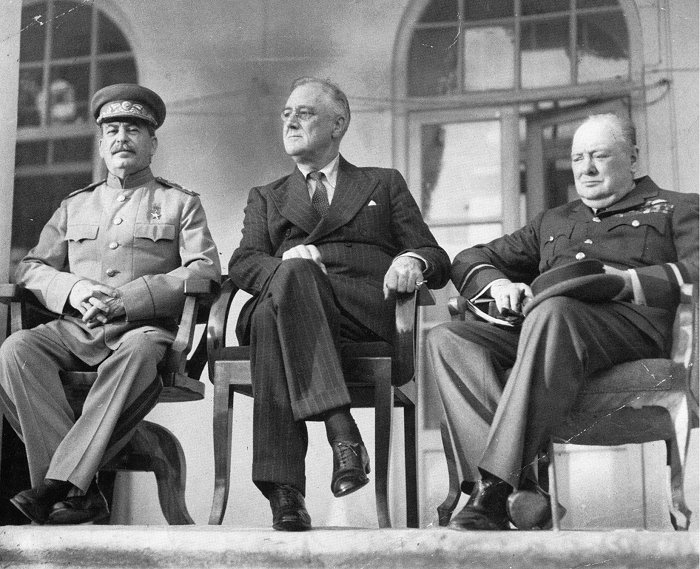 The Soviet squeeze upon Iran was initiated at the Tehran Conference, where Stalin, who is said to be unwilling to leave his territory,
entertained our rapidly declining President in the Soviet Embassy in a grandiose gesture insulting alike to the Iranians and to our staff in that country.
Stalin’s alleged reason that his embassy was the only safe spot was in truth an astute face-raising gesture before the peoples of Asia,
for he displayed Roosevelt, the symbolic Man of the West, held in virtual protective custody or house arrest by the Man of the East.
The Soviet squeeze upon Iran was initiated at the Tehran Conference, where Stalin, who is said to be unwilling to leave his territory,
entertained our rapidly declining President in the Soviet Embassy in a grandiose gesture insulting alike to the Iranians and to our staff in that country.
Stalin’s alleged reason that his embassy was the only safe spot was in truth an astute face-raising gesture before the peoples of Asia,
for he displayed Roosevelt, the symbolic Man of the West, held in virtual protective custody or house arrest by the Man of the East.
 Over all Stalin’s triumphs and Churchill’s defeats at Tehran was the shadow of the derricks of the Iranian oil fields. “Should the Abadan refineries
be shut down or their output flow in another direction, the result would be felt around the world. These refineries are the largest in the world,
processing 550,000 barrels a day” (monthly Newsletter of Representative Frances Bolton of Ohio, June, 1951). And what a sorry figure America has played
in this vital oil area from Tehran to 1951! “Our Government’s Deplorable Performance in Iran Has Contributed to a Great Disaster” was the sub-title of a
Life editorial, How to Lose a World” (May 21, 1951), on Acheson’s policy of doing nothing except “let the pieces settle” after the expected disaster
in the world’s greatest oil-producing area. In Iran or in an adjacent area, the Soviet may find it necessary to strike for
her gasoline and lubricants before any major attempts can be successful elsewhere.
Over all Stalin’s triumphs and Churchill’s defeats at Tehran was the shadow of the derricks of the Iranian oil fields. “Should the Abadan refineries
be shut down or their output flow in another direction, the result would be felt around the world. These refineries are the largest in the world,
processing 550,000 barrels a day” (monthly Newsletter of Representative Frances Bolton of Ohio, June, 1951). And what a sorry figure America has played
in this vital oil area from Tehran to 1951! “Our Government’s Deplorable Performance in Iran Has Contributed to a Great Disaster” was the sub-title of a
Life editorial, How to Lose a World” (May 21, 1951), on Acheson’s policy of doing nothing except “let the pieces settle” after the expected disaster
in the world’s greatest oil-producing area. In Iran or in an adjacent area, the Soviet may find it necessary to strike for
her gasoline and lubricants before any major attempts can be successful elsewhere.