CHAPTER THREE
The Federal Reserve Act
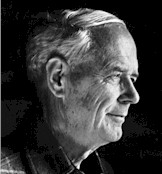
"Our financial system is a false one and a huge burden on the people . . . This Act establishes the most gigantic trust on earth."
--Congressman Charles Augustus Lindbergh, Sr.
The speeches of Senator LaFollette and Congressman Lindbergh became rallying points of opposition to the Aldrich Plan in 1912. They also
aroused popular feeling against the Money Trust. Congressman Lindbergh said, on December 15, 1911, "The government prosecutes other trusts, but supports
the money trust. I have been waiting patiently for several years for an opportunity to expose the false money standard, and to show that the greatest
of all favoritism is that extended by the government to the money trust."
Senator LaFollette publicly charged that a money trust of fifty men controlled the United States. George F. Baker, partner of J.P.
Morgan, on being queried by reporters as to the truth of the charge, replied that it was absolutely in error. He said that he knew from personal knowledge
that not more than eight men ran this country.
The Nation Magazine replied editorially to Senator LaFollette that "If there is a Money Trust, it will not be practical to establish that it
exercises its influence either for good or for bad."
Senator LaFollette remarks in his memoirs that his speech against the Money Trust later cost him the Presidency of the United States,
just as Woodrow Wilson’s early support of the Aldrich Plan had brought him into consideration for that office.
Congress finally made a gesture to appease popular feeling by appointing a committee to investigate the control of money and credit in the
United States. This was the Pujo Committee, a subcommittee of the House Banking and Currency Committee, which conducted the famous "Money Trust"
hearings in 1912, under the leadership of Congressman Arsene Pujo of Louisiana, who was regarded as a spokesman for the oil interests. These
hearings were deliberately dragged on for five months, and resulted in six-thousand pages of printed testimony in four volumes. Month after month,
the bankers made the train trip from New York to Washington, testified before the Committee and returned to New York. The hearings were extremely dull, and
no startling information turned up at these sessions. The bankers solemnly admitted that they were indeed bankers, insisted that they always operated in the
public interest, and claimed that they were animated only by the highest ideals of public service, like the Congressmen before whom they were
testifying.
The paradoxical nature of the Pujo Money Trust Hearings may better be understood if we examine the man who single-handedly carried on
these hearings, Samuel Untermyer. He was one of the principal contributors to Woodrow Wilson’s Presidential campaign fund, and was one of the wealthiest
corporation lawyers in New York. He states in his autobiography in "Who’s Who" of 1926 that he once received a $775,000 fee for a single legal transaction,
the successful merger of the Utah Copper Company and the Boston Consolidated and Nevada Company, a firm with a market value of one hundred million dollars.
He refused to ask either Senator LaFollette or Congressman Lindbergh to testify in the investigation which they alone had forced Congress to hold. As
Special Counsel for the Pujo Committee, Untermyer ran the hearings as a one-man operation. The Congressional members, including its chairman,
Congressman Arsene Pujo, seemed to have been struck dumb from the commencement of the hearings to their conclusion. One of these silent servants of the
public was Congressman James Byrnes, of South Carolina, representing Bernard Baruch’s home district, who later achieved fame as "Baruch’s man", and was
placed by Baruch in charge of the Office of War Mobilization during the Second World War.
Although he was a specialist in such matters, Untermyer did not ask any of the bankers about the system of interlocking directorates
through which they controlled industry. He did not go into international gold movements, which were known as a factor in money panics, or the international
relationships between American bankers and European bankers. The international banking houses of Eugene Meyer, Lazard Freres, J. & W. Seligman, Ladenburg
Thalmann, Speyer Brothers, M. M. Warburg, and the Rothschild Brothers did not arouse Samuel Untermyer’s curiosity, although it was well known in the New
York financial world that all of these family banking houses either had branches or controlled subsidiary houses in Wall Street. When Jacob Schiff
appeared before the Pujo Committee, Mr. Untermyer’s adroit questioning allowed Mr. Schiff to talk for many minutes without revealing any information about
the operations of the banking house of Kuhn Loeb Company, of which he was senior partner, and which Senator Robert L. Owen had identified as the
representative of the European Rothschilds in the United States.
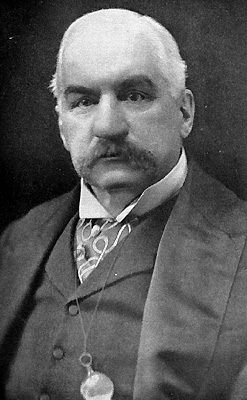
The aging J.P. Morgan, who had only a few more months to live, appeared before the Committee to justify his decades of international
financial deals. He stated for Mr. Untermyer’s edification that "Money is a commodity." This was a favorite ploy of the money creators, as they wished to
make the public believe that the creation of money was a natural occurrence akin to the growing of a field of corn, although it was
actually a bounty conferred upon the bankers by governments over which they had gained control.
J.P. Morgan also told the Pujo Committee that, in making a loan, he seriously considered only one factor, a man’s character; even the
man’s ability to repay the loan, or his collateral, were of little importance. This astonishing observation startled even the blasé members of the
Committee.
The farce of the Pujo Committee ended without a single well-known opponent of the money creators being allowed to appear or testify.
As far as Samuel Untermyer was concerned, Senator LaFollette and Congressman Charles Augustus Lindbergh had never existed. Nevertheless, these Congressmen
had managed to convince the people of the United States that the New York bankers did have a monopoly on the nation’s money and credit. At the close of
the hearings, the bankers and their subsidized newspapers claimed that the only way to break this monopoly was to enact the banking and currency
legislation now being proposed to Congress, a bill which would be passed a year later as the Federal Reserve Act. The press seriously demanded that the
New York banking monopoly be broken by turning over the administration of the new banking system to the most knowledgeable banker of them all, Paul
Warburg.
The Presidential campaign of 1912 records one of the more interesting political upsets in American history. The incumbent, William
Howard Taft, was a popular president, and the Republicans, in a period of general prosperity, were firmly in control of the government through a
Republican majority in both houses. The Democratic challenger, Woodrow Wilson, Governor of New Jersey, had no national recognition, and was a stiff, austere
man who excited little public support. Both parties included a monetary reform bill in their platforms: The Republicans were committed to the Aldrich Plan,
which had been denounced as a Wall Street plan, and the Democrats had the Federal Reserve Act. Neither party bothered to inform the public that the
bills were almost identical except for the names. In retrospect, it seems obvious that the money creators decided to dump Taft and go with Wilson. How
do we know this? Taft seemed certain of reelection, and Wilson would return to obscurity. Suddenly, Theodore Roosevelt "threw his hat into the ring." He
announced that he was running as a third party candidate, the "Bull Moose". His candidacy would have been ludicrous had it not been for the fact that he
was exceptionally well-financed. Moreover, he was given unlimited press coverage, more than Taft and Wilson combined. As a Republican ex-president, it
was obvious that Roosevelt would cut deeply into Taft’s vote. This proved the case, and Wilson won the election. To this day, no one can say what Theodore
Roosevelt’s program was, or why he would sabotage his own party. Since the bankers were financing all three candidates, they would win regardless of the outcome. Later
Congressional testimony showed that in the firm of Kuhn Loeb Company, Felix Warburg was supporting Taft, Paul Warburg and Jacob Schiff were supporting
Wilson, and Otto Kahn was supporting Roosevelt. The result was that a Democratic Congress and a Democratic President were elected in 1912 to get the
central bank legislation passed. It seems probable that the identification of the Aldrich Plan as a Wall Street operation predicted that it would have a
difficult passage through Congress, as the Democrats would solidly oppose it, whereas a successful Democratic candidate, supported by a Democratic Congress,
would be able to pass the central bank plan. Taft was thrown overboard because the bankers doubted he could deliver on the Aldrich Plan, and Roosevelt was
the instrument of his demise.
*The final electoral vote in 1912 was Wilson - 409; Roosevelt - 167; and Taft - 15.
To further confuse the American people and blind them to the real purpose of the proposed Federal Reserve Act, the architects of the
Aldrich Plan, powerful Nelson Aldrich, although no longer a senator, and Frank Vanderlip, president of the National City Bank, set up a hue and cry against
the bill. They gave interviews whenever they could find an audience denouncing the proposed Federal Reserve Act as inimical to banking and to good
government. The bugaboo of inflation was raised because of the Act’s provisions for printing Federal Reserve notes. The Nation, on October 23,
1913, pointed out, "Mr. Aldrich himself raised a hue and cry over the issue of government "fiat money", that is, money issued without gold or bullion back of
it, although a bill to do precisely that had been passed in 1908 with his own name as author, and he knew besides, that the ‘government’ had nothing to do
with it, that the Federal Reserve Board would have full charge of the issuing of such moneys."
Frank Vanderlip’s claims were so bizarre that Senator Robert L. Owen, chairman of the newly formed Senate Banking and Currency Committee,
which had been formed on March 18, 1913, accused him of openly carrying on a campaign of misrepresentation about the bill. The interests of the public, so
Carter Glass claimed in a speech on September 10, 1913 to Congress, would be protected by an advisory council of bankers. "There can be nothing sinister
about its transactions. Meeting with it at least four times a year will be a bankers’ advisory council representing every regional reserve district in the
system. How could we have exercised greater caution in safeguarding the public interests?"
Glass claimed that the proposed Federal Advisory Council would force the Federal Reserve Board of Governors to act in the best interest of the people.
Senator Root raised the problem of inflation, claiming that under the Federal Reserve Act, note circulation would always expand indefinitely, causing great inflation.
However, the later history of the Federal Reserve System showed that it not only caused inflation, but that the issue of notes could also be restricted, causing deflation,
as occurred from 1929 to 1939.
One of the critics of the proposed "decentralized" system was a lawyer from Cleveland, Ohio, Alfred Crozier: Crozier was called to testify
for the Senate Committee because he had written a provocative book in 1912, U.S. Money vs. Corporation Currency.(a) He attacked the Aldrich-Vreeland Act of
1908 as a Wall Street instrument, and he pointed out that when our government had to issue money based on privately owned securities, we were no longer a
free nation.
Crozier testified before the Senate Committee that, "It should prohibit the granting or calling in of loans for the purpose of influencing
quotation prices of securities and the contracting of loans or increasing interest rates in concert by the banks to influence public opinion or the
action of any legislative body. Within recent months, William McAdoo, Secretary of the Treasury of the United States was reported in the open press
as charging specifically that there was a conspiracy among certain of the large banking interests to put a contraction upon the currency and to raise
interest rates for the sake of making the public force Congress into passing currency legislation desired by those interests. The so-called administration
currency bill grants just what Wall Street and the big banks for twenty-five years have been striving for, that is, PRIVATE INSTEAD OF PUBLIC CONTROL OF
CURRENCY. It does this as completely as the Aldrich Bill. Both measures rob the government and the people of all effective control over the public’s
money, and vest in the banks exclusively the dangerous power to make money among the people scarce or plenty. The Aldrich Bill puts this power in one
central bank.
The Administration Bill puts it in twelve regional central banks, all owned exclusively by the identical private interests that would
have owned and operated the Aldrich Bank. President Garfield shortly before his assassination declared that whoever controls the supply of currency would
control the business and activities of the people. Thomas Jefferson warned us a hundred years ago that a private central bank issuing the public currency
was a greater menace to the liberties of the people than a standing army."
It is interesting to note how many assassinations of Presidents of the United States follow their concern with the issuing of
public currency; Lincoln with his Greenback, non-interest-bearing notes, and Garfield, making a pronouncement on currency problems just before he was
assassinated.
We now begin to understand why such a lengthy campaign of
planned deception was necessary, from the secret conference at Jekyll Island to the identical "reform" plans proposed by the Democratic
and Republican parties under different names. The bankers could not wrest control of the issuance of money from the citizens of the United
States, to whom it had been designated through its Congress by the Constitution, until the Congress granted them their monopoly for a central
bank. Therefore, much of the influence exerted to get the Federal Reserve Act passed was done behind the scenes, principally by two shadowy, non-elected
persons: The German immigrant, Paul Warburg, and Colonel Edward Mandell House of Texas.
Paul Warburg made an appearance before the House Banking and Currency Committee in 1913, in which he briefly stated his background: "I am a
member of the banking house of Kuhn, Loeb Company. I came over to this country in 1902, having been born and educated in the banking business in Hamburg,
Germany, and studied banking in London and Paris, and have gone all around the world. In the Panic of 1907, the first suggestion I made was ‘Let us get a
national clearing house.’ The Aldrich Plan contains some things which are simply fundamental rules of banking. Your aim in this plan (the Owen-Glass
bill) must be the same--centralizing of reserves, mobilizing commercial credit, and getting an elastic note issue."
Warburg’s phrase, "mobilization of credit" was an important one, because the First World War was due to begin shortly, and the first task
of the Federal Reserve System would be to finance the World War. The European nations were already bankrupt, because they had maintained large standing
armies for almost fifty years, a situation created by their own central banks, and therefore they could not finance a war. A central bank always imposes a
tremendous burden on the nation for "rearmament" and "defense", in order to create inextinguishable debt, simultaneously creating a military dictatorship
and enslaving the people to pay the "interest" on the debt which the bankers have artificially created.
In the Senate debate on the Federal Reserve Act, Senator Stone said on December 12, 1913,
"The great banks for years have sought to have and control agents in the Treasury to serve their purposes. Let me quote from this
World article, ‘Just as soon as Mr. McAdoo came to Washington, a woman whom the National City Bank had installed in the Treasury Department to get
advance information on the condition of banks, and other matters of interest to the big WallStreet group, was removed. Immediately the Secretary and the
Assistant Secretary, John Skelton Williams, were criticized severely by the agents of the Wall Street group.’" "I myself have known more than one occasion when bankers
refused credit to men who opposed their political views and purposes. When Senator Aldrich and others were going around the country exploiting this scheme,
the big banks of New York and Chicago were engaged in raising a munificent fund to bolster up the Aldrich propaganda. I have been told by bankers of my own state
that contributions to this exploitation fund had been demanded of them and that they had contributed because they were afraid of being blacklisted or boycotted.
There are bankers of this country who are enemies of the public welfare. In the past, a few great banks have followed policies and projects that have paralyzed the
industrial energies of the country to perpetuate their tremendous power over the financial and business industries of America."
Carter Glass states in his autobiography that he was summoned by Woodrow Wilson to the White House, and that Wilson told him he intended to
make the reserve notes obligations of the United States. Glass says, "I was for an instant speechless. I remonstrated. There is not any government
obligation here, Mr. President. Wilson said he had had to compromise on this point in order to save the bill."
The term "compromise" on this point came directly from Paul Warburg. Col. Elisha Ely Garrison, in Roosevelt,(b) Wilson and the Federal
Reserve Law wrote,
"In 1911, Lawrence Abbot, Mr. Roosevelt’s private officer at ‘The Outlook’ handed me a copy of the so-called Aldrich Plan for currency reform.
I said, I could not believe that Mr. Warburg was the author. This plan is nothing more than the Aldrich-Vreeland legislation which provided
for currency issue against securities. Warburg knows that as well as I do. I am going to see him at once and ask him about it. All right, the truth. Yes, I
wrote it, he said. Why? I asked. It was a compromise, answered Warburg." 13
Garrison says that Warburg wrote him on February 8, 1912.
"I have no doubt that at the end of a thorough discussion, either you will see it my way or I will see it yours--but I hope you will see it mine."
This was another famous Warburg saying when he secretly lobbied Congressmen to support his interest, the veiled threat that they
should "see it his way". Those who did not found large sums contributed to their opponents at the next elections, and usually went down in
defeat.
Col. Garrison, an agent of Brown Brothers bankers, later Brown Brothers Harriman, had entree everywhere in the financial community. He writes
of Col. House, "Col. House agreed entirely with the early writing of Mr. Warburg." Page 337, he quotes Col. House:
"I am also suggesting that the Central Board be increased from four members to five and their terms lengthened from eight to ten years.
This would give stability and would take away the power of a President to change the personnel of the board during a single term
of office."
House’s phrase, "take away the power of a President" is
significant, because later Presidents found themselves helpless to change the direction of the government because they did not have the power to change the
composition of the Federal Reserve Board to attain a majority on it during that President’s term of office. Garrison also wrote in this
book,
"Paul Warburg is the man who got the Federal Reserve Act together after the Aldrich Plan aroused such nationwide resentment and opposition. The
mastermind of both plans was Baron Alfred Rothschild of London."
Colonel Edward Mandell House(v) was referred to by Rabbi Stephen Wise in his autobiography, Challenging Years as "the unofficial Secretary of State".
House noted that he and Wilson knew that in passing the Federal Reserve Act, they had created an instrument more powerful than the Supreme
Court. The Federal Reserve Board of Governors actually comprised a Supreme Court of Finance, and there was no appeal from any of their rulings.
In 1911, prior to Wilson’s taking office as President, House had returned to his home in Texas and completed a book called Philip Dru, Administrator.
Ostensibly a novel, it was actually a detailed plan for the future government of the United States, "which would establish Socialism as
dreamed by Karl Marx", according to House. This "novel" predicted the enactment of the graduated income tax, excess profits tax, unemployment
insurance, social security, and a flexible currency system. In short, it was the blueprint which was later followed by the Woodrow Wilson and Franklin D.
Roosevelt administrations. It was published "anonymously" by B. W. Huebsch of New York, and widely circulated among government officials, who were left in
no doubt as to its authorship. George Sylvester Viereck, (d) who knew House for years, later wrote an account of the Wilson-House relationship, The Strangest
Friendship in History.14 In 1955, Westbrook Pegler, the Hearst columnist from 1932 to 1956, heard of the Philip Dru book and called Viereck to ask if he had
a copy. Viereck sent Pegler his copy of the book, and Pegler wrote a column about it, stating:
"One of the institutions outlined in Philip Dru is the Federal Reserve System. The Schiffs, the Warburgs, the Kahns, the Rockefellers
and Morgans put their faith in House. The Schiff, Warburg, Rockefeller and Morgan interests were personally represented in the mysterious
conference at Jekyll Island. Frankfurter landed on the Harvard law faculty, thanks to a financial contribution to Harvard by Felix Warburg and
Paul Warburg, and so we got Alger and Donald Hiss, Lee Pressman, Harry Dexter White and many other protégés of Little Weenie."(e)
House’s openly Socialistic views were forthrightly expressed in Philip Dru, Administrator; on pages 57-58, House wrote:
"In a direct and forceful manner, he pointed out that our civilization was fundamentally wrong, inasmuch, among other things, as it
restricted efficiency; that if society were properly organized, there would be none who were not sufficiently clothed and fed. The result, that the laws,
habits and ethical training in vogue were alike responsible for the inequalities in opportunity and the consequent wide difference between the few
and the many; that the results of such conditions was to render inefficient a large part of the population, the percentage differing in each country in the
ratio that education and enlightenment and unselfish laws bore to ignorance, bigotry and selfish laws."15
In his book, House (Dru) envisions himself becoming a dictator and forcing on the people his radical views, page 148: "They recognized the
fact that Dru dominated the situation and that a master mind had at last risen in the Republic." He now assumes the title of General. "General Dru announced
his purpose of assuming the powers of a dictator . . . they were assured that he was free from any personal ambition . . . he proclaimed himself
‘Administrator of the Republic.’" (f)
This pensive dreamer who imagined himself a dictator actually managed to place himself in the position of the confidential advisor to the
President of the United States, and then to have many of his desires enacted into law! On page 227, he lists some of the laws he wishes to enact as
dictator. Among them are an old age pension law, laborers insurance compensation, cooperative markets, a federal reserve banking system,
cooperative loans, national employment bureaus, and other "social legislation", some of which was enacted during Wilson’s administration, and
others during the Franklin D. Roosevelt’s administration. The latter was actually a continuation of the Wilson Administration, with many of the same personnel,
and with House guiding the administration from behind the scenes.
Like most of the behind-the-scenes operators in this book, Col. Edward Mandell House had the obligatory "London connection". Originally a
Dutch family, "Huis", his ancestors had lived in England for three hundred years, after which his father settled in Texas, where he made a fortune in
blockade-running during the Civil War, shipping cotton and other contraband to his British connections, including the Rothschilds, and bringing back supplies
for the beleaguered Texans. The senior House, not trusting the volatile Texas situation, prudently deposited all his profits from his blockade-running in
gold with Baring banking house in London (g). At the close of the Civil War, he was one of the wealthiest men in Texas. He named his son "Mandell" after one
of his merchant associates. According to Arthur Howden Smith, when House’s father died in 1880, his estate was distributed among his sons as follows:
Thomas William got the banking business; John, the sugar plantation; and Edward M. the cotton plantations, which brought him an income of $20,000 a
year.16
At the age of twelve, the young Edward Mandell House had brain fever, and was later further crippled by sunstroke. He was a semi-invalid, and
his ailments gave him an odd Oriental appearance. He never entered any profession, but used his father’s money to become the kingmaker of Texas
politics, successively electing five governors from 1893 to 1911. In 1911 he began to support Wilson for president, and threw the crucial Texas delegation
to him which ensured his nomination. House met Wilson for the first time at the Hotel Gotham, May 31, 1912.
In The Strangest Friendship In History, Woodrow Wilson and Col. House, by George Sylvester Viereck, Viereck writes:
"What," I asked House, "cemented your friendship?" "The identity of our temperaments and our public policies," answered House. "What was your
purpose and his?" "To translate into legislation certain liberal and progressive ideas."17
House told Viereck that when he went to Wilson at the White House, he handed him $35,000. This was exceeded only by the
$50,000 which Bernard Baruch had given Wilson.
The successful enactment of House’s programs did not escape the notice of other Wilson associates. In Vol. 1, page 157 of The Intimate
Papers of Col. House, House notes, "Cabinet members like Mr. Lane and Mr. Bryan commented upon the influence of Dru with the President. ‘All that the
book has said should be,’ wrote Lane, ‘comes about. The President comes to ‘Philip Dru’ in the end.’"18
House recorded some of his efforts on behalf of the Federal Reserve Act in The Intimate Papers of Col. House,
"December 19, 1912. I talked with Paul Warburg over the phone concerning currency reform. I told of my trip to Washington and what
I had done there to get it in working order. I told him that the Senate and the Congressmen seemed anxious to do what he desired, and that President-elect
Wilson thought straight concerning the issue." 19
Thus we have Warburg’s agent in Washington, Col. House, assuring him that the Senate and Congressmen will do what he desires, and that
the President-elect "thought straight concerning the issue." In this context, representative government seems to have ceased to exist. House continues in
his "Papers":
- "March 13, 1913. Warburg and I had an intimate discussion concerning currency reform.
- March 27, 1913. Mr. J.P. Morgan, Jr. and Mr. Denny of his firm came promptly at five.
- McAdoo came about ten minutes afterward. Morgan had a currency plan already printed. I suggested he have it typewritten, so it would not
seem too prearranged, and send it to Wilson and myself today.
- July 23, 1913. I tried to show Mayor Quincy (of Boston) the folly of the Eastern bankers taking
an antagonistic attitude towards the Currency Bill. I explained to Major Henry Higginson (h) with what care the bill had been framed. Just
before he arrived, I had finished a review by Professor Sprague of Harvard of Paul Warburg’s criticism of the Glass-Owen Bill, and will transmit it
to Washington tomorrow. Every banker known to Warburg, who knows the subject practically, has been called up about the making of the bill.
- October 13, 1913. Paul Warburg was my first caller today. He came to discuss the currency measure. There are many features of the
Owen-Glass Bill that he does not approve. I promised to put him in touch with McAdoo and Senator Owen so that he might discuss it with them.
- November 17, 1913. Paul Warburg telephoned about his trip to Washington. Later, he and Mr. Jacob Schiff came over for a few minutes.
Warburg did most of the talking. He had a new suggestion in regard to grouping the regular reserve banks so as to get the units welded together
and in easier touch with the Federal Reserve Board."
George Sylvester Viereck in The Strangest Friendship in History, Woodrow Wilson and Col. House wrote: "The Schiffs, the Warburgs, the
Kahns, the Rockefellers, the Morgans put their faith in House. When the Federal Reserve legislation at last assumed definite shape, House was the
intermediary between the White House and the financiers." 20
On page 45, Viereck notes, "Col. House looks upon the reform of the monetary system as the crowning internal achievement of the Wilson Administration."21
The Glass Bill (the House version of the final Federal Reserve Act) had passed the House on September 18, 1913 by 287 to 85. On December 19,
1913, the Senate passed their version by a vote of 54-34. More than forty important differences in the House and Senate versions remained to be settled,
and the opponents of the bill in both houses of Congress were led to believe that many weeks would yet elapse before the Conference bill would be ready for
consideration. The Congressmen prepared to leave Washington for the annual Christmas recess, assured that the Conference bill would not be brought up
until the following year. Now the money creators prepared and executed the most brilliant stroke of their plan. In a single day, they ironed out all
forty of the disputed passages in the bill and quickly brought it to a vote. On Monday, December 22, 1913, the bill was passed by the House 282-60 and the
Senate 43-23.
On December 21, 1913, The New York Times commented editorially on the act, "New York will be on a firmer basis of financial growth, and we
shall soon see her the money centre of the world."
The New York Times reported on the front page, Monday, December 22, 1913 in headlines: MONEY BILL MAY BE LAW TODAY -- CONFEREES HAD
ADJUSTED NEARLY ALL DIFFERENCES AT 1:30 THIS MORNING -- NO DEPOSIT GUARANTEES -- SENATE YIELDS ON THIS POINT BUT PUTS THROUGH MANY OTHER CHANGES "
With almost unprecedented speed, the conference to adjust the House and Senate differences on the Currency Bill practically completed its labours
early this morning. On Saturday the Conferees did little more than dispose of the preliminaries, leaving forty essential differences to be thrashed out
Sunday. . . . No other legislation of importance will be taken up in either House of Congress this week. Members of both houses are already preparing to leave Washington."
"Unprecedented speed", says The New York Times. One sees the fine hand of Paul Warburg in this final strategy. Some of the bill’s most
vocal critics had already left Washington. It was a long-standing political courtesy that important legislation would not be acted upon during the week
before Christmas, but this tradition was rudely shattered in order to perpetrate the Federal Reserve Act on the American people.
The Times buried a brief quote from Congressman Lindbergh that "the bill would establish the most gigantic trust on earth," and quoted
Representative Guernsey of Maine, a Republican on the House Banking and Currency Committee, that "This is an inflation bill, the only question being
the extent of the inflation."
Congressman Lindbergh said on that historic day, to the House:
"This Act establishes the most gigantic trust on earth. When the President signs this bill, the invisible government by the Monetary Power will be legalized.
The people may not know it immediately, but the day of reckoning is only a few years removed. The trusts will soon realize that they have gone too far even for their own
good. The people must make a declaration of independence to relieve themselves from the Monetary Power. This they will be able to do by taking control of
Congress. Wall Streeters could not cheat us if you Senators and Representatives did not make a humbug of Congress. . . . If we had a people’s
Congress, there would be stability.
The greatest crime of Congress is its currency system. The worst legislative crime of the ages is perpetrated by this banking bill.
The caucus and the party bosses have again operated and prevented the people from getting the benefit of their own government."
The December 23, 1913 New York Times editorially commented, in contrast to Congressman Lindbergh’s criticism of the bill, "The Banking and
Currency Bill became better and sounder every time it was sent from one end of the Capitol to the other. Congress worked under public supervision in making
the bill."
By "public supervision", The Times apparently meant Paul Warburg, who for several days had maintained a small office in the Capitol
building, where he directed the successful pre-Christmas campaign to pass the bill, and where Senators and Congressmen came hourly at his bidding to carry
out his strategy.
The "unprecedented speed" with which the Federal Reserve Act had been passed by Congress during what became known as "the Christmas massacre" had one unforeseen aspect.
Woodrow Wilson was taken unaware, as he, like many others, had been assured the bill would not come up for a vote until after Christmas.
Now he refused to sign it, because he objected to the provisions for the selection of Class B. Directors. William L. White relates
in his biography of Bernard Baruch that Baruch, a principal contributor to Wilson’s campaign fund, was stunned when he was informed that Wilson refused
to sign the bill. He hurried to the White House and assured Wilson that this was a minor matter, which could be fixed up later through "administrative processes". The
important thing was to get the Federal Reserve Act signed into law at once. With this reassurance, Wilson signed the Federal Reserve Act on December 23, 1913.
History proved that on that day, the Constitution ceased to be the governing covenant of the American people, and our liberties were handed over
to a small group of international bankers.
The December 24, 1913 New York Times carried a front page headline "WILSON SIGNS THE CURRENCY BILL!" Below it, also in capital letters,
were two further headlines, "PROSPERITY TO BE FREE" and "WILL HELP EVERY CLASS". Who could object to any law which provided benefits to everyone? The
Times described the festive atmosphere while Wilson’s family and government officials watched him sign the bill. "The Christmas spirit pervaded the
gathering," exulted The Times.
In his biography of Carter Glass, Rixey Smith states that those present at the signing of the bill included Vice President Marshall,
Secretary Bryan, Carter Glass, Senator Owen, Secretary McAdoo, Speaker Champ Clark, and other Treasury officials. None of the real writers of the bill, the
draftees of Jekyll Island, were present. They had prudently absented themselves from the scene of their victory. Rixey Smith also wrote, "It was as
though Christmas had come two days early."
On December 24, 1913, Jacob Schiff wrote to Col. House,
"My dear Col. House. I want to say a word to you for the silent, but no doubt effective work you have done in the interest of currency legislation and to congratulate you
that the measure has finally been enacted into law. I am with good wishes, faithfully yours, JACOB SCHIFF."
Representative Moore of Kansas, in commenting on the passage of the Act, said to the House of Representatives:
"The President of the United States now becomes the absolute dictator of all the finances of the country. He appoints a controlling board of seven men, all of whom belong to
his political party, even though it is a minority. The Secretary of the Treasury is to rule supreme whenever there is a difference of opinion between
himself and the Federal Reserve Board. AND, only one member of the Board is to pass out of office while the President is in office."
The ten year terms of office of the members of the Board were lengthened by the Banking Act of 1935 to fourteen years, which meant that
these directors of the nation’s finances, although not elected by the people, held office longer than three presidents.
While Col. House, Jacob Schiff and Paul Warburg basked in the glow of a job well done, the other actors in this drama were subject to later
afterthoughts. Woodrow Wilson wrote in 1916, National Economy and the Banking System, Sen. Doc. No. 3, No. 223, 76th Congress, 1st session, 1939: "Our
system of credit is concentrated (in the Federal Reserve System). The growth of the nation, therefore, and all our activities, are in the hands of a few men."
When he was asked by Clarence W. Barron whether he approved of the bill as it was finally passed. Warburg remarked, "Well, it hasn’t got
quite everything we want, but the lack can be adjusted later by administrative processes."
Woodrow Wilson and Carter Glass are given credit for the Act by most contemporary historians, but of all those concerned, Wilson had least
to do with Congressional action on the bill. George Creel, a veteran Washington correspondent, wrote in Harper’s Weekly, June 26, 1915:
"As far as the Democratic Party was concerned, Woodrow Wilson was without influence, save for the patronage he possessed. It was Bryan who whipped Congress into line on the
tariff bill, on the Panama Canal tolls repeal, and on the currency bill." Mr.Bryan later wrote, "That is the one thing in my public career that I regret --
my work to secure the enactment of the Federal Reserve Law."
On December 25, 1913, The Nation pointed out that "The New York Stock Market began to rise steadily upon news that the Senate was ready
to pass the Federal Reserve Act."
This belies the claim that the Federal Reserve Act was a monetary reform bill. The New York Stock Exchange is generally considered an
accurate barometer of the true meaning of any financial legislation passed in Washington. Senator Aldrich also decided that he no longer had misgivings
about the Federal Reserve Act. In a magazine which he owned, and which he called The Independent, he wrote in July, 1914: "Before the passage of this
Act, the New York bankers could only dominate the reserves of New York. Now we are able to dominate the bank reserves of the entire country."
H.W. Loucks denounced the Federal Reserve Act in The Great Conspiracy of the House of Morgan,
"In the Federal Reserve Law, they have wrested from the people and secured for themselves the constitutional power to issue money and regulate the value
thereof." On page 31, Loucks writes, "The House of Morgan is now in supreme control of our industry, commerce and political affairs. They are
in complete control of the policy making of the Democratic, Republican and Progressive parties. The present extraordinary propaganda for ‘preparedness’
is planned more for home coercion than for defense against foreign aggression." 22
The signing of the Federal Reserve Act by Woodrow Wilson represented the culmination of years of collusion with his intimate friend,
Col. House, and Paul Warburg. One of the men with whom House became acquainted in the Wilson Administration was Franklin D.Roosevelt, Assistant Secretary of Navy.
As soon as he obtained the Democratic nomination for President, in 1932, Franklin D. Roosevelt made a "pilgrimage" to Col. House’s home at Magnolia, Mass.
Roosevelt, after the Republican hiatus of the 1920s, filled in the goals of Philip Dru, Administrator, 23 which Wilson had not been able to carry out. The late
Roosevelt achievements included the enactment of the social security program, excess profits tax, and the expansion of the graduated income tax to 90% of
earned income.
House’s biographer, Charles Seymour, wrote: "He was wearied by the details of party politics and appointments. Even the share he had taken in constructive
domestic legislation (the Federal Reserve Act, tariff revision, and the Income Tax amendment) did not satisfy him. From the beginning of 1914 he gave more
and more of his time to what he regarded as the highest form of politics and that for which he was particularly suited -- international
affairs." 24
In 1938, shortly before he died, House told Charles Seymour, "During the last fifteen years I have been close to the center of things,
although few people suspect it. No important foreigner has come to the United States without talking to me. I was close to the movement that nominated
Roosevelt. He has given me a free hand in advising him. All the Ambassadors have reported to me frequently."
A comparative print of the Federal Reserve Act of 1913 as passed by the House of Representatives and amended by the Senate shows the
following striking change:
The Senate struck out, "To suspend the officials of Federal Reserve banks for cause, stated in writing with opportunity of hearing,
require the removal of said official for incompetency, dereliction of duty, fraud or deceit, such removal to be subject to approval by the President of
the United States." This was changed by the Senate to read "To suspend or remove any officer or director of any Federal Reserve Bank, the cause of such
removal to be forthwith communicated in writing by the Federal Reserve Board to the removed officer or director and to said bank." This completely altered
the conditions under which an officer or director might be removed. We no longer know what the conditions for removal are, or the cause. Apparently
incompetency, dereliction of duty, fraud or deceit do not matter to the Federal Reserve Board. Also, the removed officer does not have the opportunity
of appeal to the President. In answer to written inquiry, the Assistant Secretary of the Federal Reserve Board replied that only one officer has been
removed "for cause" in the thirty-six years, the name and details of this matter being a "private concern" between the individual, the Reserve Bank
concerned, and the Federal Reserve Board.
The Federal Reserve System began its operations in 1914 with the activity of the Organization Committee, appointed by Woodrow Wilson, and
composed of Secretary of the Treasury William McAdoo, who was his son-in-law, Secretary of Agriculture Houston and Comptroller of the Currency John Skelton
Williams.wbr>
On January 6, 1914. J.P. Morgan met with the Organizing Committee in New York. He informed them that there should not be more than
seven regional districts in the new system.
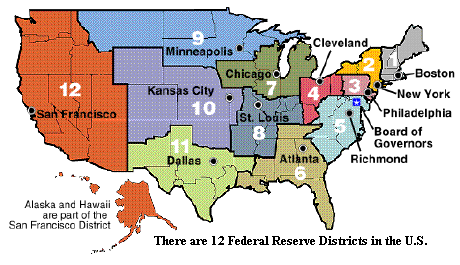
This committee was to select the locations of the "decentralized" reserve banks. They were empowered to select from eight to twelve reserve banks,
although J.P. Morgan had testified he thought that not more than four should be selected. Much politicking went into the selection of
these sites, as the twelve cities thus favored would become enormously important as centers of finance. New York, of course, was a foregone
conclusion. Richmond was the next selection, as a payoff to Carter Glass and Woodrow Wilson, the two Virginians who had been given political credit for the
Federal Reserve Act. The other selections of the Committee were Boston, Philadelphia, Cleveland, Chicago, St. Louis, Atlanta, Dallas, Minneapolis,
Kansas City, and San Francisco. All of these cities later developed important "financial districts" as the result of this selection.
These local battles, however, paled in view of the complete dominance of the Federal Reserve bank of New York in the system. Ferdinand
Lundberg pointed out, in America’s Sixty Families, that, "In practice, the Federal Reserve Bank of New York became the fountainhead of the system of
twelve regional banks, for New York was the money market of the nation. The other eleven banks were so many expensive mausoleums erected to salve the
local pride and quell the Jacksonian fears of the hinterland. Benjamin Strong, president of the Bankers Trust (J.P. Morgan) was selected as the first
Governor of the New York Federal Reserve Bank. Adept in high finance, Strong for many years manipulated the country’s monetary system at the discretion of
directors representing the leading New York banks. Under Strong, the Reserve System was brought into interlocking relations with the Bank of England and
the Bank of France. Benjamin Strong held his position as Governor of the Federal Reserve Bank of New York until his sudden death in 1928, during a
Congressional investigation of the secret meetings between Reserve Governors and heads of European central banks which brought on the Great
Depression of 1929-31."25
Strong had married the daughter of the President of Bankers Trust, which brought him into the line of succession in the dynastic intrigues
which play such an important role in the world of high finance. He also had been a member of the original Jekyll Island group, the First Name Club, and
was thus qualified for the highest position in the Federal Reserve System, as the Governor of the Federal Reserve Bank of New York which dominated the
entire system.
Paul Warburg also is mentioned in J. Laurence Laughlin’s definitive volume, The Federal Reserve Act, Its Origins and Purposes,
"Mr. Paul Warburg of Kuhn, Loeb Company offered in March, 1910 a fairly well thought out plan to be known as the United Reserve Bank of the United States. This was published in
The New York Times of March 24, 1910. The group interested in the purposes of the National Monetary Commission met secretly at Jekyll Island for about two
weeks in December, 1910, and concentrated on the preparation of a bill to be presented to Congress by the National Monetary Commission. The men who were
present at Jekyll Island were Senator Aldrich, H. P. Davison of J.P. Morgan Company, Paul Warburg of Kuhn, Loeb Company, Frank Vanderlip of the National
City Bank, and Charles D. Norton of the First National Bank. No doubt the ablest banking mind in the group was that of Mr. Warburg, who had had a
European banking training. Senator Aldrich had no special training in banking." 26
A mention of Paul Warburg, written by Harold Kelloch, and titled, "Warburg the Revolutionist" appeared in the Century Magazine, May, 1915. Kelloch writes:
"He imposed his ideas on a nation of a hundred million people . . . Without Mr. Warburg there would have been no Federal Reserve Act. The banking house of Warburg and
Warburg in Hamburg has always been strictly a family business. None but a Warburg has been eligible for it, but all Warburgs have been born into it. In
1895 he married the daughter of the late Solomon Loeb of Kuhn Loeb Company. He became a member of Kuhn Loeb Company in 1902. Mr. Warburg’s salary
from his private business has been approximately a half million a year. Mr. Warburg’s motives had been purely those of patriotic self-sacrifice."
The true purposes of the Federal Reserve Act soon began to disillusion many who had at first believed in its claims. W. H. Allen wrote in Moody’s Magazine,
1916, "The purpose of the Federal Reserve Act was to prevent concentration of money in the New York banks by making it profitable for country bankers
to use their funds at home, but the movement of currency shows that the New York banks gained from the interior in every month except December, 1915,
since the Act went into effect. The stabilization of rates has taken place in New York alone. In other parts, high rates continue. The Act, which was to
deprive Wall Street of its funds for speculation, has really given the bulls and the bears such a supply as they have never had before. The truth is that
far from having clogged the channel to Wall Street, as Mr. Glass so confidently boasted, it actually widened the old channels and opened up two
new ones. The first of these leads directly to Washington and gives Wall Street a string on all the surplus cash in the United States Treasury.
Besides, in the power to issue bank-note currency, it furnishes an inexhaustible supply of credit money; the second channel leads to the great
central banks of Europe, whereby, through the sale of acceptances, virtually guaranteed by the United States Government, Wall Street is granted immunity
from foreign demands for gold which have precipitated every great crisis in our history."
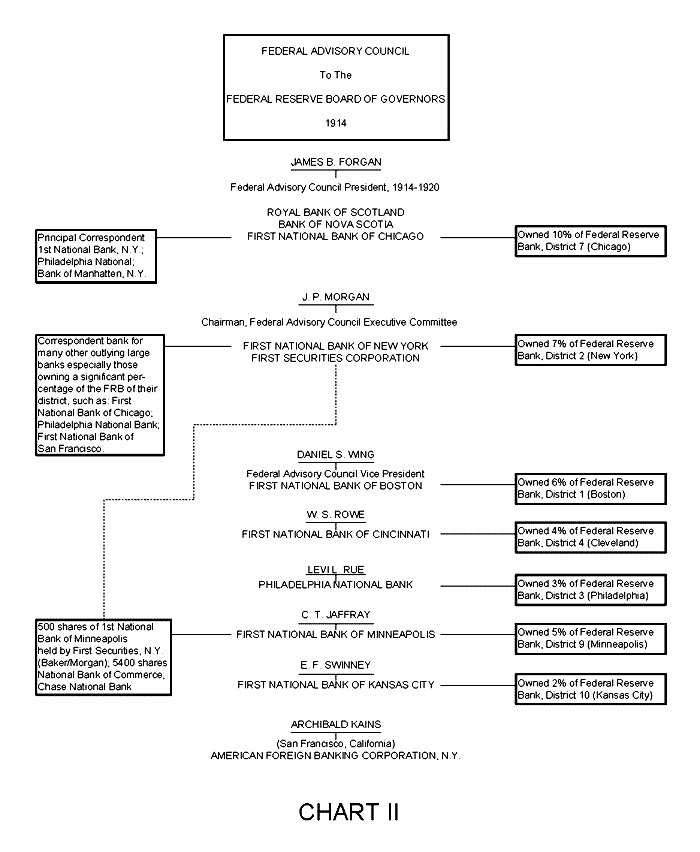
For many years, there has been considerable mystery about who actually owns the stock of the Federal Reserve Banks. Congressman Wright
Patman, leading critic of the System, tried to find out who the stockholders were. The stock in the original twelve regional Federal Reserve Banks was
purchased by national banks in those twelve regions. Because the Federal Reserve Bank of New York was to set the interest rates and direct open market
operations, thus controlling the daily supply and price of money throughout the United States, it is the stockholders of that bank who are the real
directors of the entire system. For the first time, it can be revealed who those stockholders are. This writer has the original organization certificates
of the twelve Federal Reserve Banks, giving the ownership of shares by the national banks in each district. The Federal Reserve Bank of New York issued
203,053 shares, and, as filed with the Comptroller of the Currency May 19, 1914, the large New York City banks took more than half of the outstanding
shares. The Rockefeller Kuhn, Loeb-controlled National City Bank took the largest number of shares of any bank, 30,000 shares. J.P. Morgan’s First
National Bank took 15,000 shares. When these two banks merged in 1955, they owned in one block almost one fourth of the shares in the Federal Reserve Bank
of New York, which controlled the entire system, and thus they could name Paul Volcker or anyone else they chose to be Chairman of the Federal Reserve Board
of Governors. Chase National Bank took 6,000 shares. The Marine Nation Bank of Buffalo, later known as Marine Midland, took 6,000 shares. This bank was owned
by the Schoellkopf family, which controlled Niagara Power Company and other large interests. National Bank of Commerce of New York City took 21,000
shares. The shareholders of these banks which own the stock of the Federal Reserve Bank of New York are the people who have controlled our political and
economic destinies since 1914. They are the Rothschilds, of Europe, Lazard Freres (Eugene Meyer), Kuhn Loeb Company, Warburg Company, Lehman
Brothers, Goldman Sachs, the Rockefeller family, and the J.P. Morgan interests. These interests have merged and consolidated in recent years, so
that the control is much more concentrated. National Bank of Commerce is now Morgan Guaranty Trust Company. Lehman Brothers has merged with Kuhn, Loeb
Company, First National Bank has merged with the National City Bank, and in the other eleven Federal Reserve Districts, these same shareholders indirectly
own or control shares in those banks, with the other shares owned by the leading families in those areas who own or control the principal industries in
these regions.(i) The "local" families set up regional councils, on orders from New York, of such groups as the Council on Foreign Relations, The Trilateral
Commission, and other instruments of control devised by their masters. They finance and control political developments in their area, name candidates, and
are seldom successfully opposed in their plans.
With the setting up of the twelve "financial districts" through the Federal Reserve Banks, the traditional division of the United
States into the forty-eight states was overthrown, and we entered the era of "regionalism", or twelve regions which had no relation to the traditional
state boundaries.
These developments following the passing of the Federal Reserve Act proved every one of the allegations Thomas Jefferson had made
against a central bank in 1791: that the subscribers to the Federal Reserve Bank stock had formed a corporation, whose stock could be and was held by
aliens; that this stock would be transmitted to a certain line of successors; that it would be placed beyond forfeiture and escheat; that they would receive
a monopoly of banking, which was against the laws of monopoly; and that they now had the power to make laws, paramount to the laws of the states. No state
legislature can countermand any of the laws laid down by the Federal Reserve Board of Governors for the benefit of their private stockholders. This board
issues laws as to what the interest rate shall be, what the quantity of money shall be and what the price of money shall be. All of these powers abrogate
the powers of the state legislatures and their responsibility to the citizens of those states.
The New York Times stated that the Federal Reserve Banks would be ready for business on August 1, 1914, but they actually began operations on
November 16, 1914. At that time, their total assets were listed at $143,000,000, from the sale of shares in the Federal Reserve Banks to
stockholders of the national banks which subscribed to it.
The actual part of this $143,000,000 which was paid in for these shares remains shrouded in mystery. Some historians believe that the
shareholders only paid about half of the amount in cash; others believe that they paid in no cash at all, but merely sent in checks
which they drew on the national banks which they owned. This seems most likely, that from the very outset, the Federal Reserve operations were "paper
issued against paper", that bookkeeping entries comprised the only values which changed hands.
The men whom President Woodrow Wilson chose to make up the first Federal Reserve Board of Governors were men drawn from the banking
group. He had been nominated for the Presidency by the Democratic Party, which had claimed to represent the "common man" against the "vested interests".
According to Wilson himself, he was allowed to choose only one man for the Federal Reserve Board. The others were chosen by the New York bankers.
Wilson’s choice was Thomas D. Jones, a trustee of Princeton and director of International Harvester and other corporations. The other members were Adolph
C. Miller, economist from Rockefeller’s University of Chicago and Morgan’s Harvard University, and also serving as Assistant Secretary of the Interior;
Charles S. Hamlin, who had served previously as an Assistant Secretary to the Treasury for eight years; F.A. Delano, a Roosevelt relative, and railroad
operator who took over a number of railroads for Kuhn, Loeb Company, W.P.G. Harding, President of the First National Bank of Atlanta; and Paul Warburg of
Kuhn, Loeb Company. According to The Intimate Papers of Col. House, Warburg was appointed because "The President accepted (House’s) suggestion of Paul
Warburg of New York because of his interest and experience in currency problems under both Republican and Democratic Administrations."27 Like
Warburg, Delano had also been born outside the continental limits of the United States, although he was an American citizen. Delano’s father, Warren
Delano, according to Dr. Josephson and other authorities, was active in Hong Kong in the Chinese opium trade, and Frederick Delano was born in Hong Kong in
1863.
In The Money Power of Europe, Paul Emden writes that "The Warburgs reached their outstanding eminence during the last twenty years of
the past century, simultaneously with the growth of Kuhn, Loeb Company in New York, with whom they stood in a personal union and family relationship. Paul
Warburg with magnificent success carried through in 1913 the reorganization of the American banking system, at which he had with Senator Aldrich been working
since 1911, and thus most thoroughly consolidated the currency and finances of the United States."28
The New York Times (j) had noted on May 6, 1914 that Paul Warburg had "retired" from Kuhn, Loeb Company in order to serve on the Federal Reserve
Board, although he had not resigned his directorships of American Surety Company, Baltimore and Ohio Railroad, National Railways of Mexico, Wells
Fargo, or Westinghouse Electric Corporation, but would continue to serve on these boards of directors. "Who’s Who" listed him as holding these
directorships and in addition, American I.G. Chemical Company (branch of I.G. Farben), Agfa Ansco Corporation, Westinghouse Acceptance Company, Warburg
Company of Amsterdam, chairman of the Board of International Acceptance Bank, and numerous other banks, railways and corporations. "Kuhn Loeb & Co. with
Warburg have four votes or the majority of the Federal Reserve Board."29
Despite his retirement from Kuhn, Loeb Company in May of 1914 to serve on the Federal Reserve Board of Governors, Warburg was asked to
appear before a Senate Subcommittee in June of 1914 and answer some questions about his behind-the-scenes role in getting the Federal Reserve Act through
Congress. This might have meant some questions about the secret conference in Jekyll Island, and Warburg refused to appear. On July 7, 1914 he wrote a
letter to G.M. Hitchcock, Chairman of the Senate Banking and Currency Committee, stating that it might impair his usefulness on the Board if he were
required to answer any questions, and that he would therefore withdraw his name. It seemed that Warburg was prepared to bluff the Senate Committee into
confirming him without any questions asked. On July 10, 1914, The New York Times defended Warburg on the editorial page and denounced the "Senatorial
Inquisition". Since Warburg had not yet been asked any questions, the term "Inquisition" seemed remarkably inappropriate, nor was there any real danger
that the Senators were preparing to use instruments of torture on Mr. Warburg. The imbroglio was resolved when the Senate Committee, in abject surrender,
agreed that Mr. Warburg would be given a list of questions in advance of his appearance so that he could go over them, and that he could be excused from
answering any questions which might tend to impair his service on the Board of Governors. The Nation reported on July 23, 1914 that "Mr. Warburg finally had
a conference with Senator O’Gorman and agreed to meet the members of the Senate Subcommittee informally, with a view to coming to an understanding, and
to giving them any reasonable information they might desire. The opinion in
Washington is that Mr. Warburg’s confirmation is assured." The Nation was correct. Mr. Warburg was confirmed, the way having been
smoothed by his "fixer", Senator O’Gorman of New York, more familiarly known as "the Senator from Wall Street". Senator Robert L. Owen had previously
charged that Warburg was the American representative of the Rothschild family, but questioning him about this would indeed have smacked of the mediaeval
"Inquisition", and his fellow Senators were too civilized to indulge in such
barbarity (k).
During the Senate Hearings on Paul Warburg before the Senate Banking and Currency Committee, August 1, 1914, Senator Bristow asked, "How
many of these partners (of Kuhn, Loeb Company) are American citizens?" WARBURG: "They are all American citizens except Mr. Kahn. He is a British
subject." BRISTOW: "He was at one time a candidate for Parliament, was he not?" WARBURG: "There was talk about it, it had been suggested and he had it
in his mind."
Paul Warburg also stated to the Committee, "I went to England, where I stayed for two years, first in the banking and discount firm of Samuel
Montague & Company. After that I went to France, where I stayed in a French bank."
CHAIRMAN: "What French bank was that?" WARBURG: "It is the Russian bank for foreign trade which has an agency in Paris."
BRISTOW: "I understand you to say that you were a Republican, but when Mr. Theodore Roosevelt came around, you then became a sympathizer
with Mr. Wilson and supported him?" WARBURG: "Yes." BRISTOW: "While your brother (Felix Warburg) was supporting Taft?" WARBURG: "Yes." Thus three
partners of Kuhn, Loeb Company were supporting three different candidates for President of the United States. Paul Warburg was supporting Wilson, Felix
Warburg was supporting Taft, and Otto Kahn was supporting Theodore Roosevelt. Paul Warburg explained this curious situation by telling the Committee that
they had no influence over each other’s political beliefs, "as finance and politics don’t mix."
Questions about Warburg’s appointment vanished in a hue and cry with Wilson’s sole appointment to the Board of Governors, Thomas B. Jones.
Reporters had discovered that Jones, at the time of his appointment, was under indictment by the Attorney General of the United States. Wilson leaped to the
defense of his choice, telling reporters that "The majority of the men connected with what we have come to call ‘big business’ are honest,
incorruptible and patriotic." Despite Wilson’s protestations, the Senate Banking and Currency Committee scheduled hearings on the fitness of Thomas D. Jones
to be a member of the Board of Governors. Wilson then wrote a letter to Senator Robert L. Owen, Chairman of that Committee:
White House
June 18, 1914
Dear Senator Owen:
Mr. Jones has always stood for the rights of the people against the rights of privilege.
His connection with the Harvester Company was a
public service, not a private interest. He is the one man of the whole
number who was in a peculiar sense my personal choice.
Sincerely,
Woodrow
Wilson
Woodrow Wilson said, "There is no reason to believe that the
unfavorable report represents the attitude of the Senate itself." After
several weeks, Thomas D. Jones withdrew his name, and the country had to do
without his services.
The other members of the first Board of Governors were
Secretary of the Treasury, William McAdoo, Wilson’s son-in-law, and President
of the Hudson-Manhattan Railroad, a Kuhn, Loeb Company controlled enterprise,
and Comptroller of the Currency John Skelton Williams.
When the Federal Reserve Banks were opened for business on
November 16, 1914, Paul Warburg said, "This date may be considered as the
Fourth of July in the economic history of the United States."
- (a) Crozier’s book exposed the financiers plan to substitute "corporation currency" for the lawful money of the U.S. as guaranteed by
Article I, Sec. 8 Para. 5, of the Constitution.
- (b) Theodore Roosevelt
- 13 Elisha Ely Garrison, Roosevelt, Wilson and the Federal Reserve Law, Christopher Publications, Boston, 1931
- (c)See House note in "Biographies"
- (d) See Viereck note in "Biographies"
- 14 George Sylvester Viereck, The Strangest Friendship in History, Woodrow Wilson and Col. House, Liveright, New York, 1932
(e) The present writer was with Viereck in his suite at the Hotel Belleclaire when Pegler called and asked for the book. Viereck sent it over by
his secretary. He grinned and said Pegler seemed very excited. "He ought to get a good column out of that," Viereck told me. Indeed Pegler did get a good
column out of it. Unfortunately for him, he had gone too far in mentioning the Warburgs. As long as he confined his attacks to La Grand Bouche (Eleanor
Roosevelt), and her spouse, he had been permitted to continue, but now that he had exposed the Warburg connection with the Communist spy ring in Washington,
his column was immediately dropped by the big city dailies, and Pegler’s long run was over.
- 15 Col. Edward M. House, Philip Dru, Administrator, B. W. Heubsch, New York, 1912.
(f)This quotation from Philip Dru, Administrator, written by Col. House in 1912, is included here to show his totalitarian Marxist philosophy.
House was to become for 8 years with Wilson, the President’s closest advisor. Later he continued his influence in the Franklin D. Roosevelt administration.
From his home in Magnolia, Mass., House advised FDR through frequent trips of Felix Frankfurter to the White House. Frankfurter was later appointed to the Supreme Court by
F.D.R.
(g) Dope, Inc., identifies Barings as follows: "Baring Brothers, the premier merchant bank of the opium trade from 1783 to the present day, also
maintained close contact with the Boston families . . . The group’s leading banker became, at the close of the 19th century, the House of Morgan
which also took its cut in Eastern opium traffic . . . Morgan’s Far Eastern operations were the officially conducted British opium traffic . . . Morgan’s case deserves
special scrutiny from American police and regulatory agencies, for the intimate associations of Morgan Guaranty Trust with the identified leadership
of the British dope banks."
- 16 Arthur Howden Smith, The Real Col. House, Doran Company, New York, 1918
- 17 George Sylvester Viereck, The Strangest Friendship in History, Woodrow Wilson and Col. House, Liveright, New York, 1932
- 18 Col. Edward Mandell House, The Intimate Papers of Col. House, edited by Charles Seymour, Houghton Mifflin Co., 1926-28, Vol. 1, p. 157
- 19 Ibid. Vol. 1, p. 163
- (h) The most prominent banker in Boston.
- 20 George Sylvester Viereck, The Strangest Friendship In History, Woodrow Wilson and Col. House, Liveright, New York, 1932
- 21 Ibid.
- 22 H.W. Loucks, The Great Conspiracy of the House of Morgan, Privately printed, 1916
- 23 E.M. House, Philip Dru, Administrator, B. W. Heubsch, N.Y., 1912
- 24 Col. E.M. House, The Intimate Papers of Col. House, 4 v. 1926-1928, Houghton Mifflin Co.
- 25 Ferdinand Lundberg, America’s Sixty Families, 1937
- 26 J. Laurence Laughlin, The Federal Reserve Act, It’s Origins and Purposes
- (i) See charts V through IX
- 27 Charles Seymour, The Intimate Papers of Col. House, 4 v. 1926-1928, Houghton Mifflin Co.
- 28 Paul Emden, The Money Power of Europe in the 19th and 20th Century, S. Low, Marston Co., London, 1937
- (j) The New York Times April 30, 1914, reported that the 12 districts had subscriptions of $74,740,800 and that the subscribing banks would pay
one-half of this sum in six months.
- 29 Clarence W. Barron, More They Told Barron, Arno Press, New York Times, 1973, June 12, 1914. p. 204
- (k) Warburg was confirmed August 8, 1914, 38-11, and principally opposed by Sen. Bristow of Kansas, who was denounced by The New York Times as
a "radical Republican", and whose excellent library of rare books on banking were acquired by the present writer in 1983 for research on this work.
|