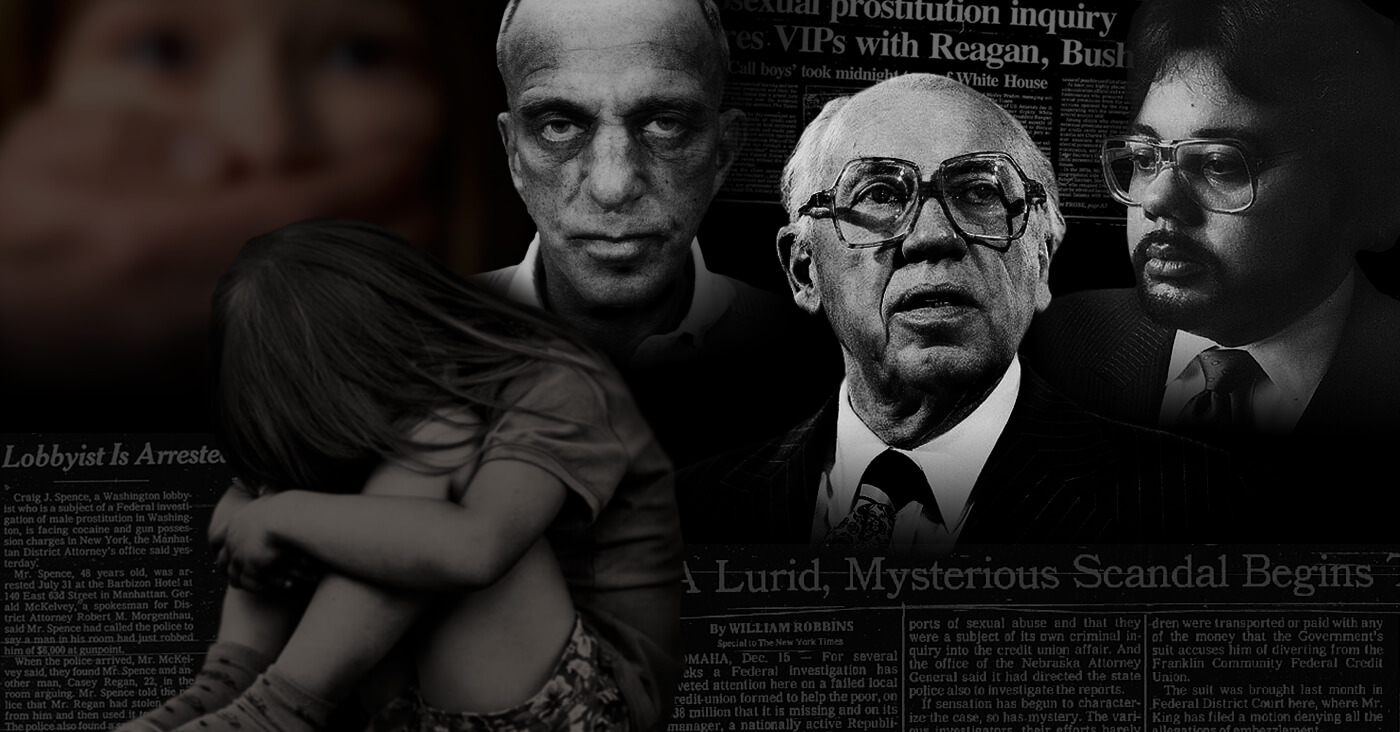
Government by Blackmail: Jeffrey Epstein, Trump’s Mentor and the Dark Secrets of the Reagan Era
Appalling for both the villainous abuse of children itself and the chilling implications of government by blackmail, this tangled web of unsavory alliances
casts a lurid light on the political history of the U.S. from the Prohibition Era right up through the Age of Trump.
by Whitney Webb - July 25th, 2019
Source :
Jeffrey Epstein, the billionaire who now sits in jail on federal charges for the sex trafficking of minors, has continued to draw media scrutiny in the weeks after
his arrest on July 6. Part of the reason for this continued media interest is related to Epstein’s alleged relationship to the intelligence services and new
information about the true extent of the sexual blackmail operation Epstein is believed to have run for decades.
As MintPress reported last week, Epstein was able to run this sordid operation for so long precisely because his was only the
latest incarnation of a much older, more extensive operation that began in the 1950s and perhaps even earlier.
Starting first with mob-linked liquor baron Lewis Rosenstiel and later with Roy Cohn, Rosenstiel’s protege and future mentor
to Donald Trump, Epstein’s is just one of the many sexual blackmail operations involving children that are all tied to the same network, which includes
elements of organized crime, powerful Washington politicians, lobbyists and “fixers,” and clear links to intelligence as well as the FBI.
This report, Part II of this series titled “The Jeffrey Epstein Scandal: Too Big To Fail,” will delve into Cohn’s close
ties to the Reagan administration, which was also closely tied to the same organized crime network led by the infamous mob figure Meyer Lansky, which was
discussed in Part I. Of particular importance is the “Iran Contra” network, a group of Reagan officials and associates who played key roles in the Iran Contra scandal.
Though it has remained relatively unknown for years, many key figures in that same network, and several fronts for the CIA that were involved in funneling money to the
Central American Contra paramilitaries, were also trafficking minors for their sexual exploitation and use in sexual blackmail rings.
Several of these rings made headlines at one point or another over the years — from the “call boy ring” run by Washington
lobbyist Craig Spence, to the Franklin child-sex and murder ring run by Republican operative Larry King, to the scandal that enveloped the Catholic
charity Covenant House in the late 1980s.
Yet, as this report will show, all of these rings — and more — were connected to the same network that involved key figures
linked to the Reagan White House and linked to Roy Cohn — revealing the true scope of the sordid sexual blackmail operations and sex rings that involved the
trafficking of children within the U.S. and even in Central America for their exploitation by dangerous and powerful pedophiles in the United States.
Appalling for both the villainous abuse of children itself and the chilling implications of government by blackmail, this
tangled web of unsavory alliances casts a lurid light on the political history of the United States from the Prohibition Era right up to the present day and
the Age of Trump, a fact made increasingly clear as more and more information comes to light in relation to the Jeffrey Epstein case.
“Roy could fix anyone in the city”
Since Donald Trump burst onto the political scene in 2015, the legacy of his mentor, Roy Cohn – as well as Cohn’s influence
on his most famous protege — have begun to garner renewed media attention. Many of the profiles on Cohn following Trump’s rise have focused solely on certain
shadowy aspects of Cohn’s history, particularly his association with major figures in New York organized crime, his corrupt dealings, and his
eventual disbarment. Some of these portrayals even went so far as to label Cohn as politically impotent. While Cohn was known to deal with a sizable amount
of sleaze in his career, such depictions of the man fail to note that he had created an influence machine of unrivaled power that included some of the most
prominent people in media and politics as well as a cadre of celebrities.
Cohn was closely associated with numerous celebrities, famous politicians and political operatives. Many of his birthday
parties over the years attracted such famous figures such as artist Andy Warhol, fashion designer Calvin Klein,
and comedian Joey Adams, as well as notable political figures including former Mayor of New York Abraham Beame and then-Assemblyman from Brooklyn and future
Senator Chuck Schumer, among others. In 1979 Margaret Trudeau, mother of current Prime Minister of Canada Justin Trudeau, attended Cohn’s birthday party, where
she famously toppled his custom birthday cake; and of course Donald Trump, who became Cohn’s protege
in the mid-1970s, was a frequent fixture at social events held in Cohn’s honor.
The politicians, journalists and celebrities invited to Cohn’s exclusive parties were said to be those who “ had open accounts in Cohn’s ‘favor
bank,’” his nickname for his unofficial balance sheet of political favors and debts that was surely informed
and influenced by his extensive involvement in sexual blackmail operations from the 1950s well into the 1980s.
Many of Cohn’s celebrity friendships were cultivated through his relationship with and frequent appearances at the famous
and famously debaucherous New York nightclub Studio 54, which was described by Vanity Fair as
“the giddy epicenter of 70s hedonism, a disco hothouse of beautiful people, endless cocaine, and every kind of sex.” Cohn was the long-time lawyer of the
club’s owners, Steve Rubell and Ian Schrager.
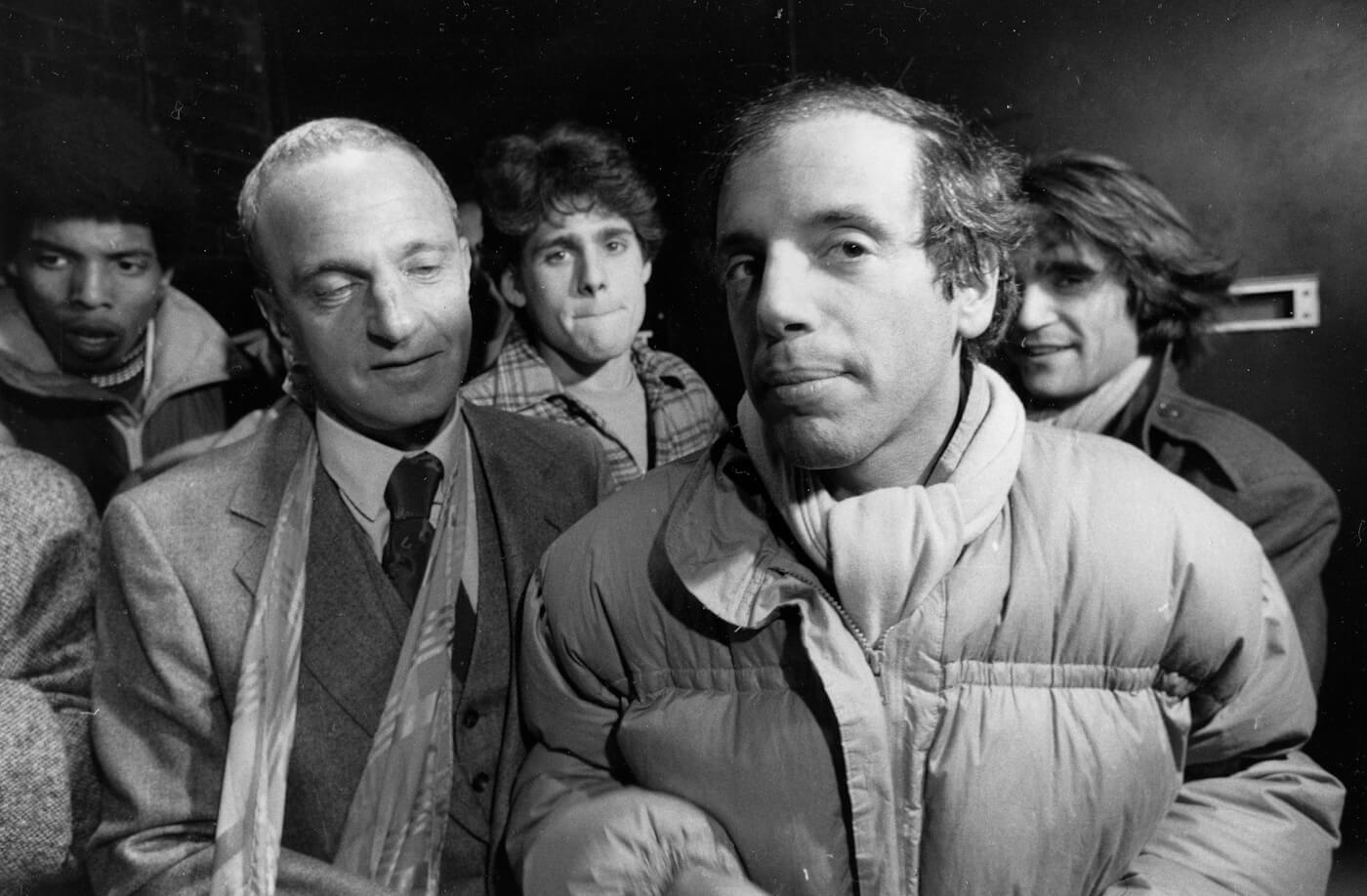
Studio 54 co-owner Steve Rubell and Roy Cohn, left, talk to reporters outside U.S. District Court
in Manhattan on, Nov. 2, 1979. Photo | AP
Among Cohn’s closest friends were Barbara Walters, to whom Cohn often referred as his “fiancee” in public, and whom he later introduced to the head of the U.S.
Information Agency, Chad Wick, and other high rollers in the Reagan White House.
Yet, Walters was just one of Cohn’s powerful friends in the media, a group that also included Abe Rosenthal, executive editor of the
New York Times; William Safire, long-time New York Times columnist and New York Magazine contributor; and George Sokolsky of
The New York Herald Tribune, NBC and ABC. Sokolsky was a particularly close friend of both Cohn and former FBI director J.
Edgar Hoover, whose involvement in Cohn’s sexual blackmail operation is described in Part I of this investigative series. Sokolsky ran the American
Jewish League Against Communism with Cohn for several years and the organization later named its Medal of Honor after Sokolsky.
Cohn was also the attorney and friend of media mogul Rupert Murdoch and, according to New York Magazine, “Whenever Roy
wanted a story stopped, item put in, or story exploited, Roy called Murdoch;” and, after Murdoch bought the New York
Post, Cohn “wielded the paper as his personal shiv.” According to the late journalist Robert Parry, the friendship between Murdoch and Cohn first began
thanks to their mutual support for Israel.
Cohn also leaned on his life-long friend since high school, Si Newhouse Jr., to exert media influence. Newhouse oversaw the media empire that now includes
Vanity Fair, Vogue, GQ, The New Yorker, and numerous local newspapers throughout the United States, as well as major interests in cable television.
New York Magazine also noted that “Cohn used his influence in the early ’80s to secure favors for himself and
his Mob clients in Newhouse publications.” In addition to Newhouse, Cohn’s other high school pals, Generoso Pope Jr. and Richard Berlin, later became the owners of the
National Enquirer and the Hearst Corporation, respectively. Cohn was also a close friend of another media mogul, Mort Zuckerman, who – along with
Rupert Murdoch – would go on to befriend Jeffrey Epstein.
Cohn’s media confidants, like journalist William Buckley of The National Review and Firing Line, often attacked Cohn’s political
enemies – particularly long-time Manhattan District Attorney Robert Morgenthau — in their columns, using Cohn as an anonymous source. Buckley, whom historian
George Nash once called “the preeminent voice of American conservatism and its first great ecumenical figure,”
received the George Sokolsky medal alongside Cohn’s mob-linked client and “Supreme Commander” Lewis Rosenstiel from the Cohn-run American Jewish League Against
Communism in 1966. Buckley later got a heavily discounted $65,000 loan to buy a luxury boat from a bank where Cohn held influence and whose president Cohn had
hand picked, according to a 1969 article in LIFE magazine.
Buckley — along with Barbara Walters, Alan Dershowitz and Donald Trump — would later serve as character witnesses for Cohn during his 1986
disbarment hearings and all but Buckley would later draw controversy for their relationships with Jeffrey Epstein.
With connections like this, it’s no wonder that Stanley Friedman — a law partner of Cohn, who was later imprisoned
over a kickback and bribery scandal while serving as New York’s deputy mayor — told journalist Marie Brenner
in 1980 that “Roy could fix anyone in the city.”
Politically ubiquitous and polygamous
Roy Cohn’s “favor bank” and his unique position as a liaison between the criminal underworld, the rich and famous, and
top media influencers made him a force to be reckoned with. Yet, it was his political connections to leadership figures in both the Republican and
Democratic parties and his close relationship to long-time FBI Director J. Edgar Hoover, among other figures, that made him and his dark secret “untouchable” for
much of his life. Though most of his political influence was forged in the 1950s, Cohn became even more powerful with the rise of Ronald Reagan.
Even though he nominally maintained his affiliation with the Democratic Party throughout his life, Cohn was a well-known
“fixer” for Republican candidates and this is clearly seen in his outsized roles during the 1976 and 1980 presidential campaigns of Ronald Reagan. It was during
the latter that Cohn would another of his proteges, Roger Stone, whom he infamously instructed to leave a hefty bribe tucked in a suitcase at the doorstep of the
Liberal Party’s headquarters during the 1980 campaign. During this campaign, Cohn would also meet Paul Manafort — an associate of Stone and later Trump’s 2016 campaign
manager — and introduce both to Donald Trump.
Cohn’s law partner, Tom Bolan, was also an influential force in the Reagan campaign and later chaired
Reagan’s transition team in 1980. Reagan then named Bolan, whom he considered a friend, a director of the Overseas Private
Investment Corporation, the government’s development finance institution, and he was also the New York
finance co-chairman in the Reagan campaign in both 1980 and 1984. Bolan was also close
to others in Cohn’s circle, such as William F. Buckley Jr., Donald Trump and Rupert Murdoch.
Furthermore, Bolan was instrumental in securing federal judgeships for several individuals who would later become
influential, including future FBI Director Louis Freeh. Cohn was also able to get friends of clients
appointed as federal judges, including Donald Trump’s sister, Maryanne Trump Barry. After Barry was appointed as a
federal judge, Trump called Cohn to thank him for pulling strings on his sister’s behalf.
Though Cohn was not given a public position in the Reagan administration, he was not merely a “dirty trickster” who worked
in the shadows during the Reagan campaigns. In fact, he worked closely with some of the more visible faces of the campaign, including the then-communications
director for Reagan’s 1980 campaign and later CIA director, William Casey. According to Christine Seymour
— Cohn’s long-time switchboard operator from the late 1960s up until his death in 1986, who listened in on his calls — Casey and Cohn were close friends and,
during the 1980 campaign, Casey “called Roy almost daily.”
Seymour also noted that one of Cohn’s other most frequent phone pals and closest friends was Nancy Reagan and she was also one of his clients.
Reagan, whose influence over her husband was well-known, was so close to Cohn that it was largely his death from AIDS that
led her to “encourage her husband to seek more funding for AIDS research.”
Prior to Cohn’s death, Nancy and her husband Ronald secured his spot in an exclusive experimental AIDS treatment program, despite the Reagan
administration’s well-documented “non-response” to the AIDS crisis of the era. Ronald Reagan was also a friend of Cohn’s and, according to
late journalist Robert Parry, “lavished favors on Cohn, including invitations to White House events, personal
thank-you notes and friendly birthday wishes” over the course of his presidency.
Given that Reagan heavily courted the evangelical right and promoted “family values” as president, the close ties
between not only himself, but his inner circle, with Cohn may seem odd. However, Reagan, like Cohn, had deep ties to the same organized-crime factions that were
among Cohn’s clients and affiliates of the same Mafia figures close to Cohn’s own mentor, Lewis Rosenstiel (see Part I).
Not unlike Cohn, Reagan’s own mentor, Lew Wasserman, had close ties to the mob. Wasserman, the long-time president of
MCA and the well-known Hollywood mogul, is known for not only making Reagan’s film and television career, but also supporting
his successful push to become president of the Screen Actors Guild, which later
launched Reagan’s political career. In addition, MCA was a major financier of
Reagan’s successful gubernatorial bid in 1966 and, not long after Reagan became
president, his administration controversially shut down a massive Department of Justice (DOJ) probe into MCA’s ties to organized
crime.
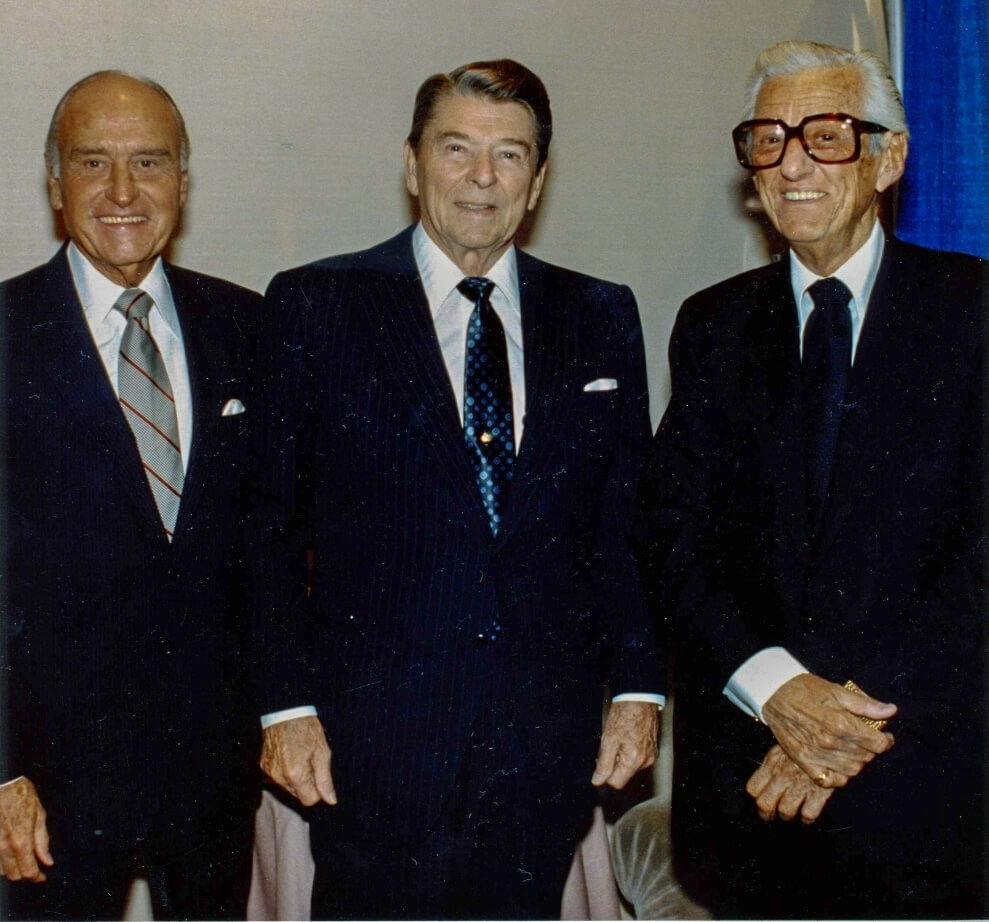
Ronald Reagan, center, with A.C. Lyles and Lew Wasserman, right. Photo | A.C. Lyles
According to Shawn Swords, a documentary filmmaker who explored Reagan’s ties to MCA in Wages of Spin II: Bring Down That Wall:
Ronald Reagan was an opportunist. His whole career was guided by MCA — by Wasserman and [MCA founder] Jules Stein, who bragged that Reagan was malleable, that they could do what they wanted with him… That thing about Reagan being tough on [organized] crime — that’s a fallacy.”
Swords’ characterization of this relationship is supported by an unnamed Hollywood source cited in a declassified
DOJ document, who called Reagan “a complete slave of MCA who would do their bidding on anything.”
What elements of organized crime were connected to Wasserman? As a young man, Lew Wasserman joined the Mayfield Road
Gang, which was run by Moe Dalitz, a close friend of Meyer Lansky who, per the FBI, was a powerful figure in Lansky’s criminal
enterprise, second only to Lansky himself among members of the Jewish mob.
Lew Wasserman would later marry Edith Beckerman, whose father was Dalitz’s lawyer.
Wasserman’s closest friend and lawyer, Sidney Korshak, also had close ties to Dalitz and once partnered with Lansky in the Acapulco Towers Hotel.
Notably, the magazine New West stated in 1976 that Korshak was the “logical successor to Meyer Lansky”. Korshak, as a lawyer, fit a niche similar to Roy
Cohn and gained a reputation as the bridge between organized crime and respectable society.
In addition, the DOJ probe into MCA that the Reagan administration quashed was reportedly spurred
after the Justice Department learned that an influential member of the Gambino crime family, Salvatore Pisello, was doing business with the massive
entertainment company. At that time, the boss of the Gambino crime family, Paul Castellano, was a client of Roy Cohn.
Cohn, Murdoch and the Contras
Though Cohn’s influence in the Reagan administration and his friendship with the Reagan family and their inner circle
has been acknowledged, less well-known is how Cohn aided the CIA’s covert propaganda efforts that were part of the larger scandal known as
Iran-Contra.
Cohn, whose influence over the press has already been detailed, forged close ties with the director of the U.S.
Information Agency, Chad Wick, even hosting a luncheon in Wick’s honor that was widely attended by influential figures in the
conservative press, as well as senators and representatives. Soon after, then-CIA Director and Cohn friend William Casey was spearheading an extensive PR
campaign aimed at shoring up public support for Reagan’s Latin American policies, including support of the Contra paramilitaries.
This domestic propaganda effort was technically illegal and required that the CIA outsource the job to the private
sector to minimize the risk of fall-out. As Robert Parry reported in 2015, Wick took the lead in obtaining private funding for the effort and, just a
few days after Wick promised to find private support, Cohn brought his close friend, the media mogul Rupert Murdoch, to the White House.

Reagan meets with Rupert Murdoch, U.S. Information Agency Director Charles Wick, and Roy Cohn in
the Oval Office in 1983. Photo | Reagan presidential library
Parry later noted that, after this meeting, “documents released during the Iran-Contra scandal in
1987 and later from the Reagan Library indicate that Murdoch was soon viewed as a source for the private funding” for the propaganda campaign.
After that initial meeting, Murdoch became the top media ally of this Casey-directed propaganda effort, and also became
increasingly close to the Reagan White House. Murdoch, as a consequence, benefited greatly
from Reagan’s policies and his friendship with the administration, which allowed
Murdoch to increase his U.S. media holdings and to create the Fox Broadcasting Corporation in 1987.
“The man in the black tuxedo”
Roy Cohn was not the only one close to the Reagan administration who was simultaneously running sexual blackmail operations
that abused and exploited children. In fact, there were several figures, all of whom shared direct connections to CIA Director William Casey and other close
friends and confidants of Cohn.br>
One of these individuals was Robert Keith Gray, the former chairman and CEO of the powerful Washington-based public
relations firm of Hill and Knowlton, which 60 Minutes once called “an unelected shadow government” due to its influence in the capitol.
According to the Washington Post, Gray himself was “one of the most sought-after lobbyists in Washington” and a Post reporter
once called him “a kind of legend in this town, …the man in the black tuxedo with snow-white hair and a smile like a diamond.”
Yet, Gray was much more than a powerful PR executive.
Gray, who had previously been a close adviser to both Dwight D. Eisenhower and Richard Nixon, was a very successful Republican
fundraiser who “collects money in six-figure globs,” according to a 1974 report in the Washingtonian.
He first came into close contact with what would become Ronald Reagan’s inner circle during Reagan’s unsuccessful 1976
presidential campaign and later as deputy director of communications during Reagan’s campaign in 1980. The latter position would see him work directly under
William Casey, who later became CIA director.
Gray would go on to co-chair Reagan’s Inauguration Committee and afterwards would return to the PR business, taking on several clients
including Saudi arms dealer Adnan Khashoggi and hedge fund manager Marc Rich. Both Khashoggi and Rich will be discussed more in detail in Part III of this
report — particularly Rich, who was an asset of Israeli intelligence outfit Mossad, and whose later criminal pardon by Bill Clinton was largely orchestrated
by members of the Mega Group like Michael Steinhardt and Israeli politicians like Ehud Barak.
The connection between Gray and Casey is particulary telling, as it was later revealed by former Nebraska state
senator-turned-investigator John DeCamp that Gray was a specialist in homosexual blackmail operations for the CIA and
was reported to have collaborated with Roy Cohn in those activities. Cohn and Gray were likely to have known each other well, as during Reagan’s 1980
presidential campaign Casey — then Gray’s boss — was calling Roy Cohn “every day,” according to Cohn’s former switchboard operator Christine Seymour.
Gray was a known associate of CIA agent and Naval Intelligence officer Edwin Wilson, having served in the 1970s on the board
of Consultants International, an organization that Wilson had founded and that the CIA used as a front company. Though Gray attempted to distance himself from
Wilson after the latter was caught illegally selling weapons to Libya in 1983, a Navy review of Wilson’s intelligence career, unearthed
by journalist Peter Maas, stated that Gray described Wilson as a man of “unqualified trust” and that Gray and Wilson
had been in professional contact “two or three times a month” as early as 1963.
Though Wilson’s main specialty was front companies used to covertly ship and smuggle goods on behalf of U.S.
intelligence, he also ran sexual blackmail operations for the CIA, particularly around the time of the Watergate scandal, according to his former partner and
fellow agent at the CIA, Frank Terpil.
Terpil later told author and investigative journalist Jim Hougan:
Historically, one of Wilson’s Agency jobs was to subvert members of both houses [of Congress] by any means necessary…. Certain people could be easily coerced by living out their sexual fantasy in the flesh…. A remembrance of these occasions [was] permanently recorded via selected cameras…. The technicians in charge of filming … [were] TSD [Technical Services Division of the CIA]. The unwitting porno stars advanced in their political careers, some of [whom] may still be in office.”
According to Terpil, Wilson ran his operation out of the George Town Club, owned by lobbyist and Korean intelligence asset
Tongsun Park. According to the Washington Post, Park set up the club on behalf of the Korean Central Intelligence Agency “as a
primary means in an illegal effort to influence U.S. politicians and officials.” The president of the George Town Club at the time
of Wilson’s alleged activities at the site was Robert Keith Gray.
DeCamp later reported that Wilson’s activities were a spin-off of the same sexual blackmail operation
in which Cohn became involved during the McCarthy era with Lewis Rosenstiel and J. Edgar Hoover.
Father Ritter and his favored youths
The operation allegedly ran by Gray and Wilson was not the only sexual blackmail operation connected to Cohn’s network
or to influential American politicians of the era. Another pedophile network that was connected to a close associate of former President George H.W. Bush in
the early 1990s was run as an affiliate of the Catholic charity Covenant House, which was founded and run by Father Bruce Ritter.
In 1968, Ritter asked his superior — Cardinal Francis Spellman of the Archdiocese of New York — for permission to take homeless teenagers, boys and girls, into his home
in Manhattan. As was noted in Part I of this series, Spellman was accused of pedophilia and ordained known pedophiles while serving as the highest-ranking
Catholic priest in the United States. Spellman was also a close associate, client and friend of Roy Cohn, as well as of his law partner Tom Bolan, and
Spellman was alleged to have been seen at least one of Cohn’s “blackmail parties.” In addition, Spellman’s nephew, Ned Spellman, worked for
Roy Cohn, according to LIFE magazine.
Ritter, like Spellman and other priests who served under Spellman, was eventually accused of having sexual relationships with many of the underaged boys he had taken in,
and of spending Covenant House funds on lavish gifts and payments to the vulnerable teenagers he exploited.
One of Ritter’s victims, Darryl Bassile, wrote an open letter to him a year after the priest’s preying on teenage boys was exposed by the
press: “You were wrong for inflicting your desires on a 14-year-old .... I know that someday you will stand before the one who judges all of us and at that time
there will be no more denial, just the truth.”
Notably, when Ritter’s activities at Covenant House were exposed in 1989 by the New York Post, Charles M. Sennott, the Post
reporter who wrote the story, would later state that “the secular powers more than the archdiocese or the Franciscans protected
him [Ritter].” Sennott’s report was attacked viciously by columnists in other New York media outlets, powerful politicians including
then-Governor of New York Mario Cuomo, as well as by Cardinal Spellman’s successor, Cardinal John O’Connor.
The likely reason these “secular powers” came to the aid of the embattled Ritter, who was never charged for having sexual
relationships with minors and was merely forced to resign from his post, is that Covenant House and Ritter himself were
deeply tied to Robert Macauley, Bush Sr.’s roommate at Yale and a long-time friend of the Bush family. Macauley was described by the
New York Times as “instrumental” to Covenant House fundraising after he joined its board in 1985 and brought on
several “other wealthy or well-connected people,” including former government officials and investment bankers.
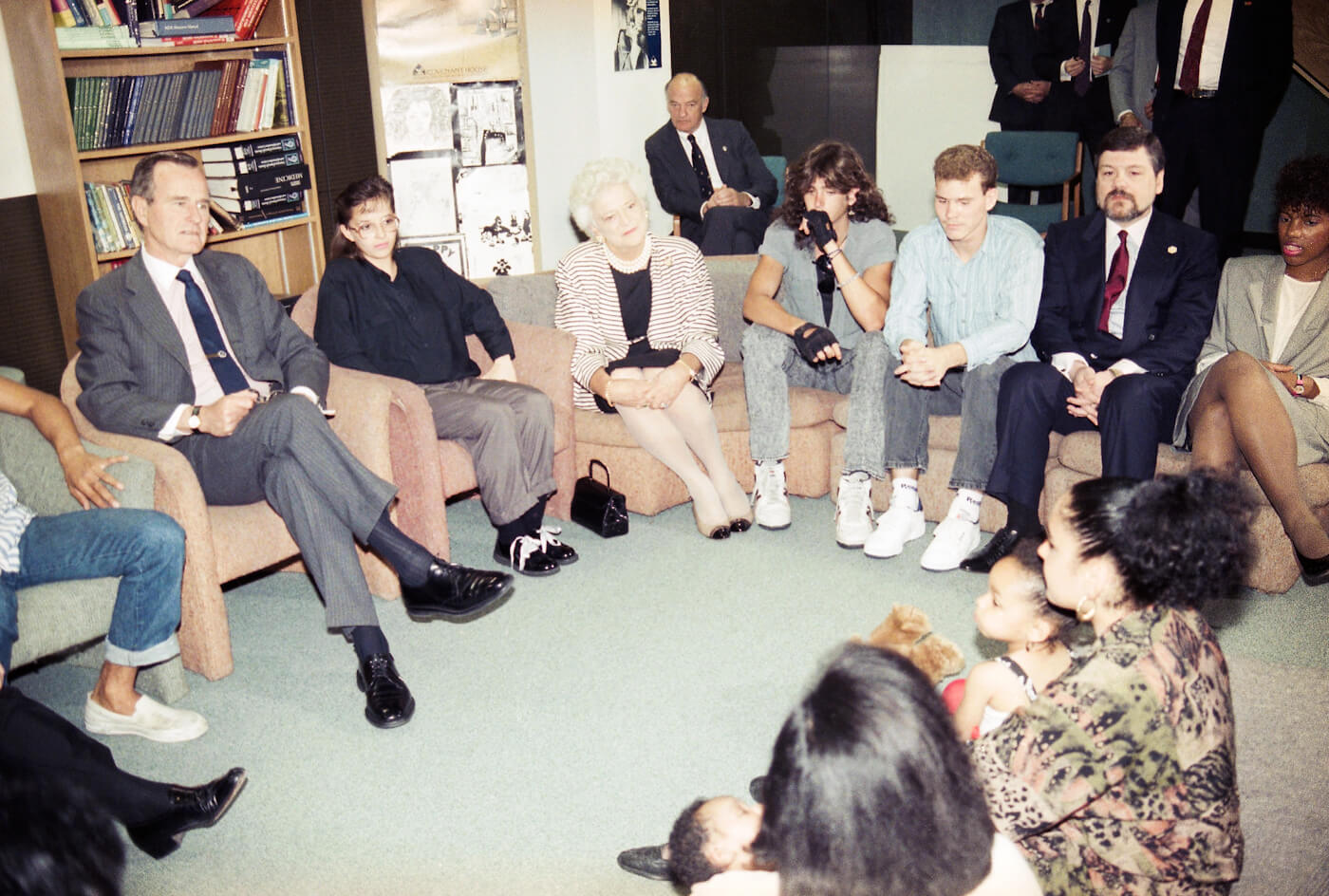
George Bush and first lady Barbara meet residents at New York’s Convent House, June 22, 1989. Father
Bruce Ritter is seated in the background. Rick Bowmen | AP
Macauley’s organization, the AmeriCares Foundation, which was later accused of funneling money to the Contras
in Central America, was one of the main sources of funding of Covenant House. One of the members of AmeriCares advisory board was William E. Simon, former
U.S. secretary of the treasury under the Nixon and Ford administrations, who also ran the Nicaraguan Freedom Fund, which sent aid to the Contras.
AmeriCares was also known to work directly with U.S. intelligence. As the Hartford Courant noted in 1991: “Knowledgeable former federal officials,
many with backgrounds in intelligence work, help AmeriCares maneuver in delicate international political environments.”
Furthermore, Ritter was known to have visited Macauley’s Connecticut estate and served as Vice President of AmeriCares until
he was forced to resign from Covenant House. Notably, George H.W. Bush’s brother, Prescott, was also on the AmeriCares advisory board.
After George H.W. Bush died last year, AmeriCares stated that he had been “instrumental in founding the health-focused relief and development
organization.”
Years before Ritter was outed as a pedophile who preyed on the disadvantaged and vulnerable teenagers who sought refuge at
his charity, Covenant House was praised heavily by President Ronald Reagan, even earning a mention in his 1984 State of the Union address, which called Ritter
one of the country’s “unsung heroes.” From 1985 to 1989, Covenant House’s operating budget grew from $27 million to $90 million
and its board came to include powerful individuals including top executives at IBM, Chase Manhattan Bank and Bear Stearns.
It was during this time that Covenant House grew into an international organization, opening branches in several countries,
including Canada, Mexico and elsewhere in Central America. Its first branch in Central America was opened in Guatemala and was headed by Roberto Alejos Arzu, a
CIA asset whose plantation was used to train the troops used in the CIA’s failed “Bay of Pigs” invasion of Cuba. Alejos Arzu was
also an associate of the former U.S.-backed dictator of Nicaragua, Anastasio Somoza, and a member of the Knights of Malta, a Catholic order to which former
CIA Director William Casey and Roy Cohn’s law partner Tom Bolan also belonged. Alejos Arzu also worked for AmeriCares and was tied to
several Central American paramilitary groups.
Intelligence community sources cited by DeCamp assert that the Alejos Arzu-led branch of Covenant House procured
children for a pedophile ring based in the United States. Years later, Mi Casa, another U.S.-run charity in Guatemala that George H.W. Bush had personally
toured with his wife Barbara in 1994, was accused of rampant pedophilia and child abuse.
The downfall of “Washington’s Jay Gatsby”
After having left his job as an ABC News correspondent in the 1980s, Craig Spence found success as a prominent conservative Washington lobbyist. Spence would soon find his fortunes shift dramatically when, in June 1989, it was revealed that he had been pimping out children to the power elite in the nation’s capital throughout the 1980s in apartments that were bugged with video and audio recording equipment. Much like Jeffrey Epstein, who ran a similar operation, Spence was often likened to Jay Gatsby, the mysterious, wealthy figure from the well-known Fitzgerald novel The Great Gatsby.
A 1982 New York Times article written about Spence said that his “personal phone book and party guest lists constitute a ‘Who’s Who’ in
Congress, Government and journalism” and stated that Spence was “hired by his clients as much for whom he knows as what he knows.” Spence was also known to
throw lavish parties, which the Times described as “glitter[ed] with notables, from ambassadors to television stars, from senators to senior State
Department officials.” Roy Cohn, William Casey and Roy Cohn’s journalist friend William Safire were just some of the other attendees at Spence’s
festivities.
“According to Mr. Spence,” the Times article continues, “ Richard Nixon is a friend. So is [former Attorney
General under Nixon] John Mitchell. [CBS journalist] Eric Sevareid is termed ‘an old, dear friend.’ Senator John Glenn is
‘a good friend’ and Peter Ustinov [British actor and journalist] is ‘an old, old friend.’”
Notably, Ustinov wrote for The European newspaper soon after it was founded in 1990 by Robert Maxwell, the father of Epstein’s alleged madam
Ghislaine Maxwell and a known Mossad agent.
It was revealed just seven years after the Times’ published its doting profile of Spence that his “glittery parties for key
officials of the Reagan and Bush administrations, media stars and top military officers” had been bugged in order “to compromise guests.” According to
the explosive report published by the Washington Times, Spence was linked to a “homosexual prostuition ring” whose clients included
“government officials, locally based U.S. military officers, businessmen, lawyers, bankers, congressional aides, media representatives and other
professionals.” Spence also offered cocaine to his guests as another means of acquiring blackmail.
According to the report, Spence’s home “was bugged and had a secret two-way mirror, and … he attempted to ensnare visitors
into compromising sexual encounters that he could then use as leverage.” One man who spoke to the Washington Times said that Spence sent a
limousine to his home, which took him to a party where “several young men tried to become friendly with him.” According to DeCamp, Spence was known to offer
young children for sex to attendees at his blackmail parties, along with illegal drugs like cocaine.
Several other sources, including a Reagan White House official and an Air Force sergeant who had attended Spence-hosted
parties, confirmed that Spence’s house was filled with recording equipment,
which he regularly used to spy on and record guests, and his house also included
a two-way mirror that he used for eavesdropping.
The report also documented Spence’s connections to U.S. intelligence, particularly the CIA. According to the Washington Times
report, Spence “often boasted that he was working for the CIA and on one occasion said he was going to disappear for
awhile ‘because he had an important CIA assignment.’” He was also quite paranoid about his alleged work for the agency, as he expressed concern “that the CIA
might ‘doublecross him’ and kill him instead and then make it look like a suicide.” Not long after the Washington Times
report on his activities was published, Spence was found dead in the Boston Ritz Carlton and his death was quickly ruled a suicide.
The Washington Times report also offers a clue as to what Spence may have done for the CIA, as it cited sources that had claimed that
Spence had spoken of smuggling cocaine into the U.S. from El Salvador, an operation that he claimed had involved U.S. military personnel. Given the timing
of these comments from Spence, Spence’s powerful connections, and the CIA’s involvement in the exchange of cocaine for weapons in the Iran Contra scandal,
his comments may have been much more than just boasts intended to impress his party guests.
One of the most critical parts of the scandal surrounding Spence, however, was the fact that he had been able to enter the
White House late at night during the George H.W. Bush administration with young men whom the Washington Times
described as “call boys.”
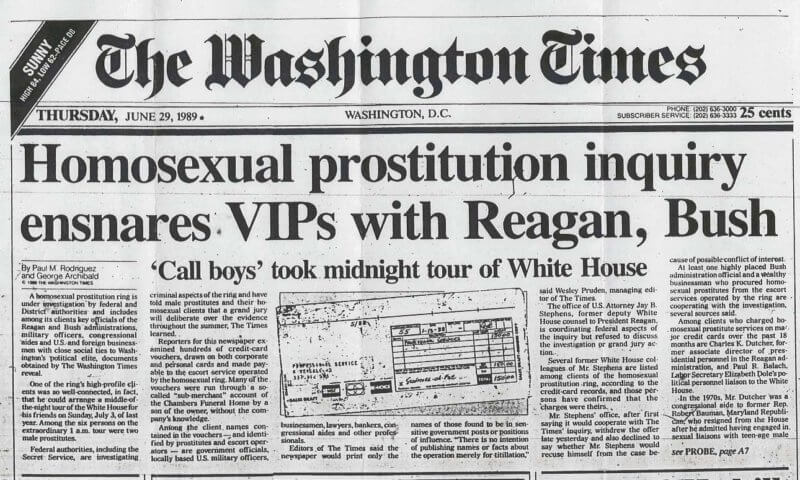
Spence later stated that his contacts within the White House, which allowed him and his “call boys” access, were “top level” officials and he
specifically singled out George H.W. Bush’s then-National Security Advisor Donald Gregg. Gregg had worked at the CIA since 1951 before he resigned in 1982
to become National Security Advisor to Bush, who was then vice president. Prior to resigning from his post at the CIA, Gregg had worked directly under William
Casey and, in the late 1970s, alongside a young William Barr in stonewalling the congressional Pike Committee and Church
Committee, which investigated the CIA beginning in 1975. Among the things that they were tasked with investigating were the CIA’s “love traps,”
or sexual blackmail operations used to lure foreign diplomats to bugged apartments, complete with recording equipment and two-way mirrors.
Barr would later become Bush’s Attorney General, rising to that post yet again under Trump. Furthermore, Barr’s father
worked for the precursor to the CIA, the Office of Strategic Services (OSS) and recruited a
young Jeffrey Epstein, then a high school drop-out, to teach at the elite Dalton
School, from which Epstein was later fired. A year prior to hiring Epstein, Donald Barr published a science fiction fantasy novel about
sex slavery. Notably, the same year Donald Barr hired Epstein, his son was working for the CIA. Bill Barr has
refused calls to recuse himself from the Epstein case, even though he worked at
the same law firm that has represented Epstein in the past.
Donald Gregg is also connected to Roy Cohn’s “influence machine” through his daughter’s marriage
to Christopher Buckley, the son of conservative journalist William Buckley, close confidant and friend of both Roy Cohn and Cohn’s law partner Tom Bolan.
The Washington Times reports on Spence’s child sex ring also reveal his close ties to none other than
the ubiquitous Roy Cohn. One of the Times’ sources for its first story
on the scandal alleged that he had attended a birthday party for Roy Cohn that
Spence had hosted at his home and that CIA Director William Casey was also in
attendance. Spence was also said in the report to often brag about his social
companions and regularly mentioned Cohn and claimed to have hosted Cohn at his
house on occasions other than the aforementioned birthday party.
“Bodies by God”
The revelation of Craig Spence’s “call boy ring” soon led to the discovery of the infamous Franklin child sex abuse and
ritual murder scandal. That sordid operation was run out of Omaha, Nebraska by Larry King,
a prominent local Republican activist and lobbyist who ran the Franklin Community Federal Credit Union until it was shut down by federal
authorities.
Buried in a May 1989 article in the Omaha World Herald’s probe into King’s Credit Union and sex ring, is
a telling revelation: “In the 6 1/2 months since federal authorities closed Franklin, rumors have persisted that money from the credit union somehow found
its way to the Nicaraguan contra rebels.”
The possibility that King’s fraudulent credit union was covertly funding the Contras was supported by subsequent reporting by the Houston Post’s
Pete Brewton, who discovered that the CIA, in conjunction with organized crime, had secretly borrowed money from various savings and loans (S&L)
institutions to fund covert operations. One of those S&Ls had Neil Bush, George H.W. Bush’s son, on its board and it had done business with King’s
organization.
Another link between King and the Iran Contra team is the fact that King had co-founded and subsequently donated over
$25,000 to an organization affiliated with the Reagan administration, Citizens for America, which sponsored speaking
trips for Lt. Col. Oliver North and Contra leaders. The director of Citizens for America at the time was David Carmen, who simultaneously
ran a public relations firm with the former head of covert operations at the Casey-led CIA, his father Gerald, who had also been
appointed by Reagan to head the General Services Administration and to a subsequent ambassadorship.
One of the investigative journalists who researched the Craig Spence ring later told DeCamp that Spence’s ring was connected to King:
The way we discovered Larry King and his Nebraska-based call boy ring, was by looking through the credit card chits of Spence’s ring, where we found King’s name.”
It was later revealed that King and Spence were essentially business partners as their child
trafficking rings were operated under a larger group that was nicknamed “Bodies by God.”
Exactly how many groups operated under this umbrella group, “Bodies by God,” is unknown. Yet, what is known is that the
rings run by both King and Spence were connected to each other and both were also connected to prominent officials in the Reagan and subsequent George H.W.
Bush administrations, including officials with ties to the CIA and Roy Cohn and his network.
Indeed Spence, just months before his alleged suicide in the Boston Ritz Carlton, had hinted to Washington Times reporters Michael Hedges and Jerry Seper,
who had originally broken the story, that they had merely scratched the surface of something much darker:
All this stuff you’ve uncovered [involving call boys, bribery and the White House tours], to be honest with you, is insignificant compared to other things I’ve done. But I’m not going to tell you those things, and somehow the world will carry on.”
It is also worth noting the role of the FBI in all of this, particularly in the Franklin child sex abuse scandal. Indeed,
Larry King’s child sex abuse ring was quickly and aggressively covered up by the FBI, which used a variety of under-handed
tactics to bury the reality of King’s sordid operation. Here, it is important to recall the key role former FBI Director J. Edgar Hoover played in similar sexual
blackmail operations that abused children (See Part I) and the close relationship between Hoover, Roy Cohn and Lewis Rosenstiel, who later
employed Hoover’s former right-hand man at the FBI, Louis Nichols.
Years later, documents released by the FBI would show that Epstein became an FBI informant in 2008, when Robert Mueller was the Bureau’s director,
in exchange for immunity from then-pending federal charges, a deal that fell through with Epstein’s recent arrest on new federal charges.
In addition, former FBI Director Louis Freeh would be hired by Alan Dershowitz, who is accused of raping girls at Epstein’s homes and was
once a character witness for Roy Cohn, to intimidate Epstein’s victims. As previously mentioned, Freeh’s past appointment as a judge for the United States
District Court for the Southern District of New York was orchestrated by Cohn’s law partner Tom Bolan.
Thus, the FBI’s cover-up of the Franklin case is just one example of the Bureau’s long-standing practice of protecting these
pedophile rings when they involve members of the American political elite and provide the Bureau with a steady supply of blackmail. It also makes it worth
questioning the impartiality of one of the main prosecutors in the Jeffrey Epstein case, Maurene Comey,
who is the daughter of former FBI Director James Comey.
The rot at the top
While there were several sexual trafficking operations connected to both Roy Cohn and the halls of power under the Reagan
administration, in a matter of months after Cohn’s death it appears that another individual became a central figure in the powerful network that Cohn had
cultivated.
That individual, Jeffrey Epstein, would be recruited, after his firing from the Dalton School, by Alan “Ace” Greenberg, a
close friend of Cohn, to work at Bear Stearns. After leaving Bear Stearns and working as an alleged financial “bounty hunter” for clients that are said to
have included the Iran-Contra-linked arms dealer Adnan Khashoggi, Epstein would come into contact with Leslie Wexner, a
billionaire close to the Meyer Lansky-linked Bronfman family, who himself was tied to members of organized crime syndicates once represented by
Cohn.
The same year that Wexner would begin his decades-long association with Epstein, another Cohn friend with ties to the
Reagan White House and the Trump family, Ronald Lauder, would provide Epstein with an Austrian passport containing Epstein’s picture but a false
name.
Lauder, Wexner and the Bronfmans are members of an elite organization known as the Mega Group, which also includes other
Meyer Lansky-connected “philanthropists” like hedge fund manager Michael Steinhardt.
While Epstein shares considerable overlap with the network described in this report and Part I of this series, he is also deeply connected to the Mega Group as well as its
associates, including Ghislaine Maxwell’s father, Robert Maxwell.
Part III of this series will focus on the Mega Group and its ties to the network that has been described in Parts I and
II. In addition, the role of the state of Israel, the Mossad, and several global pro-Israel lobby organizations will also be discussed in relation to this
network of sexual blackmail operations and Jeffrey Epstein.
It is here that the full breadth of the Epstein scandal comes into view. It is a criminal and unconscionable blackmail
operation that has been run by influential figures, hidden in plain sight, for
over half a century, exploiting and destroying the lives of untold numbers of
children in the process. Over the years, it has grown many branches and spread
well beyond the United States, as seen by the activity of Covenant House in
Latin America and Epstein’s own international effort to recruit more girls to be
abused and exploited.
All of this has taken place with the full
knowledge and blessing of top figures in the world of “philanthropy” and in the
U.S. government and intelligence communities, with great influence over several
presidential administrations, particularly since the rise of Ronald Reagan and
continuing through to Donald Trump.
Feature photo | Graphic by Claudio Cabrera
Whitney Webb is a MintPress News journalist based in Chile. She has contributed to several independent media outlets including Global Research, EcoWatch, the Ron Paul Institute and 21st Century Wire, among others. She has made several radio and television appearances and is the 2019 winner of the Serena Shim Award for Uncompromised Integrity in Journalism.
